WSP says power now accounts for up to 40% of US revenue, up from near zero five years ago
WSP Global's Q2 2026 earnings call reveals power and energy now drives up to 40% of US revenue, a structural shift driven by grid demand, data centers, and the TRC acquisition.
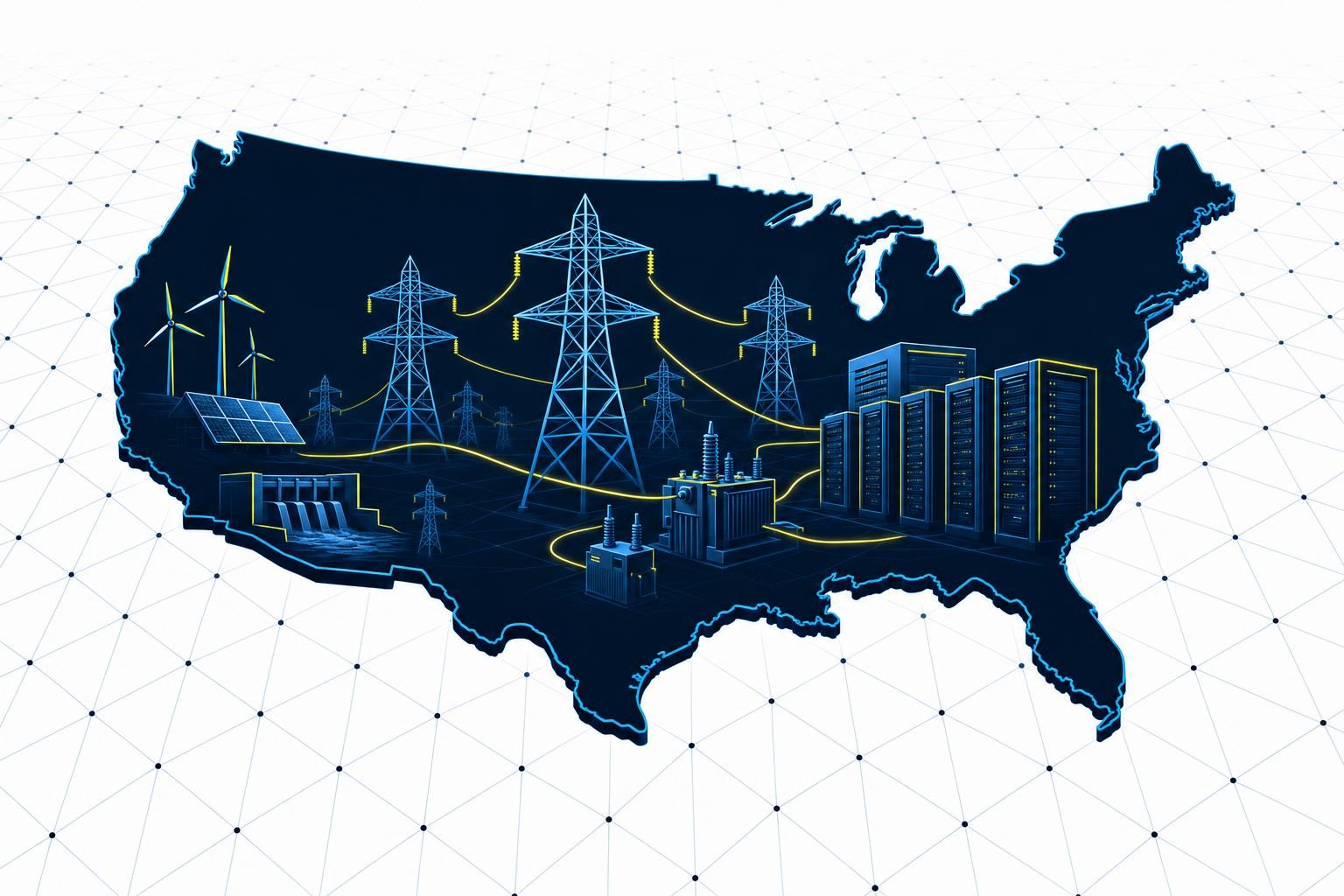
WSP Global disclosed on its 6 August 2026 second-quarter earnings call that power and energy now accounts for approximately 35% to 40% of the company's US revenue[1] - a figure CEO Alexandre L'Heureux contrasted sharply with the recent past. Five years ago, transportation and infrastructure generated about 80% of WSP's US revenue; power barely registered[1].
A portfolio reweighted by grid demand
The shift reflects both organic growth and deliberate acquisition. WSP completed its US$3.3 billion acquisition of TRC Companies on 24 February 2026, adding roughly 8,000 professionals and creating what the company describes as the largest engineering and design firm in the United States by revenue. With TRC, WSP claims the number-one Power & Energy platform in the US. TRC's hard backlog grew 30% and its sub-backlog 35% in the quarter, with management identifying more than 100 joint pursuit opportunities between the two legacy organisations.
WSP now serves the top 60 US investor-owned utilities. Net revenue from the company's 40 largest global power clients rose 30% year over year, while hard backlog from those clients in the US increased 20%[1].
Data centers and nuclear add to the load
Beyond the utility grid, two adjacent markets are pulling in the same direction. Data center revenues grew more than 20% year over year in the first half of 2026, with the sales pipeline now roughly 30% higher than a year ago. WSP is supporting 22 prospective US nuclear sites, covering site selection, licensing, design, and construction support[1].
L'Heureux framed the demand as structural rather than cyclical: "The strongest areas of demand we see today are directly linked to long-term-duration investment themes[1]."
Backlog and financials
The broader Q2 numbers underpin the power narrative:
- Total backlog reached CAD 20.1 billion, up 23% over the prior 12 months, representing 11.6 months of revenue
- Net revenue rose approximately 23% year over year, including 5% organic growth
- Adjusted EBITDA increased 29% to CAD 815 million, with margin expanding 90 basis points to 19.1% - WSP's highest second-quarter margin on record
- US sub-backlog reached CAD 10 billion, up about 9% from Q1 2026, with 86% in framework agreements
Net income fell 12% to CAD 246.1 million from CAD 279.4 million a year earlier, as higher acquisition and integration expenses, larger unrealized derivative losses, and increased amortization more than offset improved operating performance.
WSP raised its full-year 2026 outlook to CAD 16.2 billion-CAD 17.0 billion in net revenue and CAD 3.1 billion-CAD 3.18 billion in adjusted EBITDA.
What to watch
The TRC integration is the near-term execution test: whether the 30%-plus backlog growth in that unit converts to revenue at the pace management is signalling. The nuclear pipeline - 22 prospective sites - is a longer-dated indicator of how far WSP's power mix can travel beyond conventional grid work. CFO Alain Michaud said the company sees "accelerating momentum in the US[1]" - the backlog data supports that, but the net income dip is a reminder that absorbing a US$3.3 billion acquisition at speed carries its own costs.
The images and texts on this page were created with the help of AI.
Related
 Markets & Policy
Section 232 tariffs trigger two US aluminum smelter restarts, but the power arithmetic still does not add up
Two US aluminum smelter restarts announced in 2026 will add more than 20% to primary output, but electricity costs and Missouri's large-load tariff remain structural ceilings on any broader revival.
15 Aug 2026 Storage
ESS Tech begins Bridge sodium-ion rollout backed by 8.5 GWh Alsym supply LOI and 500 MWh Juniper deployment agreement
ESS Tech has started market rollout of its Bridge sodium-ion BESS, underpinned by an 8.5 GWh Alsym Energy supply LOI and a 500 MWh+ Juniper Energy deployment agreement, as Q2 revenue fell to $73,000.
15 Aug 2026 Markets & Policy
Campbell and Geyer study in Science finds scrapping a working gas car for an EV cuts 16-year emissions by up to 58%
A study published in Science by UC Santa Cruz and UCSB researchers finds that replacing a gas vehicle with an EV as early as year one cuts lifecycle carbon emissions by up to 58% over 16 years.
15 Aug 2026