Utilities weighing private LTE face a three-way spectrum choice with no obvious winner
Private LTE, public carrier services, and satellite each offer utilities different cost and control profiles. A new analysis lays out how to frame the decision.
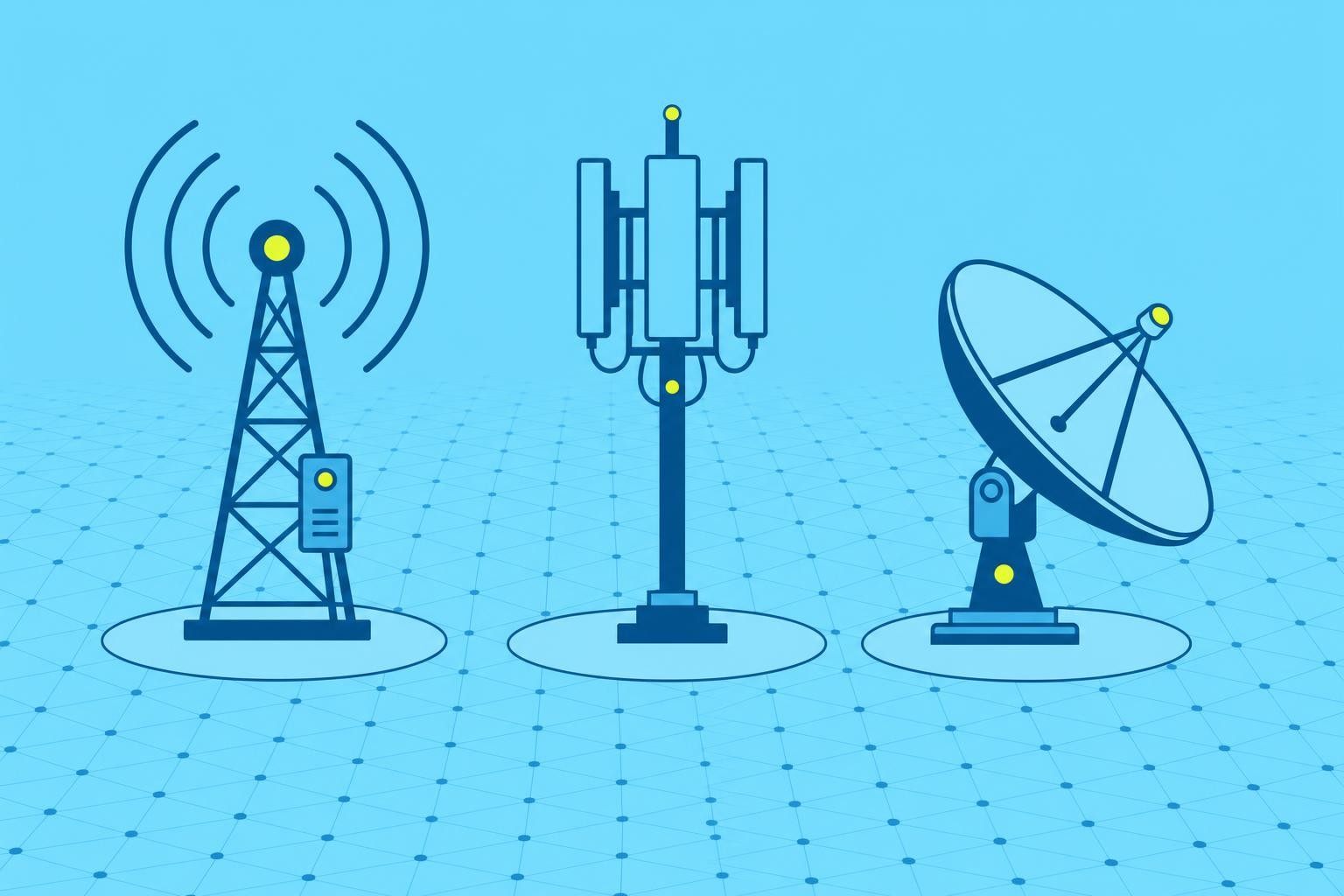
A Utility Dive analysis published 13 October 2026 frames the connectivity decision facing grid operators as a three-way choice - private LTE, public carrier services, and satellite - each with a distinct cost structure and a distinct set of operational compromises[1]. The piece arrives as the broader private LTE and 5G infrastructure market is on track to exceed $7.2 billion in annual spending by the end of 2028, growing at roughly 22% per year, with utilities among the fastest-moving verticals.
The spectrum decision is not the biggest line item - but it shapes everything else
The instinct to treat spectrum licensing as the headline cost is understandable but misleading. Spectrum is not among the top three component costs of building out a private LTE system; devices and radio infrastructure typically run higher. What spectrum choice does determine is infrastructure density: lower-frequency bands propagate farther, meaning fewer towers and lower ongoing maintenance bills. 900 MHz low-band spectrum allows for larger coverage areas with fewer towers than mid-band alternatives such as CBRS at 3.5 GHz, which is better suited to campus or substation-level deployments.
The practical split for US utilities currently looks like this:
- Licensed 900 MHz (via Anterix): wide-area coverage, long propagation, higher upfront spectrum cost, decades of interference protection
- CBRS (3.5 GHz, Band 48): shared or priority-access spectrum, lower entry cost, shorter range, more than 420,000 active CBRS base station radios deployed across the US by mid-2025
- Carrier MVNO or commercial LTE: no infrastructure capex, but the utility cedes design control, backup-power requirements, and priority access during congestion
A low-cost unlicensed or shared spectrum option can end up requiring more towers and therefore more capital than a pricier licensed band - a dynamic that makes total cost of ownership the only honest basis for comparison.
Carrier and satellite options trade control for simplicity
Utilities that rely on commercial carrier services face limitations in network design, coverage guarantees, and backup power that are not tailored to grid operations[1]. During a major outage event - precisely when communications matter most - a commercial carrier's network may itself be degraded or congested.
Satellite fills genuine gaps in remote terrain where neither licensed nor CBRS spectrum is economic to deploy, but latency and throughput constraints still limit its suitability for real-time protection and control applications.
Small and mid-sized utilities have a third path
Large utilities can absorb the capital and the in-house expertise required to own and operate a private LTE core. For smaller operators, a hosted-core model - where a partner manages the LTE EPC remotely, including software updates and security patches - can make private wireless broadband viable without carrying specialist staff. Several small and medium-sized utilities are already piloting this model.
What to watch
The FCC's August 2024 NPRM on CBRS - which proposed higher-power device classes and expanded access in offshore areas - remains open, and its outcome will directly affect deployment economics for utilities that have built their business cases around shared spectrum. Regulators in Germany and Ireland have already moved to allocate dedicated sub-1 GHz bands for utility private networks; whether the FCC follows with a more structured utility allocation, or continues to rely on market mechanisms, is the variable that will most influence which connectivity model wins out over the next decade.
The images and texts on this page were created with the help of AI.
Related
 Markets & Policy
Beacon of Hope food pantry in Marshall, NC switches on first microgrid in state's $5 million Helene resilience program
Beacon of Hope Food Pantry in Marshall, NC has energised the first of 26 planned microgrids in a $5 million state program - but domestic-content rules are narrowing which sites can follow.
13 Oct 2026 Markets & Policy
Bannock County, Idaho set to vote this fall on reversing its 2024 utility-scale renewables ban
Bannock County commissioners will vote this fall on a new ordinance that would lift a March 2024 ban on utility-scale solar and wind - and add nuclear - after Hecate Energy pulled out entirely.
13 Oct 2026 Markets & Policy
First U.S. study of real commercial kitchens finds gas and propane appliances push NO₂ above EPA limits in 70% of sites
A peer-reviewed study published 6 October 2026 in Environmental Research Letters finds gas and propane commercial kitchens routinely exceed EPA nitrogen dioxide limits, while all-electric kitchens do not.
13 Oct 2026