First U.S. study of real commercial kitchens finds gas and propane appliances push NO₂ above EPA limits in 70% of sites
A peer-reviewed study published 6 October 2026 in Environmental Research Letters finds gas and propane commercial kitchens routinely exceed EPA nitrogen dioxide limits, while all-electric kitchens do not.
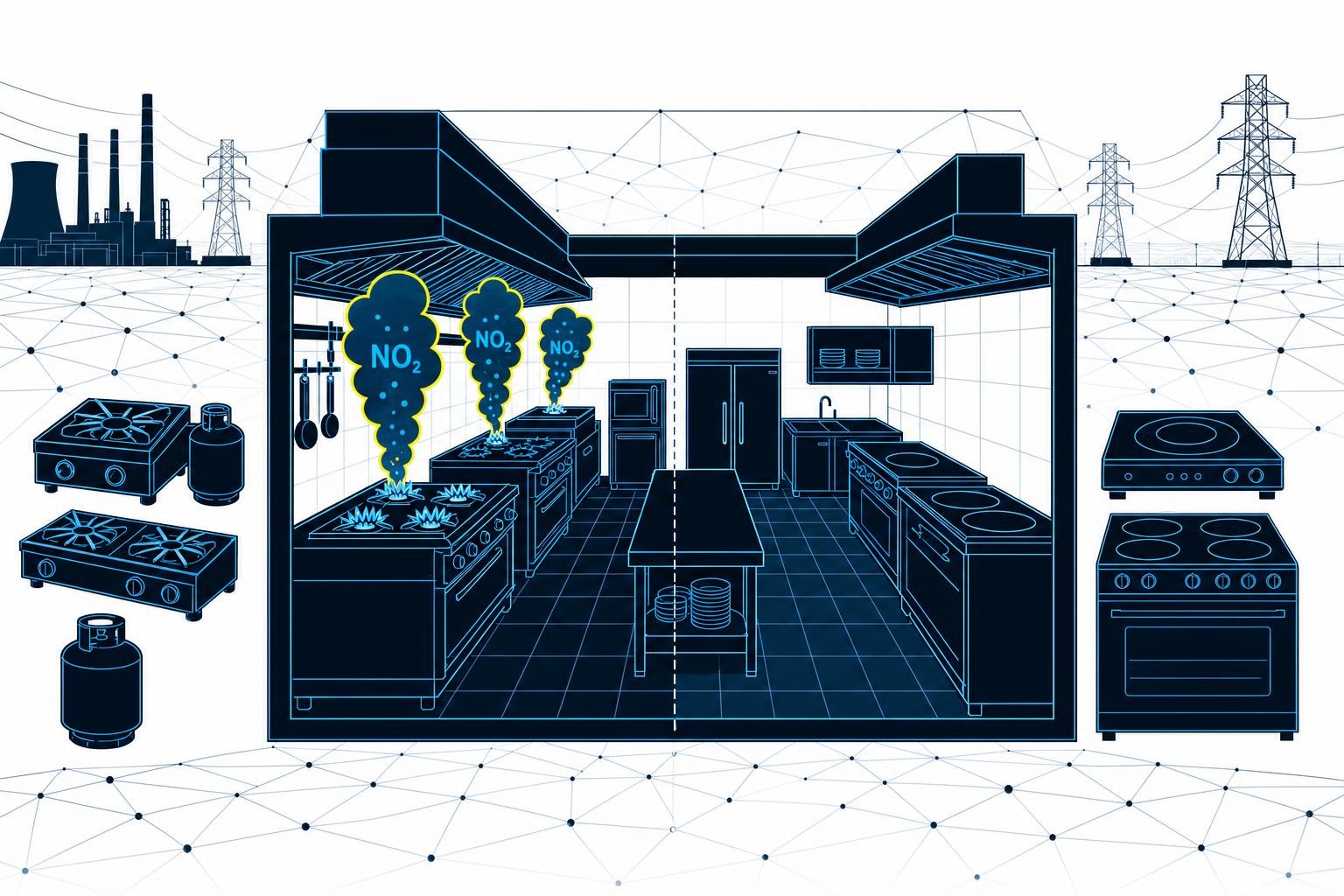
A peer-reviewed study published on 6 October 2026 in Environmental Research Letters found that roughly 70% of gas and propane commercial kitchens in the U.S. exceeded the EPA's one-hour outdoor air standard for nitrogen dioxide during cooking hours, while none of the all-electric kitchens in the sample did[1]. The research is the first U.S. analysis to compare real-world air quality and heat exposures across fuel types in operating restaurants rather than laboratory settings.
What the researchers measured and where
The study was conducted by researchers from PSE Healthy Energy, the Stanford Doerr School of Sustainability, and NYU Grossman School of Medicine, in collaboration with chef and EcoChef co-founder Christopher Galarza[1]. The team placed monitors in five employee work areas - both during service and overnight - across 21 gas kitchens, three propane kitchens, and three all-electric kitchens in California, New York, and Pennsylvania.
Pollutants tracked included:
- Nitrogen dioxide (NO₂)
- Carbon monoxide
- Benzene
- Methane
- Carbon dioxide
The EPA's one-hour outdoor NO₂ standard of 100 parts per billion by volume was used as the benchmark because no comparable U.S. indoor standard exists for commercial kitchens.
Pollution and heat findings
About 70% of gas kitchens exceeded the EPA's one-hour NO₂ outdoor air standard during cooking hours, with one kitchen recording a 15-minute average ten times above that threshold. More than two-thirds of gas kitchens also exceeded OSHA's proposed high-heat trigger of 90°F, and temperatures in four kitchens surpassed 122°F.
Carbon monoxide and benzene - a known human carcinogen linked to leukemia - also exceeded California's hourly exposure guidelines in several gas kitchens. No all-electric kitchen exceeded any pollution health guideline during cooking hours.
PSE Healthy Energy principal scientist Drew Michanowicz noted that chefs work directly above cooking surfaces before air reaches the ventilation hood, meaning measured concentrations outside the hood represent what workers actually inhale.
The overnight problem
The study identified a second, less-visible exposure pathway: pilot lights. About 71% of gas kitchens that underwent overnight monitoring recorded higher concentrations of NO₂, carbon monoxide, methane, and benzene during off-hours than during service, when ventilation systems are typically switched off. Seven kitchens exceeded the 100 ppbv NO₂ standard during overnight hours alone. None of the all-electric kitchens exceeded any threshold overnight.
"Some of the highest indoor pollution levels we measured came when no one was cooking at all," Michanowicz said. The authors flag cleaning crews and early-arriving staff as particularly exposed. They also note that the same commercial-grade gas appliances are used in schools, hospitals, and mixed-use buildings, broadening the potential affected population beyond restaurant workers.
Workforce scale and policy relevance
The study's authors frame the findings against a workforce of an estimated 15.7 million U.S. food service workers, the majority of whom work in kitchens equipped with gas or propane appliances. The research adds commercial kitchens to a body of evidence - previously concentrated on residential settings - linking gas combustion indoors to elevated pollutant exposure. Regulators have so far set no indoor NO₂ standard for commercial kitchens in the U.S., leaving workers reliant on ventilation systems that the study shows are frequently insufficient.
The Building Decarbonization Coalition cited the findings as evidence for accelerating the shift to all-electric commercial equipment. Whether OSHA or state-level agencies move to set indoor air quality standards for commercial kitchens - or whether equipment procurement rules in publicly funded institutions such as schools and hospitals respond - will be the near-term policy question to track.
The images and texts on this page were created with the help of AI.
Related
 Markets & Policy
Beacon of Hope food pantry in Marshall, NC switches on first microgrid in state's $5 million Helene resilience program
Beacon of Hope Food Pantry in Marshall, NC has energised the first of 26 planned microgrids in a $5 million state program - but domestic-content rules are narrowing which sites can follow.
13 Oct 2026 Markets & Policy
Bannock County, Idaho set to vote this fall on reversing its 2024 utility-scale renewables ban
Bannock County commissioners will vote this fall on a new ordinance that would lift a March 2024 ban on utility-scale solar and wind - and add nuclear - after Hecate Energy pulled out entirely.
13 Oct 2026 Storage
Marinus Link turns first sod at Heybridge as Tasmania's 750 MW Bass Strait cable enters construction
Construction has formally begun on Marinus Link's 750 MW HVDC interconnector after a sod-turning ceremony at Heybridge, Tasmania on 2 October 2026, backed by AU$5 billion in public finance.
13 Oct 2026