Nvidia contributes Vera Rubin rack and tray designs to OCP under MGX 1.2 spec
Nvidia opened its Vera Rubin rack and compute tray designs to the Open Compute Project on 12 October 2026, with the updated MGX 1.2 spec supporting racks up to 250 kW.
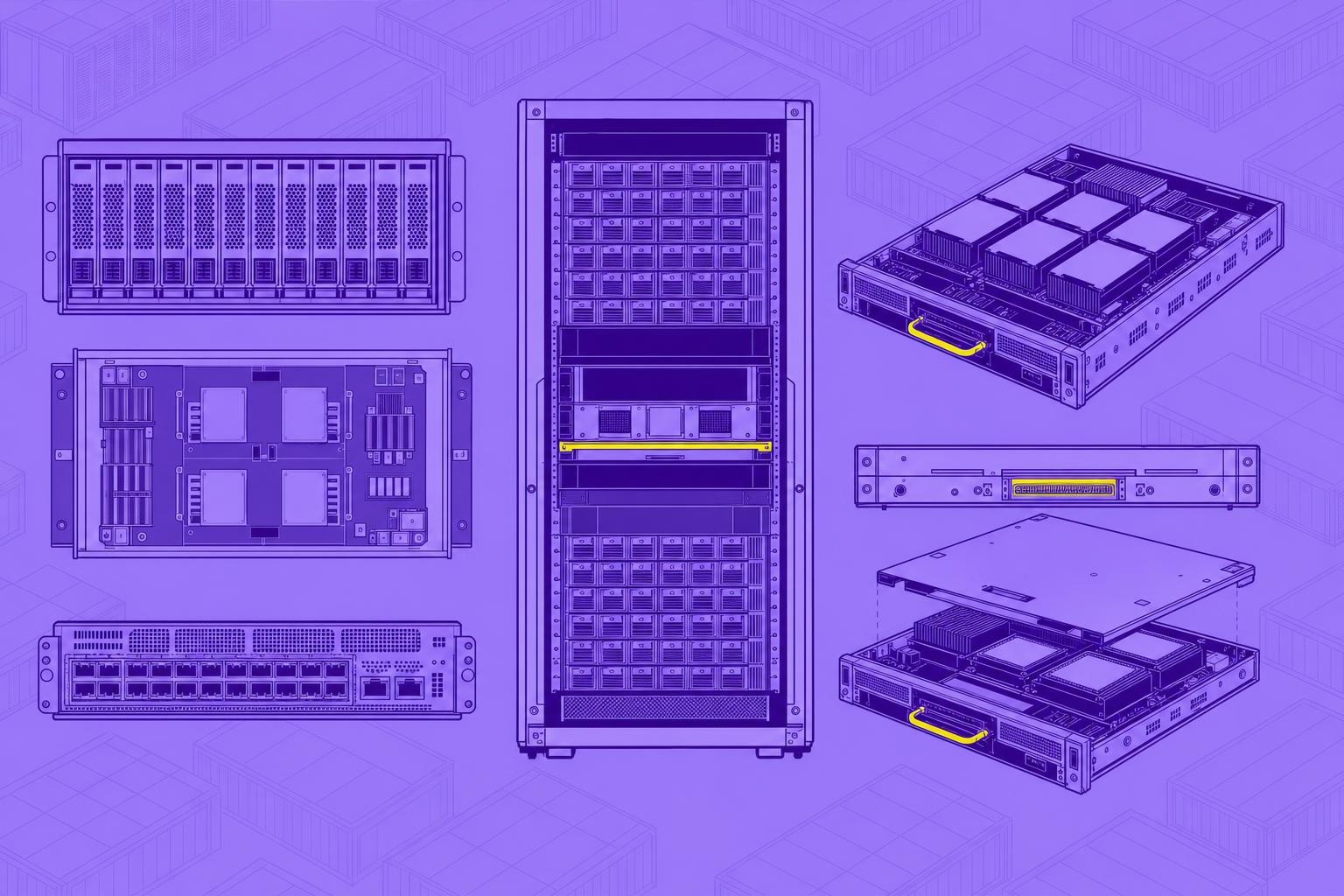
At the OCP Global Summit in San Jose on 12 October 2026, Nvidia contributed its Vera Rubin rack and compute tray designs to the Open Compute Project, releasing them through an updated MGX 1.2 specification[1] that supports rack deployments of up to 250 kW[1] - roughly double the density of the previous generation of AI-optimised racks.
What MGX 1.2 changes
The specification centres on eliminating the thermal and mechanical complexity that has made dense AI racks difficult to deploy at scale. Key additions include:
- Rack-scale blind-mate liquid cooling, which connects cooling interfaces automatically when a tray is pushed into position, removing the need to connect individual hoses by hand[1]
- A liquid-cooled 5,000 A busbar designed for higher-power AI systems[1]
- Fanless, cable-free compute trays that replace traditional connections with a central printed circuit board midplane
- Native 19-inch equipment support and configurable I/O bays
- Standardised power and cooling interfaces for interoperability across ecosystem partners
Nvidia said the same MGX rack footprint already supports the GB300 NVL72 and will carry forward to Vera Rubin NVL72 and Vera Rubin NVL72 CPX variants. A separate specification covers the Vera CPU rack, which Nvidia said has begun shipping for AI agent workloads.
This is not the first time Nvidia has opened a generation of rack designs to OCP; it did the same with Blackwell. The pattern is consistent: standardise the infrastructure layer around the chip, giving manufacturers a common target while keeping the compute hardware proprietary.
Power and grid standards alongside the rack
The rack contribution arrived alongside a broader set of facility and grid specifications. Nvidia joined AMD, Google, and Meta to publish Open Data Center Specification v0.7, a shared blueprint covering facility power architecture, cooling, and physical layout[1]. Google, Meta, Microsoft, and Nvidia separately published an OCP Grid Resilience Specification defining how large AI sites should behave during utility disturbances - staying connected, responding automatically, and restoring to near-full load within two seconds.
On the power delivery side, Visionbay - an AI infrastructure company under Foxconn Technology - unveiled Project K-1, an AI factory platform built around Nvidia's 800 V DC reference architecture and Vertiv power and thermal equipment. The design moves AC-to-DC conversion into cluster-level power centres and distributes 800 V DC closer to compute, reducing copper dependency and conversion losses. More than 80 partners are now developing 800 V DC-compatible infrastructure through OCP.
The ecosystem moves
Meta committed to adopting Nvidia's Spectrum-6 102.4 Tb/s Ethernet switches for its Vera Rubin AI factories, with Nvidia's Spectrum-X Multiplane technology sized for clusters of more than 100,000 GPUs. Nvidia and Cisco also outlined the Ultra-Dense Small Form Factor Pluggable (USFP) standard, targeting 400 Gb/s per lane - though no sampling schedule or availability date was given.

What to watch
The Open Data Center Specification is at version 0.7, and Nvidia has not disclosed which system builders will adopt MGX 1.2 or on what timeline. The grid resilience specification's two-second recovery target is a meaningful commitment for utilities and grid operators managing large-load interconnection - watch for how transmission planners respond to facilities that claim near-instant autonomous grid response as a design standard rather than an aspiration.
The images and texts on this page were created with the help of AI.
Related
 Markets & Policy
Beacon of Hope food pantry in Marshall, NC switches on first microgrid in state's $5 million Helene resilience program
Beacon of Hope Food Pantry in Marshall, NC has energised the first of 26 planned microgrids in a $5 million state program - but domestic-content rules are narrowing which sites can follow.
13 Oct 2026 Markets & Policy
Bannock County, Idaho set to vote this fall on reversing its 2024 utility-scale renewables ban
Bannock County commissioners will vote this fall on a new ordinance that would lift a March 2024 ban on utility-scale solar and wind - and add nuclear - after Hecate Energy pulled out entirely.
13 Oct 2026 Markets & Policy
First U.S. study of real commercial kitchens finds gas and propane appliances push NO₂ above EPA limits in 70% of sites
A peer-reviewed study published 6 October 2026 in Environmental Research Letters finds gas and propane commercial kitchens routinely exceed EPA nitrogen dioxide limits, while all-electric kitchens do not.
13 Oct 2026