Ukraine's energy minister sets a 54 GW rebuild target - but not the old system
Ukraine's energy minister told a German delegation in August 2026 that the country wants to restore 54 GW of generation capacity - with 30% renewables and no significant coal rebuild.
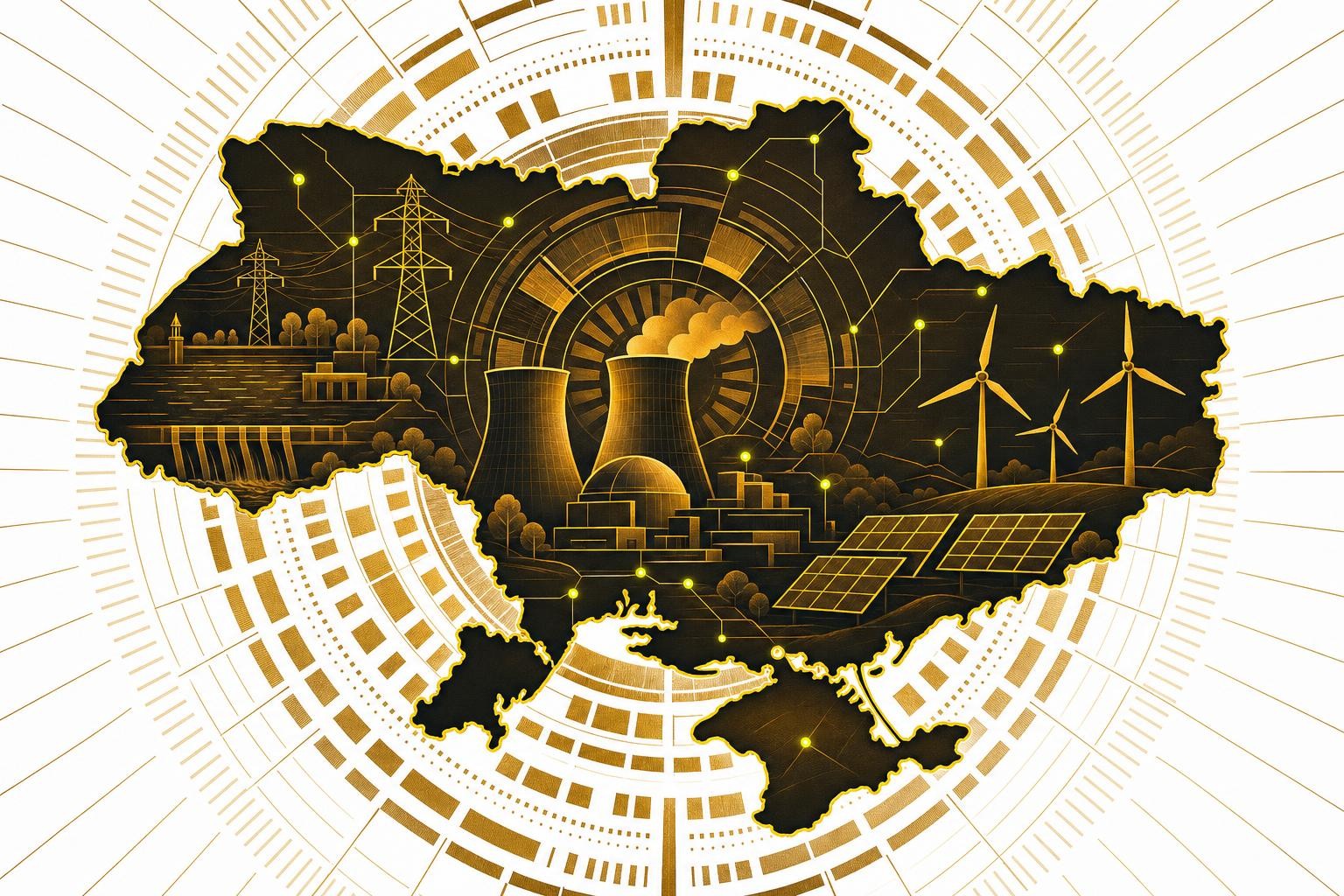
A German green-tech business delegation that visited Kyiv and Lviv on 18-20 August 2026 returned with a single figure that frames Ukraine's energy challenge: before Russia's full-scale invasion, Ukraine had more than 50 GW of generation capacity[1]. Following the heaviest attacks on its energy infrastructure last winter, at times barely 10 GW remained available[1].
What the minister said
Energy Minister Denys Shmyhal, who also serves as First Deputy Prime Minister, outlined the government's target to the delegation: restore capacity to more than 50 GW - specifically, a strategic ambition of 54 GW, the level Ukraine held before Russia's aggression began in 2014. But the composition of that system is set to look very different from what existed before the war.
Speaking at the Ukraine Recovery Conference in Gdańsk in June 2026, Shmyhal described a three-pillar energy balance:
- Nuclear energy providing approximately 50% of total generation capacity
- Renewable energy sources accounting for around 30%, in line with Ukraine's EU integration commitments
- Gas-fired generation contributing the remaining 20%, with plants designed to be hydrogen-ready
There are no plans for any significant rebuilding of coal-fired generation[1]. The priorities Shmyhal named are speed, resilience, and greater energy independence[1].
The decentralization signal
The delegation's account of street-level conditions in Kyiv adds texture to the statistics. Backup diesel generators run continuously outside shops, apartment buildings, and restaurants following attacks[1]. The constant noise and exhaust fumes were described by some residents as more psychologically draining than air-raid sirens, because the strain can persist for hours or days[1].
That context helps explain why Ukraine's battery storage market has grown faster than almost anywhere else in Europe. Ukraine installed approximately 2.9 GWh of battery storage in 2025, nearly five times as much as in the previous year, according to SolarPower Europe's European Battery Market Outlook 2026-2030[1]. That placed Ukraine fourth in Europe, behind only Germany, the United Kingdom, and Italy[1].
The composition of those installations is the more telling detail. More than 60% of the newly installed capacity consisted of decentralized systems for households, businesses, schools, hospitals, water utilities, and other critical infrastructure[1]. Just under one-third came from large-scale systems providing grid services[1].
Ukraine's 2.9 GWh of battery storage added in 2025 was driven overwhelmingly by decentralized demand — hospitals, schools, and businesses seeking backup power rather than grid-optimization economics. That is a structurally different demand driver from any other top-five European market.
Why the mix matters for investors
Ukraine is running two parallel procurement tracks. For distributed gas generation, the government launched a tender for 1.5 GW of new highly maneuverable capacity in the most energy-deficient regions - Kharkiv, Sumy, Poltava, Dnipropetrovsk, Odesa, Chernihiv, and Kyiv, with winners supported through a market premium mechanism. For renewables, a separate 1 GW support round is in progress, weighted toward wind.
The World Bank, European Commission, and UN jointly estimated energy infrastructure damage through end-2024 at over $20 billion, with lost revenue to the energy sector exceeding $72 billion. Ukraine's full rebuild is estimated to require at least $67 billion, the bulk of which will need to come from private capital and international partners.
The German delegation included representatives from BSW-Solar, Goldbeck Solar, and PMT, alongside Federal Minister Carsten Schneider and Parliamentary State Secretary Sören Bartol[1]. Their presence signals that European solar and storage suppliers are beginning to treat Ukraine's reconstruction not as a post-war opportunity but as an active market - one where procurement is already running and where the policy framework explicitly excludes a return to centralized coal.
What to watch
The near-term test is whether Ukraine can restore and construct more than 10 GW of generation capacity before the next heating season, as Shmyhal has stated as an immediate target. Russian strikes have repeatedly reset progress - available capacity fell from roughly 17.5 GW in 2025 to around 11.5 GW by February 2026 as attacks intensified over winter. The 54 GW long-term target and the 30% renewables share are credible policy signals, but the path runs through a grid that remains under active attack.
The images and texts on this page were created with the help of AI.
Related
 Renewables
RenewableUK hands out 14 awards at fifth annual Global Offshore Wind ceremony in London
RenewableUK presented 14 awards at the Royal Lancaster London on 13 October 2026, with Ocean Winds, ScottishPower Renewables and RWE among the winners across projects, people and industry priorities.
15 Oct 2026 Renewables
Panasonic's Aquarea N Series brings R454C refrigerant to residential heat pumps ahead of April 2027 European launch
Panasonic has unveiled the Aquarea High-Performance N Series, four air-to-water heat pump models using R454C refrigerant with a GWP of 148, targeting European residential markets from April 2027.
15 Oct 2026 Renewables
UK Energy Secretary Fahnbulleh calls for systemic overhaul, citing grid failures and consumer cost crisis
Speaking at Energy UK's annual conference on 14 October, DESNZ Secretary Miatta Fahnbulleh declared the UK energy system is failing consumers and demanded structural reform beyond piecemeal adjustment.
15 Oct 2026