Rhine July average in 2026 fell below the worst single day of the previous seven years
Europe's 2026 drought cut hydro output by roughly 13 TWh across seven corridor countries between April and July, while forcing the first-ever full shutdown of Hungary's Paks nuclear plant.
The Rhine at Lobith averaged 850 m³/s in July 2026 - below the lowest single July day of the entire 2019-25 baseline, which was 880 m³/s recorded during the drought summer of 2022[1]. That one figure captures how far outside historical experience this summer has run: an average month in 2026 was worse than the worst day of the previous seven years.
The deterioration was gradual and then severe. Modelled discharge at Lobith ran at 81% of the 2019-25 norm in April, fell to 66% in May, 58% in June, and 37% in July. Twenty-seven days in 2026 fell below the lowest single day recorded at that station in the previous seven Aprils-to-Julys, a period that includes the 2022 drought[1].
France's rivers tracked a similar arc. The Garonne at Tonneins averaged 5% of its normal July flow, with sixteen days below anything seen in 2019-25[1]. The Loire at Saumur reached 13% of normal in July and the Rhône at Beaucaire 41%[1].
Hydro losses in the drought corridor
Generation followed river conditions closely. The seven corridor systems - Austria, Italy, Romania, Serbia, Hungary, Slovakia, and France - produced roughly 13 TWh less hydro between April and July than the 2019-25 average for the same months, a shortfall of about one fifth[1]. Country-level figures for July:
- Austria: -34%
- Italy: -38%
- Serbia: -34%
- Romania: -32%
- Hungary: -53%[1]
France swung from 6-7% above normal in April and May to 16-17% below in June and July[1]. The link between river flow and output was direct: daily Serbian run-of-river generation tracked Iron Gates discharge with a correlation of 0.89, and French run-of-river tracked the Rhône at 0.73[1].
Iberia and Switzerland partially offset the losses. Portuguese hydro ran 117% above its norm in July after a rain-heavy first half, and Spain finished the window 16-44% above normal by month[1]. Together the wet flanks added roughly 9 TWh against the baseline - about 70% of the corridor's loss at continental level, but not in the places that needed it[1].
Nuclear plants on a shrinking river
The Danube corridor produced the most acute single events. In July 2026, drought reduced the Danube's flow to about a third of the long-term monthly average, approaching the record low set in 1985; Cernavodă Unit 1 was shut on 28 July under severe-drought procedures as the flow rate fell to roughly 1,630-1,750 m³/s against a multiannual July average of about 4,700 m³/s. A shutdown of Unit 2 was announced on 29 July but reversed the following day after a review of operating parameters, and the government funded emergency works - barges at the Bala-Old Danube junction and the blasting of rock in the channel on 3 August - to direct more water toward the plant.
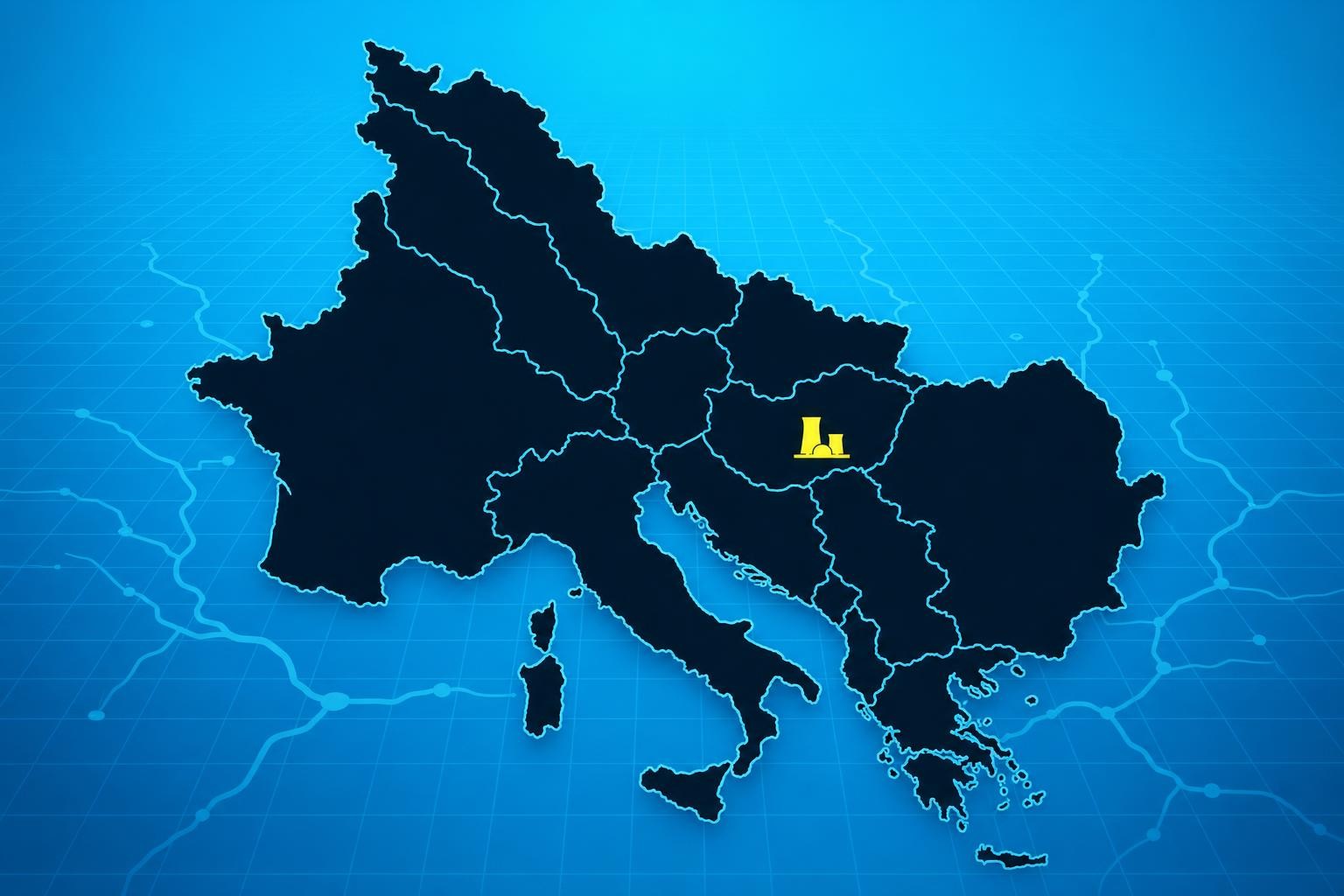
At Paks in Hungary, the situation escalated faster. Hungary's only nuclear power plant was confirmed for full shutdown for the first time in its history due to record-low Danube water levels; at the time of the announcement, the plant was producing 965 MW rather than its usual 2,000 MW. Unlike many European nuclear plants that recirculate water through cooling towers, Paks was built to draw water directly from the Danube - a river long assumed too mighty to run dry. The source briefing data show Paks output fell from 38 GWh per day on 28 July to 21 GWh on 31 July, a cut of 45% in three days[1].
Reservoir position and the autumn outlook
Reservoir data sharpens the forward picture. By mid-July, Italian and Romanian storage stood closer to the 2015-25 minimum than to the median[1]. Spanish reservoirs sat near the top of their historical band and Portuguese storage held above its median - a geographic inversion that will matter when autumn demand rises and the corridor countries need to draw on whatever is left[1].
Temperatures across the continent were forecast to be 2°C to 8°C above seasonal norms through early August, and longer-term weather models support continued high-pressure dominance, suggesting little drought-breaking rainfall before late autumn. For grid operators in Austria, Romania, and Hungary, the question is no longer whether this summer was exceptional - it was - but whether reservoir buffers can carry the system through to the first autumn rains.
The images and texts on this page were created with the help of AI.
Related
Ready-to-build BESS projects lose their premium as Australia's NEM arbitrage spreads collapse 85%
Panellists at the Battery Asset Management Summit Australia 2026 said the venture-capital-style returns that once rewarded ready-to-build BESS projects have disappeared as NEM price spreads fell 85% in a year.
10 Sept 2026UK government opens three-month consultation on AI for clean energy, backed by 34-recommendation network review
DESNZ published its Vision for an AI-enabled clean energy system on 8 September, opening a call for evidence that closes 6 November and will feed into the UK's first AI for Clean Energy Strategy.
10 Sept 2026Heatwaves expose a three-layer risk for wind operators: resource, hardware, and people
Extreme heat cuts wind output, stresses nacelle components, and grounds maintenance crews - all at once. A look at how bad the summer of 2026 has been, and what the trend means for grid reliability.
10 Sept 2026