Ming Yang Smart Energy declares Haiyou Anlan commissioned, confirming world's first 16 MW TLP floating turbine in operation
Ming Yang Smart Energy has formally commissioned the Haiyou Anlan, the world's first 16 MW tension-leg platform floating wind turbine, now supplying green power to CNOOC's Lufeng oilfield in the South China Sea.
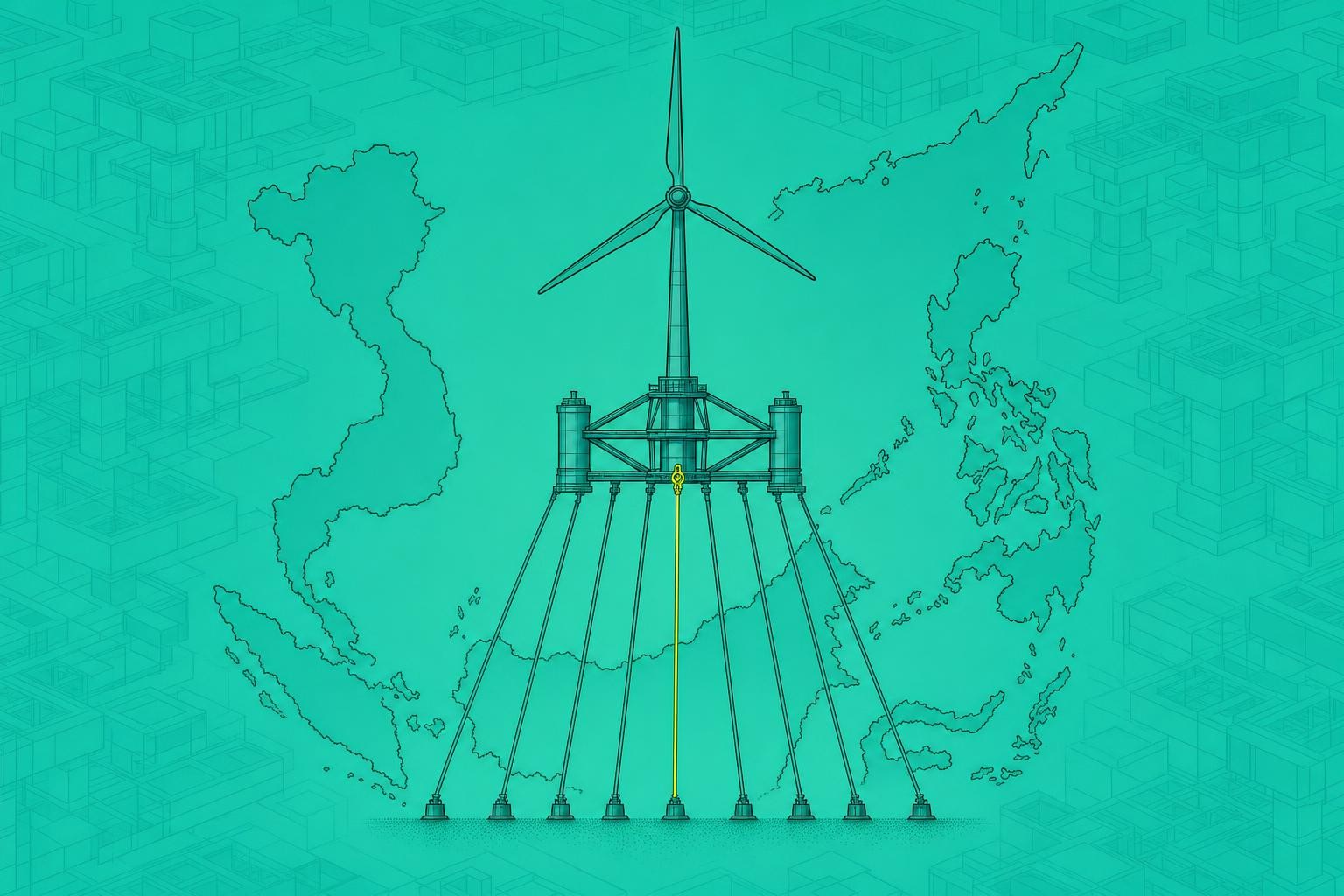
Ming Yang Smart Energy has formally commissioned the Haiyou Anlan, declaring it the world's first 16 MW tension-leg platform (TLP) floating wind turbine[1]. The platform connected to the Lufeng oilfield power grid on 6 August 2026 and began supplying green electricity directly to offshore oil operations, according to operator CNOOC[1].
What the platform is
Haiyou Anlan is installed 136 km from the coast in the Pearl River Mouth Basin, in 136 metres of water, placing it beyond the reach of fixed-bottom foundations[1]. The complete system stands over 307 metres tall[1] - roughly equivalent to a 110-story building - and weighs 7,800 tonnes, with a rotor swept area equivalent to 7.5 standard football fields.
The TLP mooring concept uses nine tension tendons anchored to the seabed, constraining vertical motion while allowing the platform to respond to wave loads. CNOOC developed high-strength mooring systems and high-precision anchoring technologies specifically for the project, which it describes as having no mature global precedent at this scale.
Key platform parameters:
- Rated capacity: 16 MW
- Water depth: 136 m
- Distance from shore: 136 km
- Total system height: over 307 m
- Platform weight: 7,800 tonnes
- Mooring: nine tension tendons, TLP configuration
- Designed survival wind speed: approximately 220 km/h (Category-17 typhoon equivalent)
How power reaches the oilfield
Electricity is transmitted to the Lufeng oilfield grid via a 4.3 km subsea cable. Rather than feeding an onshore grid, the turbine has a dedicated industrial load: it powers offshore drilling platforms directly, substituting for fuel-oil generation on the oilfield. CNOOC expects the facility to generate 54 million kWh of green electricity annually, saving an estimated 15,000 cubic metres of fuel oil per year and cutting CO₂ emissions by approximately 35,000 tonnes annually.
The platform also incorporates a hybrid power system combining wind generation, conventional fuel backup and energy storage to maintain stable supply when wind conditions vary.
Why the TLP configuration matters
Most floating wind demonstrators deployed to date use semi-submersible or spar-buoy foundations. The TLP approach offers lower vertical motion - an advantage for turbine drivetrain loads - but demands precise anchoring in deep water and is considered among the most technically demanding floating substructure types. CNOOC acknowledged in its commissioning statement that no mature global system existed for TLP floating wind before this project.
The project was assembled at Zhuhai and departed for the Lufeng site on 28 June 2026, with grid connection following roughly six weeks later. The 25-year design life and typhoon-resistance specification reflect the South China Sea operating environment, where Category-17 conditions are a credible design load.
What to watch
The Haiyou Anlan is a single-unit demonstrator, not a commercial array. The near-term question is whether CNOOC and Ming Yang publish performance data - capacity factor, availability, mooring tension readings - that would allow independent assessment of TLP viability at this scale. China's 15th Five-Year Plan targets 50% non-fossil power generation by 2030, and floating wind is positioned as the route to deepwater resources where fixed-bottom turbines cannot reach. A credible operational record from Haiyou Anlan would materially advance the case for commercial-scale TLP projects in the South China Sea and beyond.
The images and texts on this page were created with the help of AI.
Related
Ready-to-build BESS projects lose their premium as Australia's NEM arbitrage spreads collapse 85%
Panellists at the Battery Asset Management Summit Australia 2026 said the venture-capital-style returns that once rewarded ready-to-build BESS projects have disappeared as NEM price spreads fell 85% in a year.
10 Sept 2026UK government opens three-month consultation on AI for clean energy, backed by 34-recommendation network review
DESNZ published its Vision for an AI-enabled clean energy system on 8 September, opening a call for evidence that closes 6 November and will feed into the UK's first AI for Clean Energy Strategy.
10 Sept 2026Heatwaves expose a three-layer risk for wind operators: resource, hardware, and people
Extreme heat cuts wind output, stresses nacelle components, and grounds maintenance crews - all at once. A look at how bad the summer of 2026 has been, and what the trend means for grid reliability.
10 Sept 2026