Ming Yang's 16 MW floating turbine connects to CNOOC's Lufeng oilfield grid
CNOOC's Haiyou Anlan - the world's first 16 MW tension-leg floating wind platform - connected to the Lufeng oilfield grid on 6 August 2026, supplying green power directly to offshore oil operations.
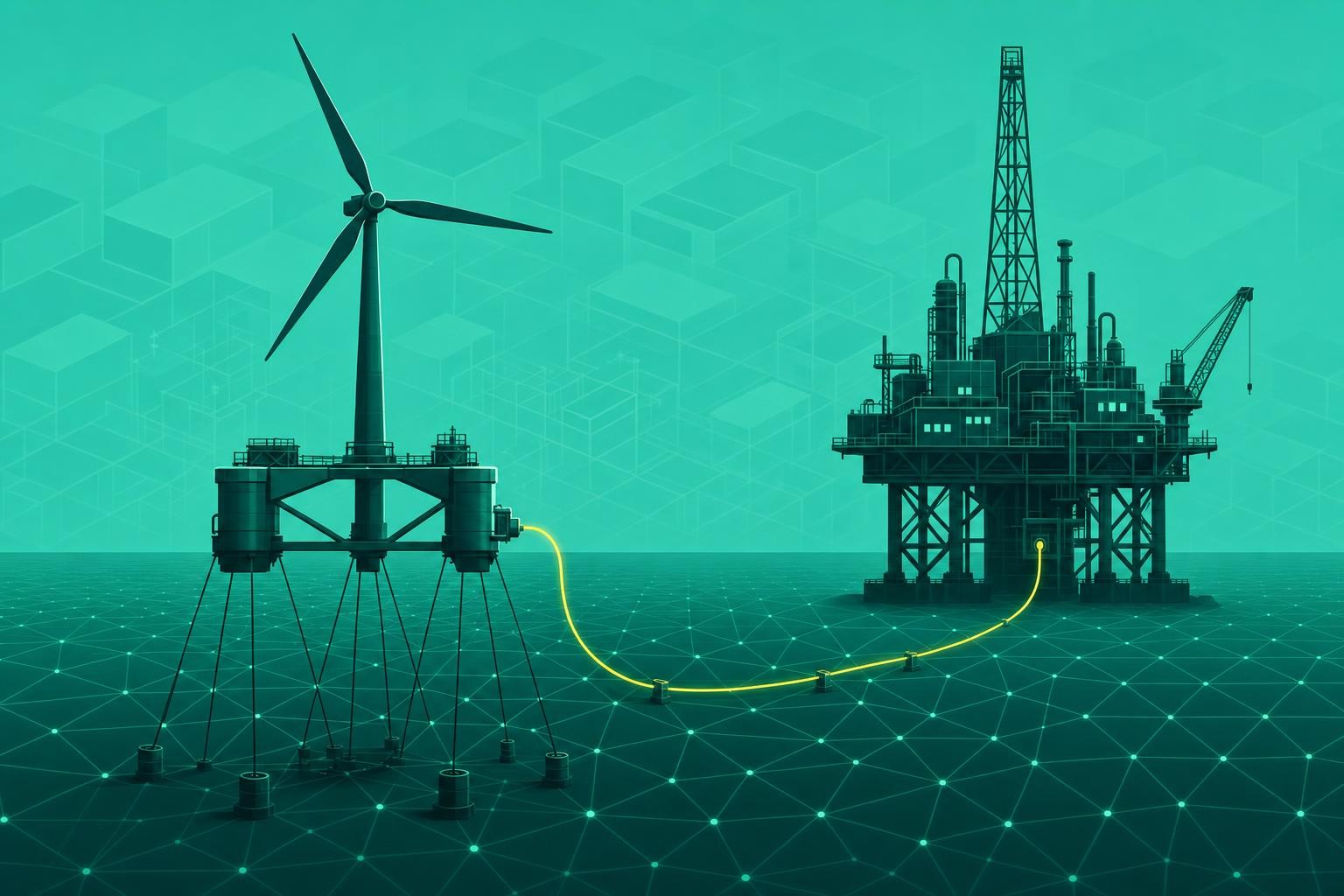
CNOOC connected the Haiyou Anlan, the world's first 16 MW tension-leg platform (TLP) floating wind facility, to the Lufeng oilfield power grid on 6 August 2026[1]. The turbine, supplied by Ming Yang Smart Energy, is now delivering electricity directly to offshore oil operations in the South China Sea - the first time a floating wind unit of this scale has powered an active oilfield cluster.
What the platform is
Installed about 136 km from the coast in the Pearl River Mouth Basin, the platform stands nearly as tall as a 110-story building and weighs 7,800 tonnes, with a swept area equivalent to 7.5 standard football fields. It sits in waters 136 m deep and is engineered to withstand Category 17 typhoons.
Key technical parameters:
- Foundation type: tension-leg platform, moored to the seabed by taut vertical steel cables
- Turbine capacity: 16 MW, supplied by Ming Yang Smart Energy[1]
- Grid connection: 4.3 km subsea cable linking the platform to the Lufeng oilfield grid
- Design life: 25 years
- Typhoon rating: designed to withstand sustained wind speeds of up to approximately 220 km/h, the conditions of a super typhoon
How it works at the oilfield
The facility uses a hybrid power system that combines wind energy, conventional fuel generation, and energy storage to ensure a stable electricity supply despite fluctuations in wind conditions. That hybrid architecture matters: an oilfield cannot tolerate the intermittency that a grid-connected wind farm can absorb across a wider system.
Once fully operational, the platform is expected to supply 54 million kilowatt-hours of green electricity to the oilfield annually, saving about 15,000 cubic metres of fuel oil and reducing carbon dioxide emissions by 35,000 tonnes.[1]
Records and firsts
The project represents China's first TLP floating wind platform and the world's largest of its kind by turbine capacity, operating at the greatest water depth and farthest distance from shore.[1] The platform departed its assembly yard in Zhuhai in late June 2026 and, from approval to installation, the project took 17 months to complete.
The TLP foundation type is a deliberate choice for typhoon-prone deep water. A tension-leg platform is a buoyant, floating structure moored to the seafloor by taut, vertical steel cables - a configuration that limits vertical motion and is better suited to the wave conditions of the South China Sea than semi-submersible alternatives.
What to watch
The Lufeng deployment is a proof-of-concept for wind-powered offshore oil and gas production, a model that could reduce diesel consumption across China's extensive South China Sea oilfield network. Whether CNOOC scales the approach - and whether Ming Yang's TLP turbine finds buyers outside China - will be the test of whether 6 August marks a commercial turning point or a one-off engineering demonstration.
The images and texts on this page were created with the help of AI.
Related
Ready-to-build BESS projects lose their premium as Australia's NEM arbitrage spreads collapse 85%
Panellists at the Battery Asset Management Summit Australia 2026 said the venture-capital-style returns that once rewarded ready-to-build BESS projects have disappeared as NEM price spreads fell 85% in a year.
10 Sept 2026UK government opens three-month consultation on AI for clean energy, backed by 34-recommendation network review
DESNZ published its Vision for an AI-enabled clean energy system on 8 September, opening a call for evidence that closes 6 November and will feed into the UK's first AI for Clean Energy Strategy.
10 Sept 2026Heatwaves expose a three-layer risk for wind operators: resource, hardware, and people
Extreme heat cuts wind output, stresses nacelle components, and grounds maintenance crews - all at once. A look at how bad the summer of 2026 has been, and what the trend means for grid reliability.
10 Sept 2026