Google data center sourcing veteran Allyson Fealtman joins OpenAI to lead interconnect and rack power procurement
Allyson Fealtman, who spent 16 years leading commodity sourcing at Google, has joined OpenAI to focus on high-speed interconnect and rack power - two of the tightest supply chain bottlenecks in AI infrastructure.
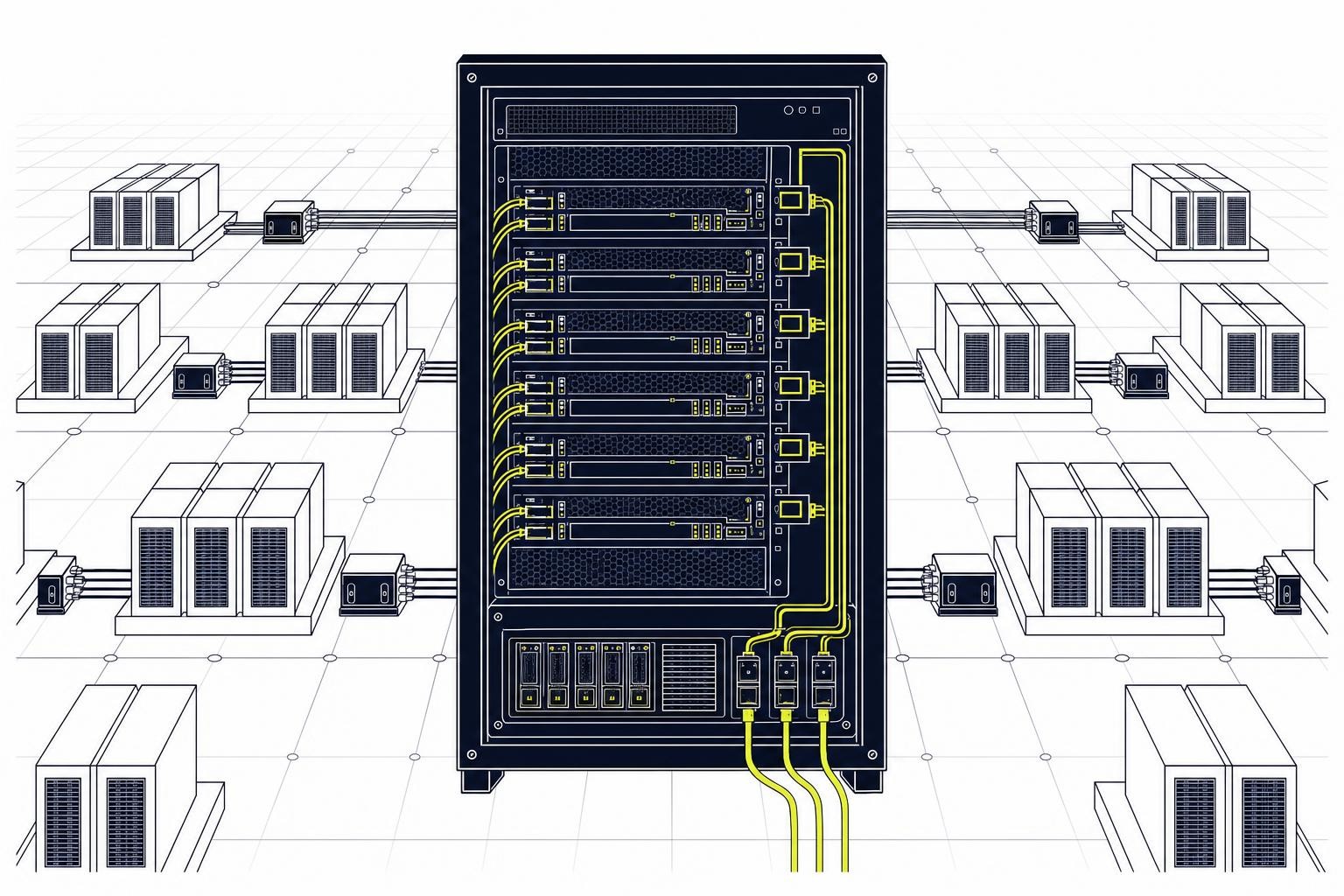
Allyson Fealtman, a lead in Google's data center strategic sourcing and supplier development team, has moved to OpenAI. She spent 16 years at Google, where she managed a team of 11 commodity managers covering liquid and air cooling, interconnect, and mechanical data center equipment[1]. She joined OpenAI in May 2026 but disclosed the move publicly on 13 October[1].
At OpenAI, Fealtman will focus on strategic sourcing for high-speed interconnect and rack power[1] - two categories that have become among the most constrained in the AI infrastructure supply chain.
Why interconnect and rack power matter right now
The two categories Fealtman is taking on are not incidental. Fiber optic transceivers, connectors, and optical modules have entered the most-extended lead time categories tracked by component analysts, driven by the bandwidth requirements of AI training clusters where thousands of GPUs must communicate at terabit-per-second speeds. DAC and AOC cable lead times for large GPU deployments have stretched beyond 20 weeks, and the broader interconnect market - valued at roughly $2.7 billion today - is under sustained pressure as AI racks require an order of magnitude more fiber than traditional server configurations.
Rack power is equally strained. Current-generation GPU-based AI training deployments commonly require rack densities of 40 kW to well in excess of 100 kW per rack, compared with 5-15 kW for legacy enterprise and colocation designs. A single Nvidia GB200 NVL72 rack draws 120-130 kW, and next-generation accelerator platforms are expected to push those requirements higher still. Power management ICs and discrete semiconductors - the components that regulate hundreds of kilowatts flowing to GPU clusters - are facing a supply shortage projected to persist through 2026.
Fealtman's prior Google remit — liquid and air cooling, interconnect, and mechanical data center equipment — maps almost exactly onto the categories where OpenAI's Stargate buildout faces its tightest vendor constraints.
OpenAI's infrastructure sourcing push
OpenAI has been building out its sourcing function in parallel with its physical infrastructure ambitions. The company's InfraDev team has been hiring sourcing professionals to lead procurement for the Stargate programme, with job listings describing roles that cover electrical, mechanical, and connectivity equipment alongside contractor and engineering relationships. Stargate has seven publicly confirmed U.S. sites in 2026, designed for 20-80 kW per rack AI density - four to ten times the power draw of traditional cloud infrastructure.
The scale of the sourcing challenge is significant. OpenAI says Stargate surpassed its initial U.S. compute goal of 10 GW by 2029 ahead of schedule, with over 3 GW added in the 90 days to April 2026. Bringing that capacity online requires negotiating supply agreements for high-bandwidth optical interconnects and rack-level power hardware at volumes that strain global manufacturing.
Before her time at Google, Fealtman held supply chain roles at Infinera, PowerFile, and supercomputing firm SGI[1] - a background that spans both optical networking and high-performance compute, directly relevant to the categories she is now sourcing.
A second senior Google departure in a week
Fealtman's move follows the departure of Michael Terrell, Google's global head of advanced energy, who left after 19 years. The two exits cover different functions - energy procurement versus hardware sourcing - but together they represent a notable loss of institutional knowledge from Google's data center organisation at a moment when the company is itself managing rapid load growth.
Google's data centres used 30.8 million MWh of electricity in 2024, roughly double the figure four years earlier. The company has been replacing departing leaders: Lucia Tian, director since May, now heads Google's advanced energy technologies division following Terrell's exit.
What to watch
OpenAI has not disclosed which vendors Fealtman will be engaging or whether her hire signals a shift toward more direct, long-term supply agreements rather than spot procurement. Given the lead times now attached to optical interconnect and rack power hardware, the sourcing decisions made in the next six to twelve months will directly determine how quickly Stargate sites can be energised and equipped. Fealtman's 16-year track record negotiating these categories at hyperscale makes her appointment one of the more consequential infrastructure hires OpenAI has made this year.
The images and texts on this page were created with the help of AI.
Related
 Markets & Policy
Ofgem opens consultation on how network owners must evidence wider procurement value, closing 5 January 2027
Ofgem published draft guidance on 13 October 2026 setting out how electricity network owners, interconnector developers and offshore hybrid asset developers must justify procurement decisions that trade cost or schedule for wider long-term benefits.
14 Oct 2026 Markets & Policy
Solar Energy Industries Association backs two Georgia PSC Democrats with $250,000 in ad spending ahead of 3 November vote
A SEIA-tied super PAC is spending $250,000 on ads for two Georgia PSC Democrats who, if elected, would hand the commission its first non-Republican majority in roughly three decades.
14 Oct 2026 Storage
Mexico's CFE closes first mixed-investment tender at 7,411 MW, with 1,850 MW of mandated battery storage
Mexico's first CFE mixed-investment tender closed on 5 June 2026, awarding 37 projects totalling 7,411 MW - 114% of target - with 1,850 MW of co-located BESS required under the scheme.
14 Oct 2026