Mexico's CFE closes first mixed-investment tender at 7,411 MW, with 1,850 MW of mandated battery storage
Mexico's first CFE mixed-investment tender closed on 5 June 2026, awarding 37 projects totalling 7,411 MW - 114% of target - with 1,850 MW of co-located BESS required under the scheme.
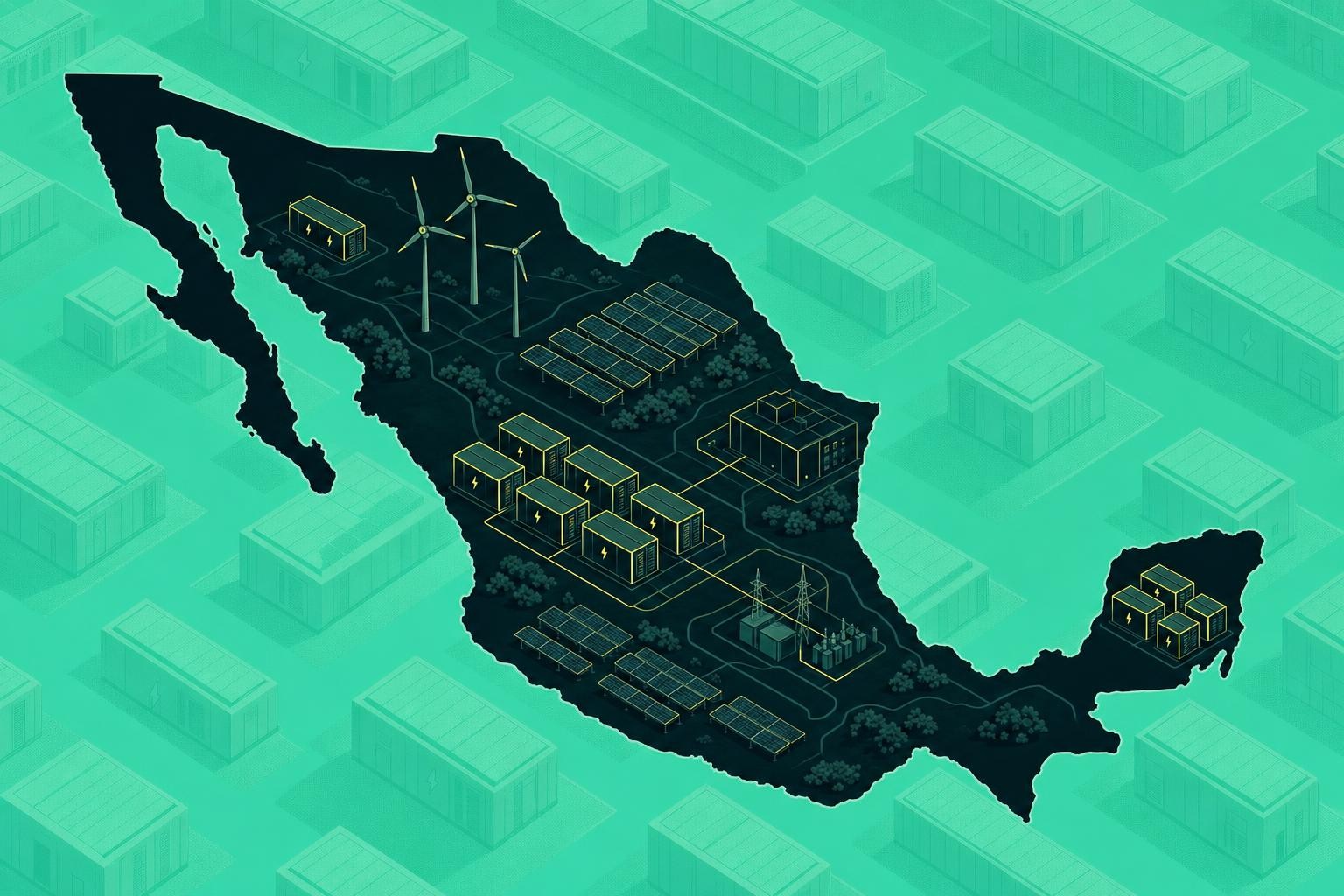
Mexico's state-owned utility CFE closed its first Mixed Development Schemes tender on 5 June 2026, awarding 37 renewable energy projects totalling 7,411 MW - 114% of the original 6,500 MW target - and requiring 1,850 MW of co-located battery energy storage systems (BESS)[1]. The result, described by one analyst as the most significant private capital mobilisation in Mexico's electricity sector since the 2016-2018 clean energy auctions, marks a structural shift in how the country intends to build out its grid.
How the scheme works
The mixed-investment model is deliberately asymmetric. CFE retains at least 54% ownership in each project, while private partners may hold up to 46%. On the revenue side, the structure tilts further toward the developer: the private investor covers the project's capital expenditure, while CFE guarantees the purchase of at least 70% of the energy produced[1]. The remaining 30% can be sold into the wholesale electricity market or supplied back to CFE[1].
Josué Alberto Valenzuela, Director of Strategic Productive Investment Projects at the Secretariat of Economy and Innovation of Baja California, speaking ahead of the Energy Storage Summit Latin America, put it plainly: "There is such strong interest in promoting renewable energy projects that the mixed-investment model involving the CFE and private entities provides investors with certainty."[1]
The scheme attracted outsized demand. Registrations of interest reached roughly six times the 6,500 MW on offer, including major international developers that had not participated in the earlier fast-track permit round. CFE subsequently launched a second call that integrates BESS for the first time.
The BESS mandate
Storage is not optional under the new framework. Mexico introduced a grid-code-linked requirement for new wind and solar plants to co-locate batteries equivalent to 30% of installed capacity, with a minimum three-hour discharge duration. The first tender's 1,850 MW of awarded BESS reflects that rule applied at scale.
Several large deals have already moved toward financial close:
- CIP / La Esperanza (Campeche): 420 MW solar PV plus 150 MW / 750 MWh BESS; financial close announced 6 August 2026.
- Cubico Sustainable Investments: five projects combining 578 MW of generation and 175.7 MW of BESS across Tamaulipas, Nuevo León, Campeche and Yucatán, representing nearly US$1 billion in investment; construction of the first project, the 78 MW Altamira Solar plant, scheduled to begin December 2026.
- Actis / Yeltica Energy: three solar-plus-storage projects totalling approximately 330 MWp of solar and 255 MWh of BESS, backed by 25-year US-dollar-denominated PPAs with CFE as anchor offtaker.
CFE's own pipeline runs in parallel. The utility is investing 6.49 billion Mexican pesos (approximately US$361 million) in the third phase of the Puerto Peñasco Solar + Storage complex in Sonora, adding 300 MW of PV and 90 MW of BESS at three-hour duration.
Regulatory scaffolding
Two sets of electricity regulations published in April 2026 - covering energy storage and the migration of existing independent power producer permits to the new framework - have increased investor confidence, according to market participants. A second tender call followed shortly after.
For smaller projects, SENER published guidelines on 8 May 2026 for the Ventanilla Única de Autoconsumo (VUA), a single-window platform that consolidates permitting, interconnection studies, and connection contracts for self-consumption projects between 0.7 MW and 20 MW that include energy storage[1]. The platform integrates SENER, CENACE, and CFE into one interinstitutional process, replacing a previously fragmented set of procedures.
Mexico's government has set a target of raising clean energy's share of the generation mix to 40% by 2030, up from roughly 22%, and plans to add approximately 40,000 MW of new capacity through mixed public and private investment. Fitch Ratings has noted that the mixed-investment scheme is expected to fund nearly 70% of CFE's generation investment, shifting equity and execution risk to private developers - a structural feature that makes the offtake guarantee central to project bankability.
What to watch
The second mixed-investment call - which integrates BESS requirements explicitly - will be the next test of whether the scheme can sustain the oversubscription seen in round one. Grid congestion and curtailment risk in resource-rich regions such as the Yucatán Peninsula remain the sharpest constraint on storage economics; how CFE prices availability agreements for batteries in the second round will determine whether the pipeline converts into financed projects at the pace the government's 2030 targets require.
The images and texts on this page were created with the help of AI.
Related
 Markets & Policy
Ofgem opens consultation on how network owners must evidence wider procurement value, closing 5 January 2027
Ofgem published draft guidance on 13 October 2026 setting out how electricity network owners, interconnector developers and offshore hybrid asset developers must justify procurement decisions that trade cost or schedule for wider long-term benefits.
14 Oct 2026 Markets & Policy
Solar Energy Industries Association backs two Georgia PSC Democrats with $250,000 in ad spending ahead of 3 November vote
A SEIA-tied super PAC is spending $250,000 on ads for two Georgia PSC Democrats who, if elected, would hand the commission its first non-Republican majority in roughly three decades.
14 Oct 2026 Storage
Foss & Company closes $58 million tax equity deal for GridStor's 150 MW Gunnar BESS in Texas
Foss & Company closed a $58 million partnership flip on 7 October 2026 to finance GridStor's 150 MW / 300 MWh Gunnar Reliability Project in Hidalgo County, Texas, due in service this month.
14 Oct 2026