Enpal and Würth launch RAST, a DIN-tested safety system for pitched-roof PV installation
Enpal and Adolf Würth GmbH have developed RAST, a roof access and fall-protection system for residential PV installers, tested to DIN EN 13374 with input from BG ETEM and BG BAU.
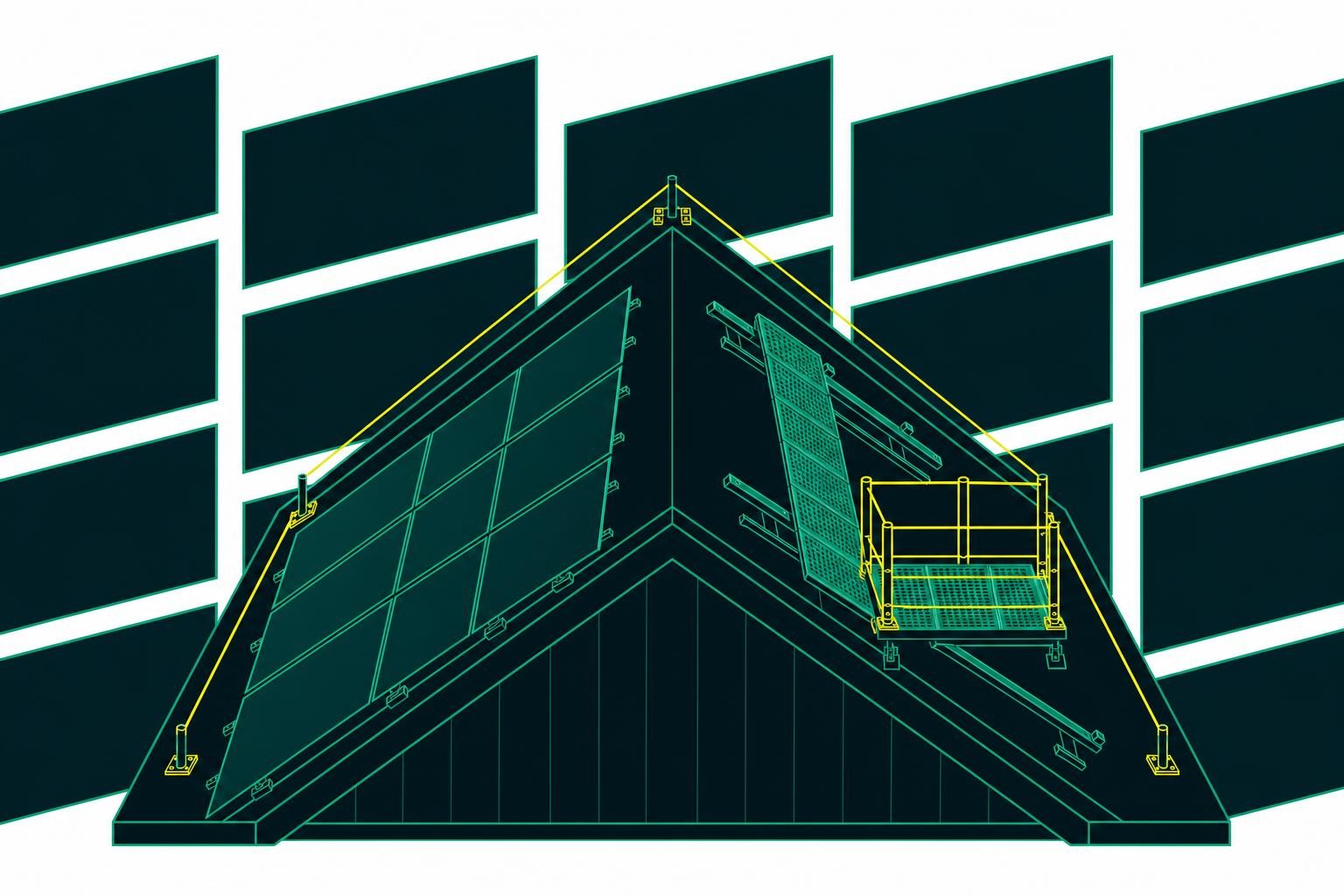
German residential solar installer Enpal and fastening and assembly technology supplier Adolf Würth GmbH & Co. KG announced on 13 October 2026 the joint development of the Roof Access Safety Transport System (RAST), a standardised safety platform designed to reduce fall risk during rooftop PV installations on pitched roofs[1].
What the system does
RAST bundles several protection measures into a single, sequenced installation workflow[1]. Its components include:
- A mobile work platform providing roof access
- Edge protection along the roof perimeter
- Personal fall arrest equipment
- Fixed roof anchor points
- A material lift
- Emergency equipment[1]
The work platform and a walkway along the roof edge give installers a working area the companies describe as comparable to scaffolding, without requiring a full scaffold erection[1]. The system is rated for pitched roofs with eaves heights of up to 8 meters[1].
A central design objective is eliminating ladder use for both access and material transport. "Working without ladders, in particular, will noticeably reduce the risk of accidents," said Martin Umminger, product manager at Würth[1].
Standards and certification
The mobile work platform is claimed by the companies to be the first solution of its kind tested in accordance with DIN EN 13374, the German adoption of European standard EN 13374, which specifies safety and testing requirements for temporary edge protection systems[1].
Testing was conducted in cooperation with DGUV Test, the testing and certification arm of the German Social Accident Insurance[1]. Two statutory accident insurance institutions provided technical input throughout the project:
- BG ETEM, covering the energy, textile, electrical and media industries
- BG BAU, covering the construction sector[1]
The involvement of both bodies is significant. Residential PV installation sits at the intersection of their respective mandates - electricians and energy technicians fall under BG ETEM, while roofwork is BG BAU's domain - and their joint participation gives RAST a cross-sector compliance footing.

Rollout and availability
Enpal plans to introduce RAST through training sessions at its Enpal Academy before integrating the system into its standard installation procedures[1]. No timeline for full deployment was given.
The companies did not disclose the cost of the system or indicate whether it would be made available to third-party installation firms[1]. That question matters for the broader market: if RAST remains proprietary to Enpal's own workforce, its safety impact is bounded by Enpal's installation volume. If Würth - whose distribution network spans professional trades across Europe - eventually offers it commercially, the reach could be considerably wider.
What to watch
The key open question is whether Würth will bring RAST to market beyond Enpal's own operations. Würth's role as a hardware supplier rather than an installer makes a broader commercial release plausible, but neither company has committed to one. The DIN EN 13374 certification gives the platform a credible compliance basis for any such expansion; watch for a product listing in Würth's professional catalogue as a signal that the system is moving from internal tool to commercial offering.
The images and texts on this page were created with the help of AI.
Related
 Markets & Policy
Ofgem opens consultation on how network owners must evidence wider procurement value, closing 5 January 2027
Ofgem published draft guidance on 13 October 2026 setting out how electricity network owners, interconnector developers and offshore hybrid asset developers must justify procurement decisions that trade cost or schedule for wider long-term benefits.
14 Oct 2026 Markets & Policy
Solar Energy Industries Association backs two Georgia PSC Democrats with $250,000 in ad spending ahead of 3 November vote
A SEIA-tied super PAC is spending $250,000 on ads for two Georgia PSC Democrats who, if elected, would hand the commission its first non-Republican majority in roughly three decades.
14 Oct 2026 Storage
Mexico's CFE closes first mixed-investment tender at 7,411 MW, with 1,850 MW of mandated battery storage
Mexico's first CFE mixed-investment tender closed on 5 June 2026, awarding 37 projects totalling 7,411 MW - 114% of target - with 1,850 MW of co-located BESS required under the scheme.
14 Oct 2026