EnerNex says conventional interconnection studies are no longer sufficient for AI mega-campus loads
EnerNex argues that AI training campuses reaching 1,000 MW or more have outgrown traditional power-flow studies, as NERC's May 2026 reliability guideline and a Level 3 alert push EMT analysis to the fore.
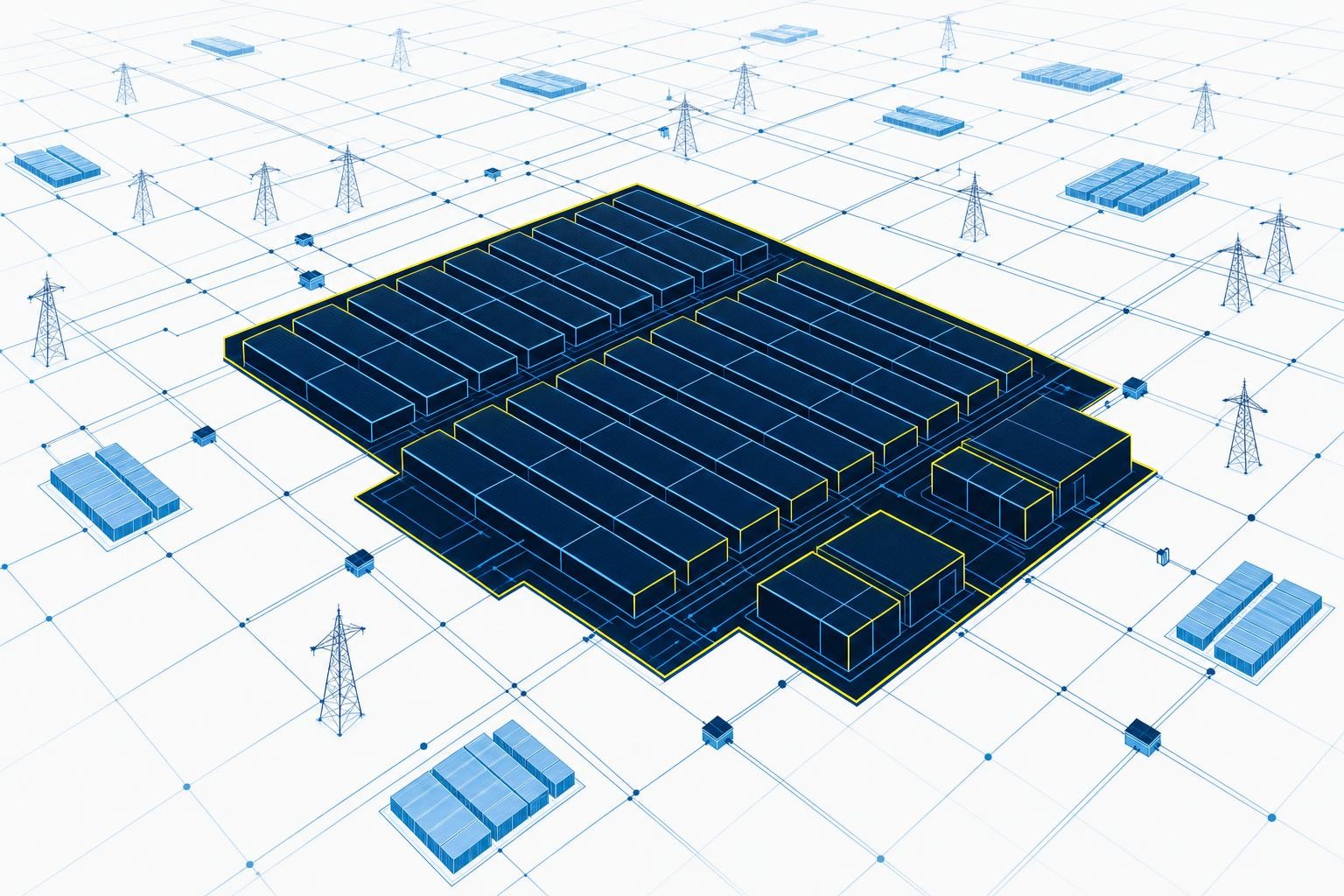
In a piece published 8 September 2026 on Utility Dive, Dave Mueller, VP of Energy System Studies at EnerNex, argued that AI training campuses with proposed loads of 1,000 MW or more represent a new category of grid-connected customer whose electrical behavior has outgrown the planning tools utilities have relied on for decades[1].
What changed about the load
For most of the industry's history, large industrial customers - manufacturing facilities, refineries, early data centers - presented as stable, predictable blocks of demand. Their relatively flat load profiles made conventional interconnection studies sufficient to assess reliability and grid impacts[1]. AI training campuses break that pattern in at least two ways: their scale is an order of magnitude larger than prior data center vintages, and their power draw is neither flat nor slow-moving.
Cyclical AI training workloads have been documented to produce real power oscillations in the electromechanical range of 0.1 to 2 Hz that can interact with natural inter-area and local grid modes. NERC has documented at least one cryptocurrency mining facility oscillation event in ERCOT and one data center event in Dominion territory. The NERC May 2026 Reliability Guideline recommends software mitigations including GPU power smoothing and rack-level energy storage where a load may excite those modes.
The regulatory response
The regulatory framework has moved quickly. On 4 May 2026, NERC issued a rare Level 3 "Essential Actions" Alert after repeated events in which more than 1,000 MW of computational load dropped off the bulk power system in seconds, causing major grid stability issues. Registered entities subject to the alert were required to submit responses by 3 August 2026.
The paired Reliability Guideline - published in May 2026 - goes further. It maps specific recommendations across twelve entity types, from Planning Coordinators and Transmission Planners to the large load entities themselves. Key requirements include:
- Electromagnetic transient (EMT) screening for weak-grid conditions, defined as a short-circuit ratio of two or less
- Small-signal, sub-synchronous, and transient stability studies
- Annual stability studies with explicit load-drop contingencies in planning files
- Triggers for re-study when a project's operational profile changes mid-stream - a provision prompted by documented cases where a facility entered interconnection as a data center and emerged as a cryptocurrency mining operation
NERC's Standards Committee accepted the SAR for Project 2026-02 Computational Loads on 18 March 2026 and appointed a drafting team the same day, targeting a standards filing by 31 December 2026.
Where EMT analysis fits
Traditional positive-sequence dynamic studies remain necessary but are no longer sufficient on their own[1]. EMT models operate at sub-second to second timescales and capture fast electrical switching and uninterruptible power supply behavior - the dynamics that determine whether a data center stays connected during a disturbance. MISO's June 2026 technical compendium on large-load interconnection reliability requirements echoes the same expectation, calling for system-strength screening and electromagnetic transient assessment scaled to facility characteristics and local transmission conditions.
EnerNex, operating as part of CESI Group, is positioning its advanced interconnection study practice around this gap[1]. Mueller's argument is that early EMT engagement - before site control is finalized - reduces schedule risk; treating EMT screening as a downstream activity rather than a gating decision is the mistake utilities and developers are most likely to repeat.
The question to watch is whether NERC's December 2026 standards filing translates the guideline's recommendations into enforceable reliability standards, and how quickly FERC - which committed in April 2026 to acting on large-load interconnection rules under Docket RM26-4-000 - moves to assert federal jurisdiction over a process that has historically been left to states and utilities.
The images and texts on this page were created with the help of AI.
Related
 Renewables
RenewableUK hands out 14 awards at fifth annual Global Offshore Wind ceremony in London
RenewableUK presented 14 awards at the Royal Lancaster London on 13 October 2026, with Ocean Winds, ScottishPower Renewables and RWE among the winners across projects, people and industry priorities.
15 Oct 2026 Renewables
Panasonic's Aquarea N Series brings R454C refrigerant to residential heat pumps ahead of April 2027 European launch
Panasonic has unveiled the Aquarea High-Performance N Series, four air-to-water heat pump models using R454C refrigerant with a GWP of 148, targeting European residential markets from April 2027.
15 Oct 2026 Renewables
UK Energy Secretary Fahnbulleh calls for systemic overhaul, citing grid failures and consumer cost crisis
Speaking at Energy UK's annual conference on 14 October, DESNZ Secretary Miatta Fahnbulleh declared the UK energy system is failing consumers and demanded structural reform beyond piecemeal adjustment.
15 Oct 2026