Electrovaya ties Amazon warrant deal to $280 million purchase threshold, then launches data center BESS two weeks later
Electrovaya signed a warrant-linked commercial agreement with Amazon on 14 July 2026, then launched the ElvaPulse 1500 - a 7 MW, 2.88 MWh containerised BESS - on 30 July, targeting Q2 2027 deliveries.
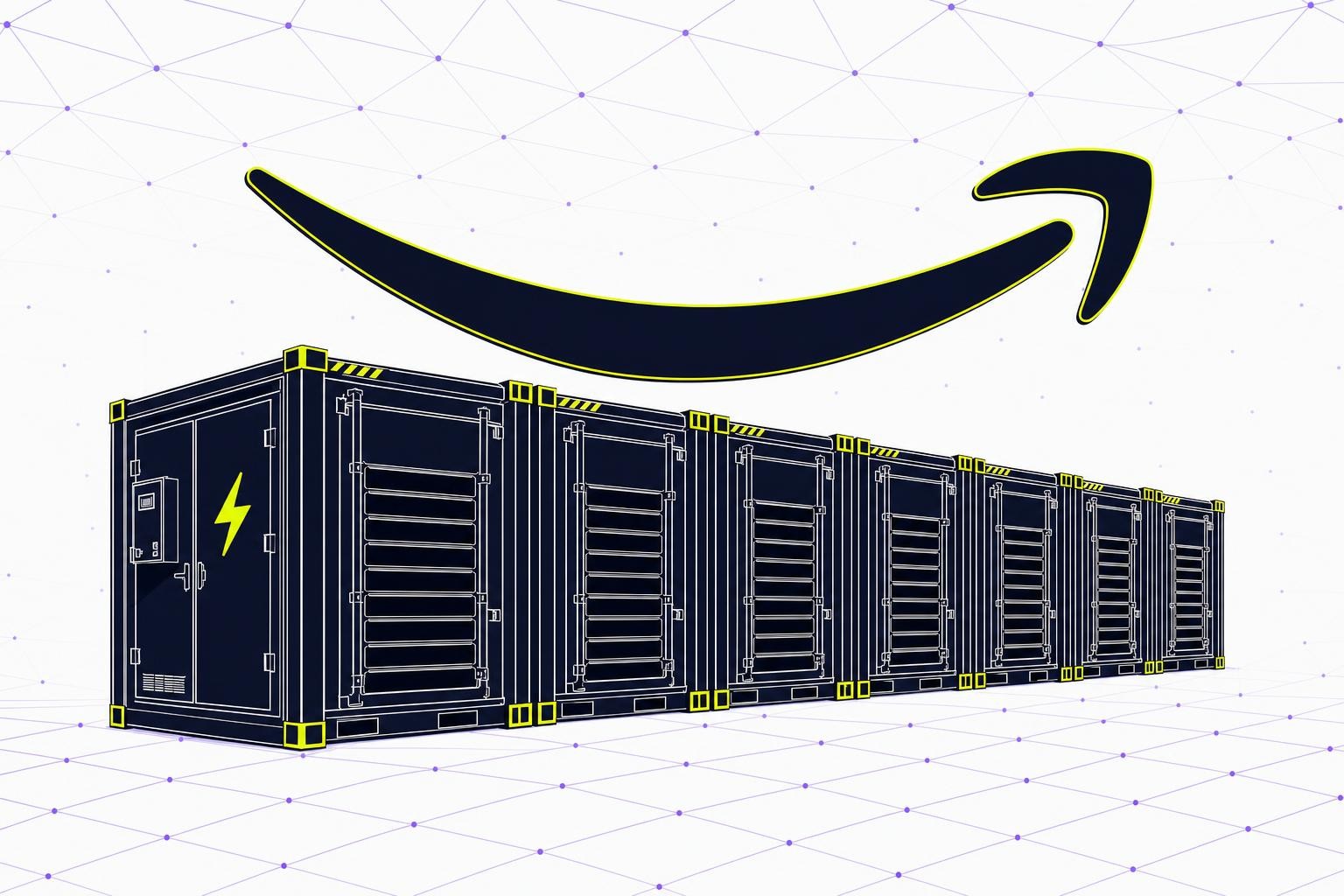
Toronto-based Electrovaya signed a commercial agreement and warrant transaction with Amazon on 14 July 2026, issuing warrants on up to 13,880,345 common shares that fully vest only when Amazon reaches cumulative purchases of $280 million[1]. Two weeks later, on 30 July, the company launched the ElvaPulse 1500 - its first stationary battery energy storage system aimed at the data center market - pairing a named hyperscaler relationship with a new product in the same fortnight.
The warrant structure
Electrovaya entered into the transaction agreement with Amazon on 14 July 2026, covering deployment of Infinity Battery Technology in material handling, robotics, and potential energy-storage applications. Amazon received warrants exercisable on up to 13,880,345 Electrovaya common shares, vesting incrementally as purchase milestones are met, at an exercise price of US$8.56 per share for a ten-year term. A total of 5,545,880 warrants vested immediately when the commercial agreement was executed.
The agreement covers the deployment of Electrovaya's Infinity Battery Technology in material handling operations, with potential expanded engagement in robotics and energy storage. The warrant structure is a performance-linked incentive: Amazon's equity upside scales directly with how much it buys, aligning the two companies' commercial interests without committing Electrovaya to a fixed supply obligation.
What the ElvaPulse 1500 adds
The ElvaPulse 1500 is housed in a 20-foot modular container, delivering up to 2.88 MWh of energy capacity and around 7 MW of continuous power, built around Electrovaya's proprietary ceramic separator technology. The power-to-energy ratio allows the unit to discharge its full rated capacity in under 30 minutes - well above the roughly 2- to 4-hour duration profile of most utility-scale lithium-ion BESS platforms - which Electrovaya believes makes it one of the highest power-density containerised stationary battery systems commercially available.
Electrovaya has initiated certification activities for ElvaPulse 1500 under UL 1973 and UL 9540, with completion currently targeted for the first quarter of 2027. Key commercial parameters:
- First deliveries: Q2 2027 from Jamestown, New York[1]
- Manufacturing site: 52-acre Jamestown campus, 137,000 sq ft planned gigafactory
- Tax credit positioning: designed to support Section 48E ITC domestic content eligibility and FEOC compliance under the One Big Beautiful Bill Act[1]
- Certification path: UL 1973 and UL 9540, targeted Q1 2027
The data center demand context
The International Energy Agency projects data center power demand will more than double by 2030, driven by AI workloads that draw power unevenly, with frequent, large surges that put facility uptime at risk. Electrovaya positions ElvaPulse to complement generators and UPS systems as data center operators face growing power demand from AI infrastructure; battery storage systems in this class are increasingly being used for peak shaving and shorter-duration resilience support alongside those legacy systems.
Electrovaya is developing battery systems that combine its Infinity technology with high-power architectures for data center, industrial, and logistics applications, and views the segment as a growth opportunity as AI infrastructure buildout accelerates.
The sequence to watch is whether the Amazon relationship - currently anchored in material handling - migrates toward energy storage applications before or after ElvaPulse 1500 clears UL certification in early 2027. The company is already in active discussions with hyperscale and energy developers on ElvaPulse deployments and is accepting production reservations now. How quickly those reservations convert to firm orders will indicate whether the product launch has real demand behind it or is running ahead of the market.
The images and texts on this page were created with the help of AI.
Related
Ready-to-build BESS projects lose their premium as Australia's NEM arbitrage spreads collapse 85%
Panellists at the Battery Asset Management Summit Australia 2026 said the venture-capital-style returns that once rewarded ready-to-build BESS projects have disappeared as NEM price spreads fell 85% in a year.
10 Sept 2026UK government opens three-month consultation on AI for clean energy, backed by 34-recommendation network review
DESNZ published its Vision for an AI-enabled clean energy system on 8 September, opening a call for evidence that closes 6 November and will feed into the UK's first AI for Clean Energy Strategy.
10 Sept 2026Heatwaves expose a three-layer risk for wind operators: resource, hardware, and people
Extreme heat cuts wind output, stresses nacelle components, and grounds maintenance crews - all at once. A look at how bad the summer of 2026 has been, and what the trend means for grid reliability.
10 Sept 2026