Trane argues data centre cooling must shift from static design to engineered flexibility as AI rack densities surge
AI rack densities have more than doubled in a year, making fixed cooling designs obsolete. A new Trane analysis sets out why thermal infrastructure must be built to adapt.
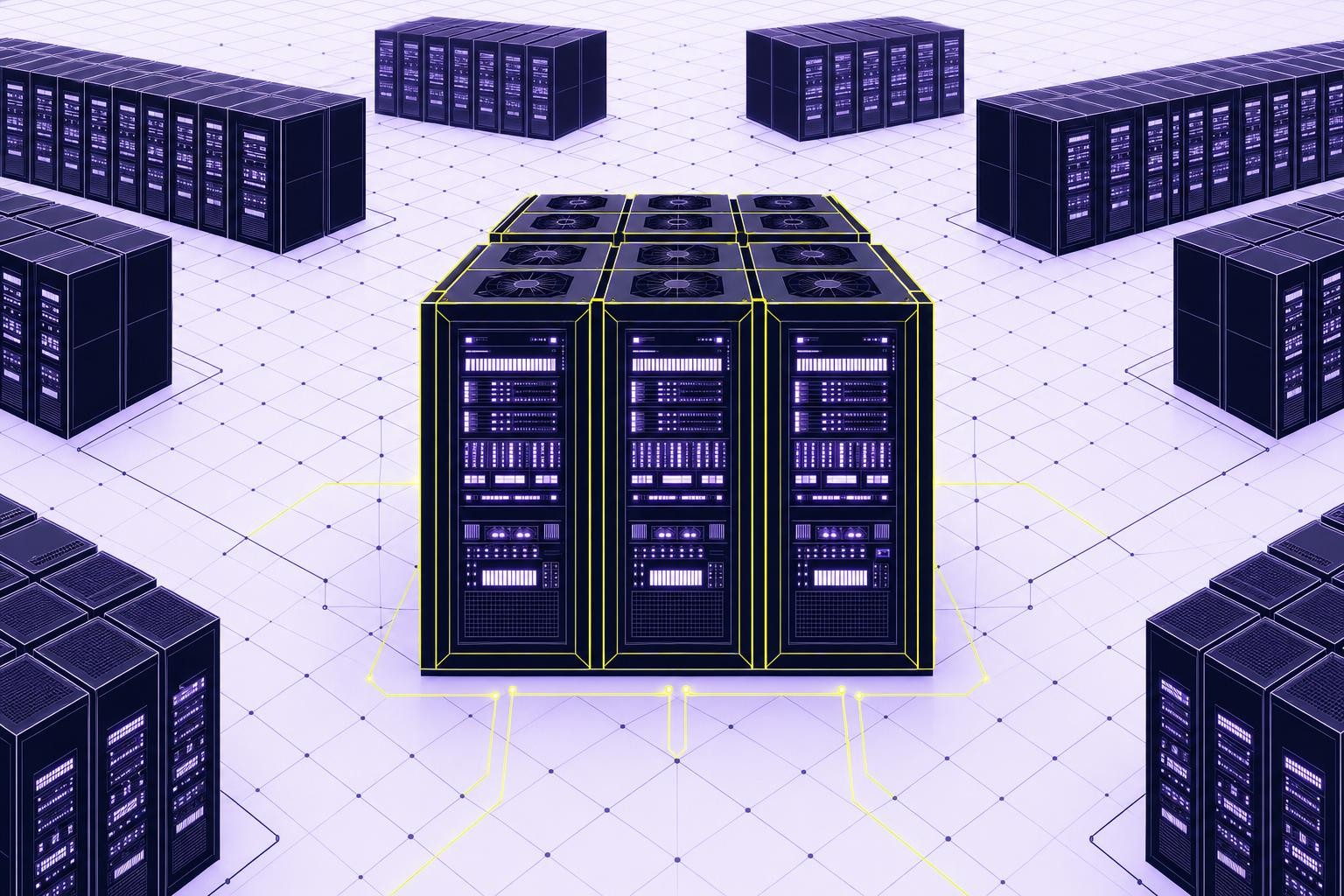
A new analysis published by Trane through Data Center Dynamics argues that the data centre industry can no longer treat cooling as a static, point-in-time engineering decision[1]. With AI workloads reshaping heat loads faster than most facilities were designed to absorb, the paper makes the case for what it calls "engineered flexibility" - thermal infrastructure built to adapt rather than to optimise for a single, assumed operating point[1].
The density problem is moving faster than facilities can respond
The numbers behind the argument are stark. Average rack density across the industry rose from approximately 16 kW in 2025 to 27 kW in 2026, yet only one in five operators report being prepared to support the 50-70 kW racks now common in AI deployments. Forecasts put average densities near 40 kW within a few years, and the newest GPU systems - Nvidia's Vera Rubin platform - can push individual rack requirements to 246 kW.
Global data centre electricity demand is projected to reach approximately 132 GW in 2026, climbing toward 290 GW by 2030, driven largely by AI-optimised servers. That trajectory means the thermal problem compounds: more facilities, running hotter, for longer.
Air cooling becomes physically inadequate above roughly 30-40 kW per rack. Beyond that threshold, air cannot move fast enough to extract heat without consuming disproportionate energy. The consequence is that a facility designed for conventional enterprise workloads - typically 10-20 kW per rack - faces a structural mismatch the moment it takes on AI inference or training loads.
What engineered flexibility means in practice
The Trane framing is not a call to rip out existing infrastructure[1]. It is closer to a design philosophy: build cooling systems that can accommodate air, hybrid, and liquid architectures as requirements evolve, rather than locking in a single method at commissioning.
For brownfield operators - the majority of those deploying AI capacity today - that translates into a set of incremental retrofit options:
- Rear-door heat exchangers (RDHx): Mounted on the back of existing racks, these transfer heat from exhaust air into a closed chilled-water loop. Systems such as Motivair's ChilledDoor can cool up to 72 kW per rack without requiring changes to server internals.
- Direct-to-chip (cold plate) cooling: Coolant circulates directly over CPUs and GPUs via cold plates, offering precise thermal control for the highest-density AI clusters. Deployable at rack or row level using a Coolant Distribution Unit (CDU).
- Liquid-to-air exchangers: For sites without access to facility water, self-contained liquid loops reject heat locally to air - a bridge technology that extends the life of constrained brownfield sites.
- Phased, modular execution: Rack-by-rack or pod-by-pod deployment lets hybrid air and liquid environments coexist during transition, reducing capital risk and avoiding live-site disruption.
A retrofit from air to liquid cooling typically raises capital expenditure by 10-15% but can cut operational expenditure by more than 30% over a five-year horizon, according to infrastructure modelling published in academic literature on data centre management. For operators constrained by fixed utility allocations, every megawatt freed from cooling overhead can support additional AI workloads without waiting years for new grid capacity.
Brownfield modernisation does not have to begin at campus scale. Modular approaches — adding liquid-cooled capacity at rack, row, or pod level while retaining conventional infrastructure elsewhere — let operators spread capital and build operational expertise before committing to a full transition.
The grid dimension
Cooling flexibility has a second-order effect that is increasingly relevant to power planners. Cooling systems can provide operational flexibility without immediately affecting computing workloads, supporting load balancing and other grid services through coordinated control and inherent thermal inertia. Research published in 2026 describes this as treating cooling infrastructure as a "flexible thermal battery" - pre-cooling during periods of renewable abundance and shedding load during grid stress.
That framing matters for hyperscalers and colocation operators navigating large-load tariffs and interconnection queues. A facility whose cooling load can flex in response to grid signals is a more attractive grid participant than one locked into a fixed thermal setpoint.
What to watch
Goldman Sachs forecasts that 76% of all AI servers will run on liquid cooling by end-2026, up from 15% in 2024 - a pace that places liquid cooling on track to become the default for new AI infrastructure within this budget cycle. The near-term test is whether the industry's engineering and procurement pipelines can keep up: liquid cooling deployments require piping, pumps, heat exchangers, monitoring systems, facility modifications, and revised maintenance procedures, and the talent to operate them remains scarce. Operators who treat cooling as a strategic variable - rather than a fixed cost - will be better positioned to absorb the next generation of GPU hardware without waiting for a greenfield build.
The images and texts on this page were created with the help of AI.
Related
 Markets & Policy
Ofgem opens consultation on how network owners must evidence wider procurement value, closing 5 January 2027
Ofgem published draft guidance on 13 October 2026 setting out how electricity network owners, interconnector developers and offshore hybrid asset developers must justify procurement decisions that trade cost or schedule for wider long-term benefits.
14 Oct 2026 Markets & Policy
Solar Energy Industries Association backs two Georgia PSC Democrats with $250,000 in ad spending ahead of 3 November vote
A SEIA-tied super PAC is spending $250,000 on ads for two Georgia PSC Democrats who, if elected, would hand the commission its first non-Republican majority in roughly three decades.
14 Oct 2026 Storage
Mexico's CFE closes first mixed-investment tender at 7,411 MW, with 1,850 MW of mandated battery storage
Mexico's first CFE mixed-investment tender closed on 5 June 2026, awarding 37 projects totalling 7,411 MW - 114% of target - with 1,850 MW of co-located BESS required under the scheme.
14 Oct 2026