AI is both the grid's biggest new problem and one of its most promising tools
AI data centres drove a 50% surge in electricity consumption in 2025 and are triggering a gas-plant buildout that could lift US power sector emissions by up to a third. The same technology is also cutting curtailment and improving dispatch. Grid professionals need both sides of the ledger.
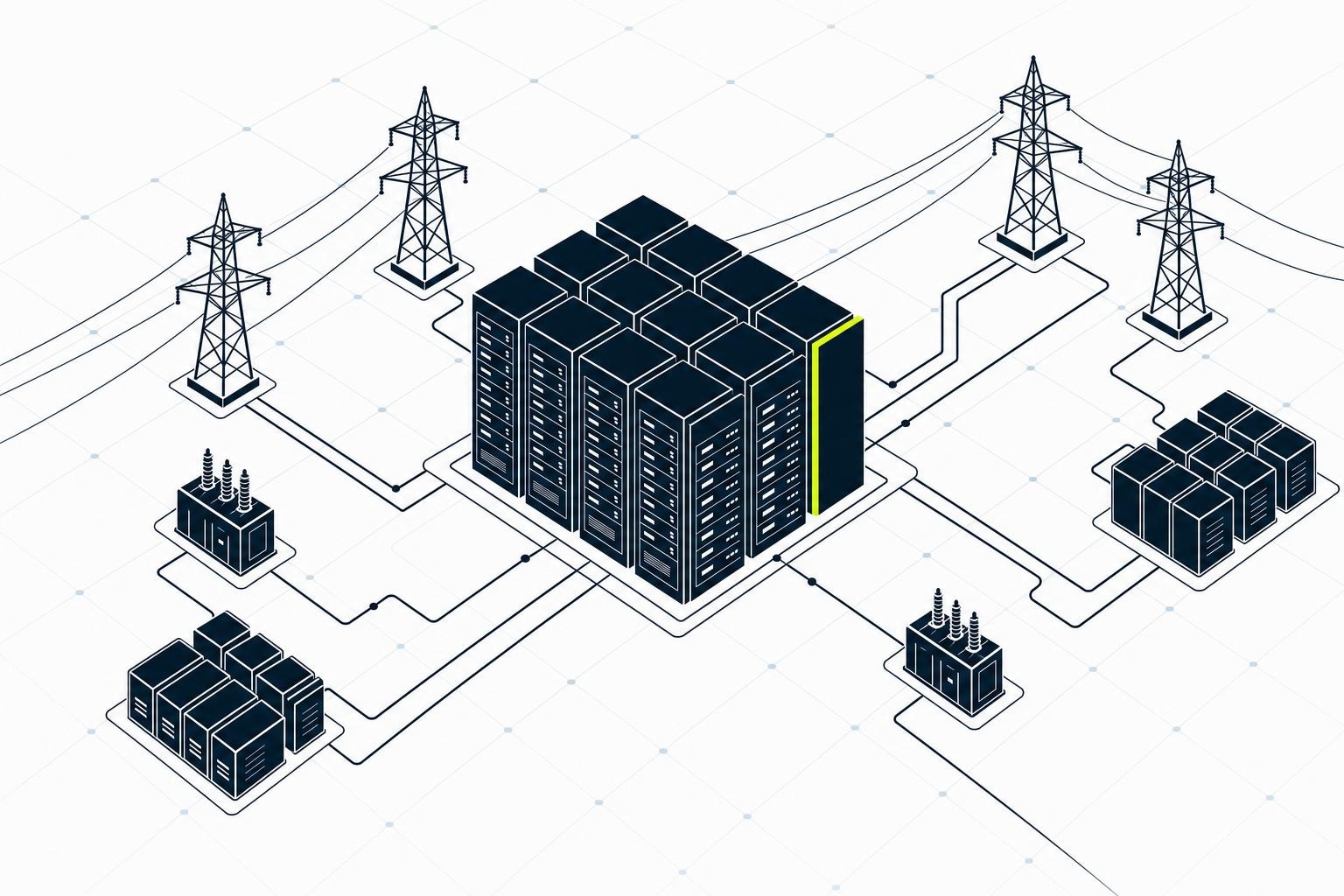
A debate that once seemed settled has reopened. When the current AI race began, the dominant narrative was that machine learning would accelerate the clean energy transition - smarter forecasting, faster materials discovery, more efficient dispatch. By 2025, electricity consumption from AI-focused data centres had surged 50% in a single year, and the narrative had inverted: AI is now widely framed as a climate liability[1]. The truth, as MIT professor and Climate Change AI co-founder Priya Donti argued this week on Latitude Media's Open Circuit, sits somewhere between those poles - but for grid operators, the specific numbers matter more than the framing[1].
The load problem is real and accelerating
Global data centre electricity consumption grew 17% in 2025, well above the 3% growth in overall global electricity demand, according to the IEA's updated analysis. The IEA projects consumption from data centres will roughly double from 485 TWh in 2025 to around 950 TWh by 2030, with AI-focused facilities tripling their draw over the same period.
NERC's 2025 Long-Term Reliability Assessment is unambiguous about what is driving that growth: new data centres for AI and the digital economy account for most of the projected increase in North American electricity demand over the next ten years. The regulator has since escalated its concern. In May 2026, NERC issued a Level 3 alert - its highest - over reliability risks from computational loads, after events in which:
- More than 1,000 MW of AI training load dropped from the bulk power system in seconds
- Sudden disconnections unfolded faster than conventional operators could respond
- A 230 kV transmission fault in the Eastern Interconnection coincided with roughly 1,500 MW of data-centre load reduction
Five major North American regions - ERCOT, MISO, PJM, SPP, and WECC-NW - are now flagged as high risk of resource inadequacy within five years, up from zero high-risk regions the prior year, with data centre growth in several balancing-authority footprints projected to exceed 120% by 2027.
The gas buildout is the emissions story
The grid stress is translating directly into new fossil fuel infrastructure. EIA filings as of August 2026 show plans for 60.4 GW of additional gas capacity by end of 2030, up 44% from the 41.8 GW forecast in December 2025. A Bloomberg analysis of 99 planned behind-the-meter gas plants - projects built on-site to bypass the interconnection queue - found that those plants could emit roughly 318 million metric tons of CO₂ annually, lifting US power sector emissions by 20% at industry-average utilisation rates, or as much as a third at full capacity.
The hyperscalers' own disclosures confirm the direction of travel. Microsoft reported a 27% jump in emissions in its latest fiscal year; Google's were nearly 81% above its 2019 baseline.
The 2019 paper co-authored by Donti and more than twenty leading researchers - "Tackling Climate Change with Machine Learning" - explicitly warned that machine learning is not a silver bullet and that it can also be applied in ways that make climate change worse. That caveat has aged poorly as a caution and well as a prediction.
Where AI is working on the other side of the ledger
Behind the demand shock, AI is also being deployed across grid operations with documented results:
- Wind dispatch: Google DeepMind's wind forecasting system, predicting output 36 hours ahead, increased the commercial value of 700 MW of US wind power by approximately 20% by enabling advance capacity commitments rather than spot-market sales.
- Balancing costs: The UK National Grid ESO deployed an AI platform on Microsoft Azure to manage wind volatility, improving wind forecasting accuracy to 97.2% and cutting grid balancing costs by an estimated £420 million annually.
- Curtailment: AI dispatch and forecasting systems have demonstrated renewable curtailment reductions of 30-50% in high-penetration grids, according to multiple operational reviews. IRENA has specifically identified AI-based forecasting as a key tool for curtailment reduction.
- Demand forecasting: Elia Group, the Belgian TSO, reports that AI demand forecasting reduces forecast error by 30% compared to traditional statistical models, directly lowering operating reserve requirements.
What the grid desk should watch
The tension Donti identified in 2019 - AI as tool versus AI as accelerant - has become a live operational problem for transmission planners. The interconnection queue is the pressure point: PJM projects a 56 GW rise in summer peak demand by 2035, largely driven by data centres; ERCOT projects growth from 94.7 GW in 2026 to 154.1 GW in 2035, including 23 GW of data centre load. Behind-the-meter gas plants are partly a response to queue delays - developers bypassing a system that cannot process their requests fast enough.
The near-term watch items are FERC's show-cause orders requiring six major ISO/RTOs to justify or reform their large-load tariff provisions, and whether NERC's Level 3 essential actions produce measurable changes in how computational loads model and report their grid behaviour. The longer-term question - whether AI-enabled grid optimisation can offset AI-driven load growth - remains genuinely open.
The images and texts on this page were created with the help of AI.
Related
 Renewables
RenewableUK hands out 14 awards at fifth annual Global Offshore Wind ceremony in London
RenewableUK presented 14 awards at the Royal Lancaster London on 13 October 2026, with Ocean Winds, ScottishPower Renewables and RWE among the winners across projects, people and industry priorities.
15 Oct 2026 Renewables
Panasonic's Aquarea N Series brings R454C refrigerant to residential heat pumps ahead of April 2027 European launch
Panasonic has unveiled the Aquarea High-Performance N Series, four air-to-water heat pump models using R454C refrigerant with a GWP of 148, targeting European residential markets from April 2027.
15 Oct 2026 Renewables
UK Energy Secretary Fahnbulleh calls for systemic overhaul, citing grid failures and consumer cost crisis
Speaking at Energy UK's annual conference on 14 October, DESNZ Secretary Miatta Fahnbulleh declared the UK energy system is failing consumers and demanded structural reform beyond piecemeal adjustment.
15 Oct 2026