Private capital unlocks Boralex's 8.3 GW wind and renewables pipeline after C$9 billion take-private closes
Brookfield and La Caisse completed their C$9 billion acquisition of Boralex on 14 August 2026. Here is what private ownership means for the developer's 8.3 GW wind and renewables pipeline.
Baseload News reported the mechanics of the Boralex deal close on 15 August: Brookfield and La Caisse completed their C$9 billion acquisition on 14 August 2026, paying C$37.25 per share in cash, with TSX delisting expected on or about 17 August[1]. What that wire item did not cover is what the ownership change means for Boralex as a wind and renewables developer - and why the deal structure matters for the pipeline behind it.
The asset base and the pipeline
Boralex's installed capacity reached 3,783 MW as at 31 March 2026, more than 50% higher than five years earlier. Behind that operating base sits a development and construction pipeline of 8.3 GW across wind, solar and battery storage projects. Executing that pipeline requires sustained capital deployment at a scale that quarterly earnings cycles and public market sentiment make difficult to sustain.
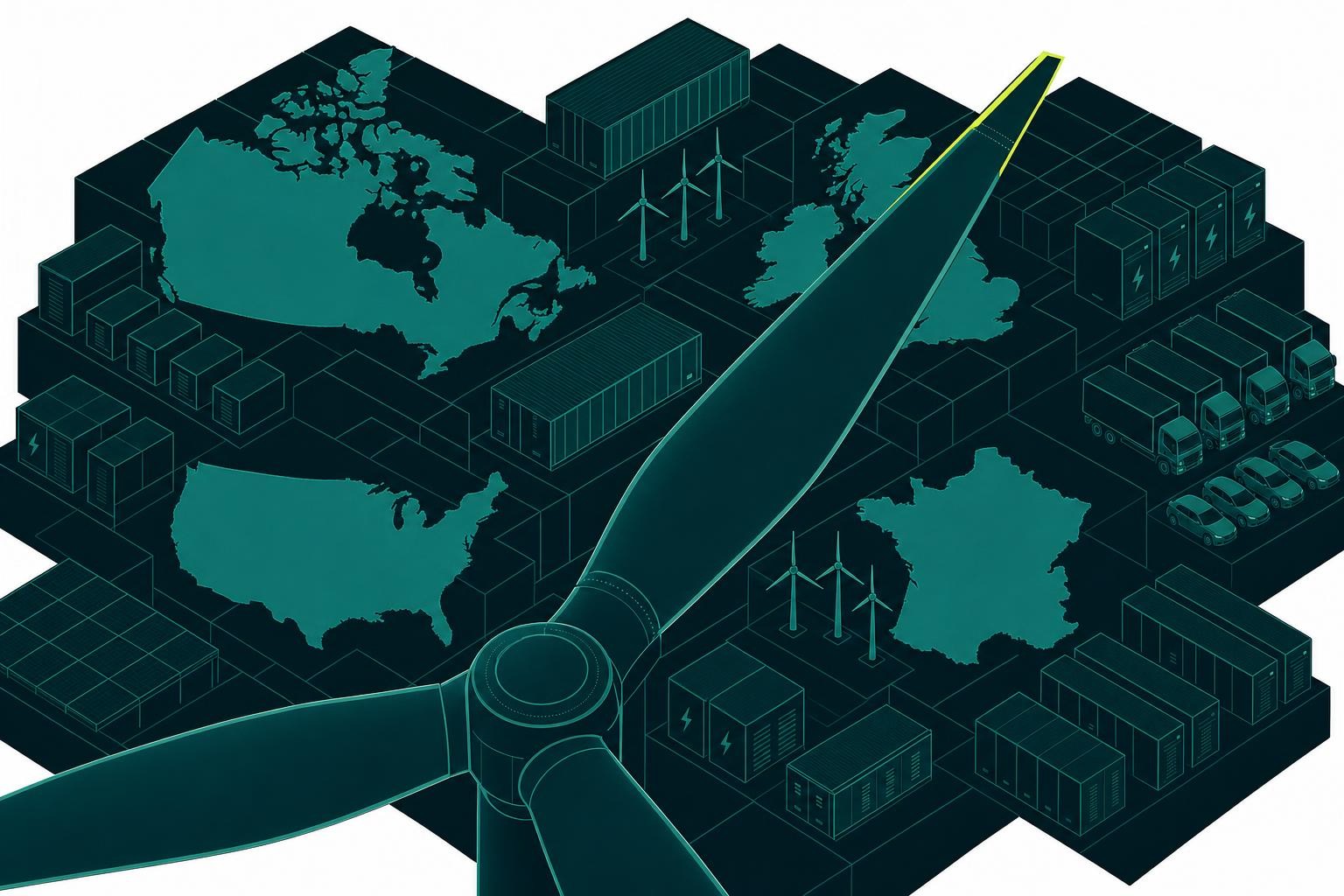
The company's geographic footprint spans four markets:
- Canada - its home market and the largest share of operating capacity
- France - where Boralex is the largest independent producer of onshore wind power
- United States - development-stage projects
- United Kingdom - early-stage development
What private ownership changes
The deal was priced at 13 times 2026 consensus EBITDA on a combined enterprise value basis, a multiple that reflects the contracted nature of the portfolio. Substantially all of Boralex's operating assets are subject to indexed fixed-price energy sales contracts - the kind of long-duration, inflation-linked cash flow that infrastructure funds are built to hold.
Post-transaction, La Caisse will increase its ownership from approximately 15% to 30%, while Brookfield will hold the remaining 70%. Brookfield's institutional partners in the acquisition include Brookfield Renewable Partners.
The structural shift matters most for project finance. In June 2026, while the deal was still pending regulatory clearance, Boralex and its French co-shareholder Energy Infrastructure Partners closed a €1.45 billion single platform-level financing covering Boralex's entire French operations - described at the time as one of the largest debt packages for a renewable energy platform in Europe that year. The transaction moved Boralex from a multi-borrower debt structure to a single platform financing, providing enhanced flexibility to support its strategy in France centred around growth, efficiency and long-term differentiation. That refinancing, completed before the take-private closed, signals the direction of travel: consolidating project-level debt into platform-level structures that are easier to manage and cheaper to service at scale.
The broader context
Boralex's shares had declined along with other renewable-energy players due to a combination of supply constraints, cost inflation, elevated interest rates and US policy uncertainty. The C$37.25 offer represented a 31.8% premium to the 20 March 2026 closing price and a 36.4% premium to the 30-day volume-weighted average price. The gap between intrinsic asset value and depressed public market pricing is precisely the arbitrage that infrastructure funds have been exploiting across the sector.
In June 2025, Boralex announced plans to invest as much as C$6.8 billion to more than double its output, with a pipeline of 1,600 MW of advanced-stage development projects and an additional 5,600 MW of mid- and early-stage projects. Executing that plan without the constraints of public market reporting - and with Brookfield's balance sheet behind it - is the core rationale for the deal.
What to watch: whether Boralex accelerates permitting and construction activity in France and Canada in the second half of 2026, and whether the platform financing model it used in France is replicated in other markets once the company is fully private.
The images and texts on this page were created with the help of AI.
Related
 Markets & Policy
Global aluminum deficit widens as Middle East smelter damage opens a window for US production - if Oklahoma's power contract closes
Middle East smelter strikes and Hormuz disruptions have pushed the 2026 global aluminum deficit toward 4 Mt, creating a demand window for US producers - but the Oklahoma greenfield project still needs a power deal.
16 Aug 2026 Markets & Policy
UC Santa Cruz and UCSB study in Science finds EV manufacturing debt repaid within three years across most U.S. grid regions
A study in Science by Campbell and Geyer finds that replacing a working gas car with an EV cuts 16-year lifecycle emissions by up to 58%, with the manufacturing carbon debt offset in roughly three years.
16 Aug 2026 Storage
ESS Tech's Q2 net loss widens 41% to $15.6 million as cash falls to $5.6 million and going concern doubt emerges
ESS Tech reported a $15.6M Q2 2026 net loss and near-zero revenue on 11 August, disclosed going concern doubt, and signed a non-binding $515M business combination LOI alongside its sodium-ion pivot.
16 Aug 2026