BPA dispatcher warns WECC-1 remedial scheme is blind to south-to-north flows on the California-Oregon Intertie
Speakers at the 18 August CAISO-SPP Market Seams workshop flagged that the Western Interconnection's primary automated protection scheme was designed for a grid that no longer exists.
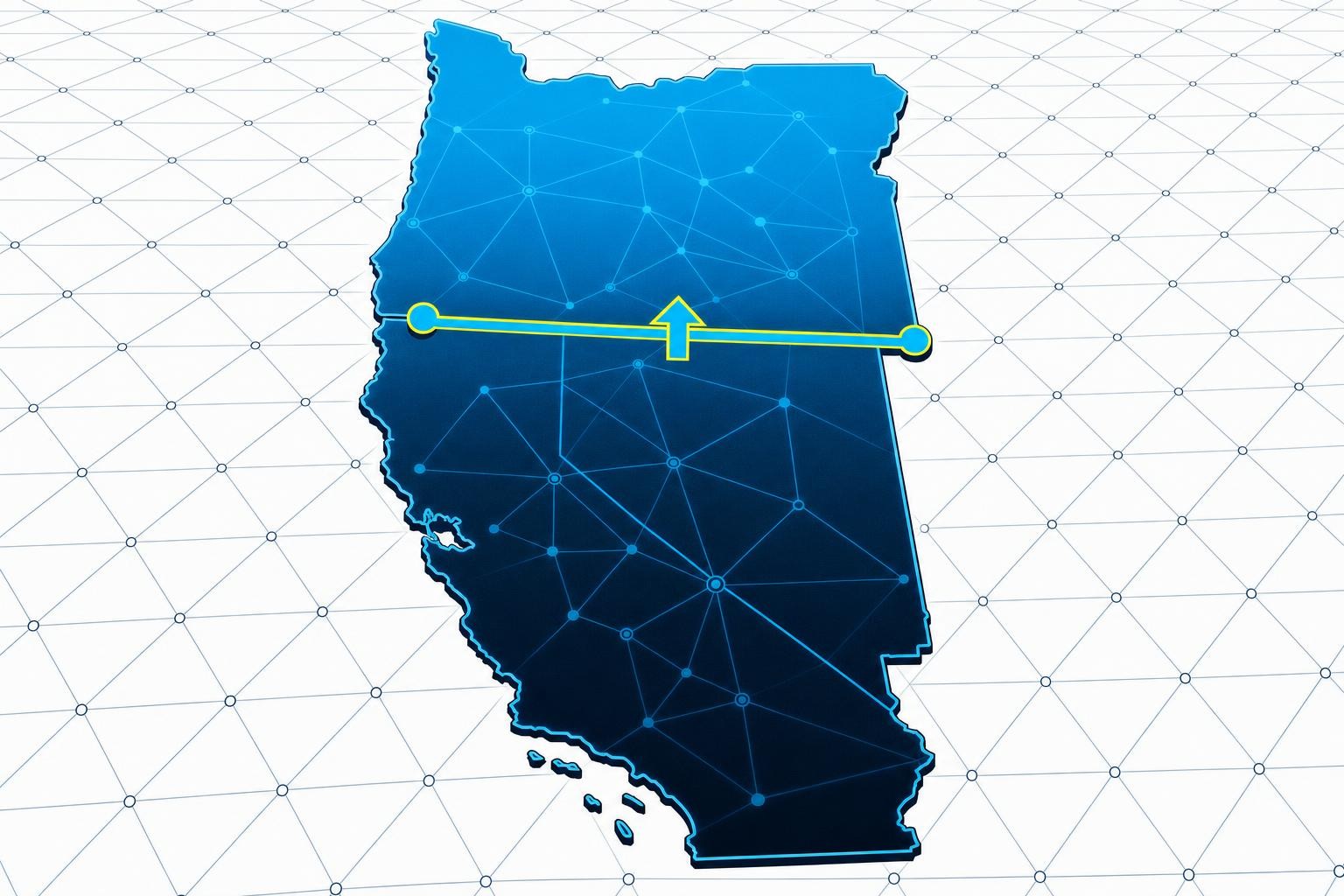
Speakers at the 18 August 2026 CAISO-SPP Market Seams workshop warned that the Western Interconnection's primary automated protection scheme - WECC-1 RAS - was designed around north-to-south power flows and has not been updated to reflect a grid that is increasingly running in reverse[1].
The specific concern
The WECC-1 Remedial Action Scheme is the automated response that splits the Western Interconnection along its north-south boundary to protect grid stability under certain contingencies. The scheme was built for an era when hydropower from the Pacific Northwest flowed south to California. That assumption is eroding.
"If we had a triple line loss on [the California-Oregon Intertie], God forbid, with 3,600 MW flowing south-to-north, I don't think California is prepared to deal with the loss of 3,600 MW of load," said Bonneville Power Administration system dispatcher Chris Sanford at the workshop[1]. He added that the Pacific Northwest would face an equally difficult problem absorbing the sudden loss of 3,600 MW of generation. "We still haven't solved that problem. Honestly, I don't even think we're looking at it."[1]
The California-Oregon Intertie (Path 66) has a rated capacity of approximately 4,800 MW from north to south and 3,675 MW from south to north, making the asymmetry in the protection scheme a material gap as solar-heavy California increasingly exports surplus midday generation northward.
Portland General Electric's manager of transmission operations engineering, Sanman Rokade, raised a related problem: data standardization. Operators on either side of a seam need to be certain they are studying the same constraint using the same inputs[1]. Without that assurance, co-optimization across market boundaries is unreliable regardless of what the market rules say.
Why flows are reversing
The driver is straightforward. California's solar build has pushed the Western Interconnection toward south-to-north flow conditions during high-generation midday periods, a significant reversal from historical precedent[1]. Portland General Electric's own 2026 annual progress report to WECC identifies infrastructure upgrades in the Beaverton-Hillsboro area specifically to address overloads caused by south-to-north flows resulting from increased solar dispatch out of California.
WECC's Western Assessment of Resource Adequacy projects roughly 20% demand growth across the Western Interconnection over the next decade, with peak load rising from approximately 164 GW in 2025 to nearly 193 GW by 2034, and roughly 177 GW of new generation planned - 90% inverter-based. That trajectory will intensify the flow reversal problem, not moderate it.
The market context
The 18 August workshop was the second in a four-part series jointly hosted by CAISO and Southwest Power Pool (SPP) in response to a FERC directive on western seams coordination. The series is running as the Western Interconnection undergoes its most significant market restructuring in decades:
- CAISO's Extended Day-Ahead Market (EDAM) launched on 1 May 2026 with PacifiCorp as its first participant, extending day-ahead optimization across a broader western footprint for the first time.
- Portland General Electric is scheduled to join EDAM in October 2026, with additional entities following in 2027 and beyond.
- SPP's competing Markets+ framework is targeting a 2027 launch, and its Inter-Market Optimization mechanism - designed to enable 5-minute economic transfers across market seams - is targeting 2028 deployment.
- EDAM and WEIM participants received more than $470 million in gross benefits in Q2 2026, the first full quarter of EDAM operations.
CAISO's own framing of the seams challenge is unambiguous: the West is moving from a transaction-based to a flow-based operating paradigm, and market-to-market coordination mechanisms address only a subset of the problem - they do not eliminate the effects of fragmented market configuration.
What to watch
CAISO and SPP have two more workshops in the series before the end of 2026. The immediate question is whether the WECC-1 RAS review Sanford flagged gets formally scoped - and by whom. The scheme sits under WECC's reliability standards process, not the market seams process, which means the two workstreams could run in parallel without ever directly addressing the gap. Stakeholder design alignment on SPP's Inter-Market Optimization is due in late 2026; whether that timeline holds will be an early indicator of how seriously the seams coordination effort is being taken.
The images and texts on this page were created with the help of AI.
Related
Ready-to-build BESS projects lose their premium as Australia's NEM arbitrage spreads collapse 85%
Panellists at the Battery Asset Management Summit Australia 2026 said the venture-capital-style returns that once rewarded ready-to-build BESS projects have disappeared as NEM price spreads fell 85% in a year.
10 Sept 2026UK government opens three-month consultation on AI for clean energy, backed by 34-recommendation network review
DESNZ published its Vision for an AI-enabled clean energy system on 8 September, opening a call for evidence that closes 6 November and will feed into the UK's first AI for Clean Energy Strategy.
10 Sept 2026Heatwaves expose a three-layer risk for wind operators: resource, hardware, and people
Extreme heat cuts wind output, stresses nacelle components, and grounds maintenance crews - all at once. A look at how bad the summer of 2026 has been, and what the trend means for grid reliability.
10 Sept 2026