Utilities are tracking quantum computing as a load type they have never planned for before
EPRI, Duke Energy, and Schneider Electric are pushing utilities to embed quantum computing in infrastructure planning now - before the load arrives and catches them flat-footed, as AI did.
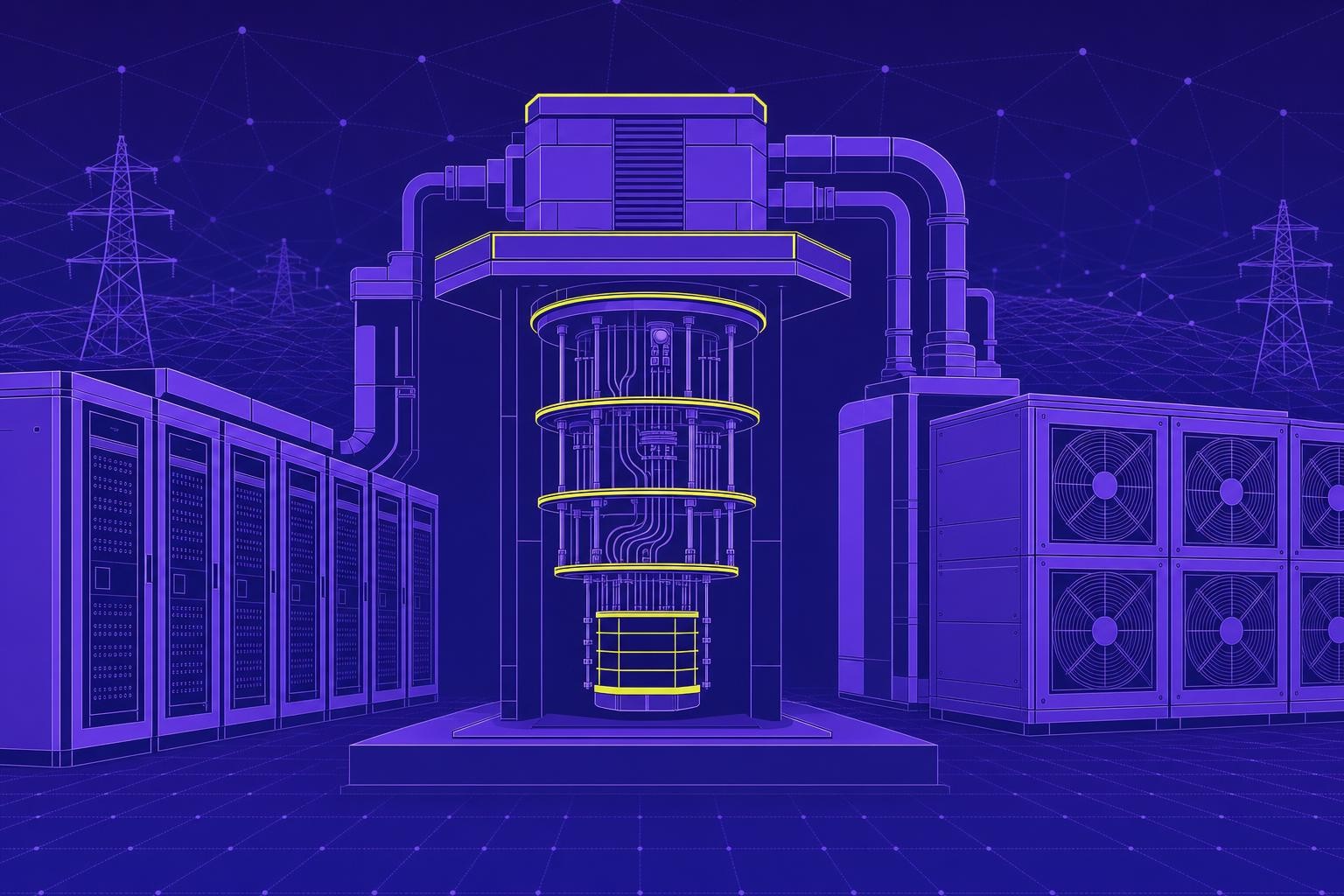
The U.S. power sector is trying to avoid repeating the AI mistake with quantum computing: waiting until the load is already at the fence before asking how to serve it. EPRI, Duke Energy, and Schneider Electric are among the organisations now pressing utilities to treat quantum computing as a planning variable, not a future curiosity, according to a 14 August 2026 report in Utility Dive.[1]
A load profile unlike anything in the planning stack
The core concern is not the scale of quantum demand - that remains uncertain - but its character. Quantum computers require 24/7 cryogenic cooling to near absolute zero, layered on top of incremental workflow loads, a combination that produces a load shape with no classical analogue in utility planning models.[1] "The load profile is different from anything utilities have planned for before," said Aparna Prabhakar, chief strategy and sustainability officer for energy management at Schneider Electric.[1]
That cooling requirement is the key distinction from conventional data centers. Research published in IEEE Transactions on Sustainable Computing found that in quantum data centers, the energy required for cooling far exceeds the energy consumed by computation itself, and that cooling loads are sensitive to the underlying computational architecture - meaning the power draw can shift depending on qubit type and system design. Superconducting qubits, the dominant commercial approach, operate at roughly 15 millikelvin, demanding refrigeration systems that dwarf the processors they serve.
Prabhakar's prescription is direct: planners must "build smarter infrastructure" because adding substations alone will not address this load profile.[1] Software-defined power systems that let utilities see and orchestrate new loads in real time are part of the answer, she said.[1]
The AI lesson, applied early
Today's utility work on quantum computing has one key goal: to avoid being left scrambling to address quantum's impact on electricity demand and its load profile, as the power sector was with artificial intelligence.[1] The framing is explicit. Utilities must track quantum developments and translate them into infrastructure decisions "inside the planning process," Prabhakar said, even while the ultimate scale of demand remains unknown.[1]
Jeremy Renshaw, EPRI's director of open power AI and quantum, put the timeline bluntly: quantum is coming, and it is coming fast.[1] He drew a parallel to drones, cloud computing, and AI - each dismissed as hypothetical a decade before becoming routine.[1] For the subset of problems where quantum holds an advantage, such as large-scale optimisation and materials science, Renshaw said it offers "polynomial or even exponential speedup" over classical approaches.[1]
For Duke Energy, the central uncertainty is timing: specifically, when large-scale, fault-tolerant, economically viable quantum systems will be available to support planning and dispatch optimisation.[1] Hardware scalability, error correction, software tooling, and algorithm maturity all remain active research areas, Duke's team noted.[1]
What to watch
ARPA-E's $6.2 million ENCODE programme - the first DOE project focused on quantum methods for grid optimisation - is now under contract, with EPRI and ComEd among the collaborators. EPRI is also running a 2026 Cyber Quantum Challenge to develop quantum-resistant and quantum-enabled cybersecurity solutions for electric power systems. The near-term signal to watch is whether any utility files a quantum load study or interconnection request - that would mark the shift from planning exercise to infrastructure commitment.
Quantum computing's grid impact is a two-sided question: it may add a novel cryogenic load to the system, but it also offers potential tools for dispatch optimisation, cybersecurity hardening, and materials discovery that could reduce overall grid complexity. Utilities tracking only the demand side are missing half the picture.
The images and texts on this page were created with the help of AI.
Related
Ready-to-build BESS projects lose their premium as Australia's NEM arbitrage spreads collapse 85%
Panellists at the Battery Asset Management Summit Australia 2026 said the venture-capital-style returns that once rewarded ready-to-build BESS projects have disappeared as NEM price spreads fell 85% in a year.
10 Sept 2026UK government opens three-month consultation on AI for clean energy, backed by 34-recommendation network review
DESNZ published its Vision for an AI-enabled clean energy system on 8 September, opening a call for evidence that closes 6 November and will feed into the UK's first AI for Clean Energy Strategy.
10 Sept 2026Heatwaves expose a three-layer risk for wind operators: resource, hardware, and people
Extreme heat cuts wind output, stresses nacelle components, and grounds maintenance crews - all at once. A look at how bad the summer of 2026 has been, and what the trend means for grid reliability.
10 Sept 2026