Trane and Eaton release joint medium-voltage reference design for AI data centers, claiming 15% efficiency gain
Trane Technologies and Eaton published a joint medium-voltage reference design on 17 August 2026, promising 15% energy efficiency gains and 30% lower installation costs for AI data centers.
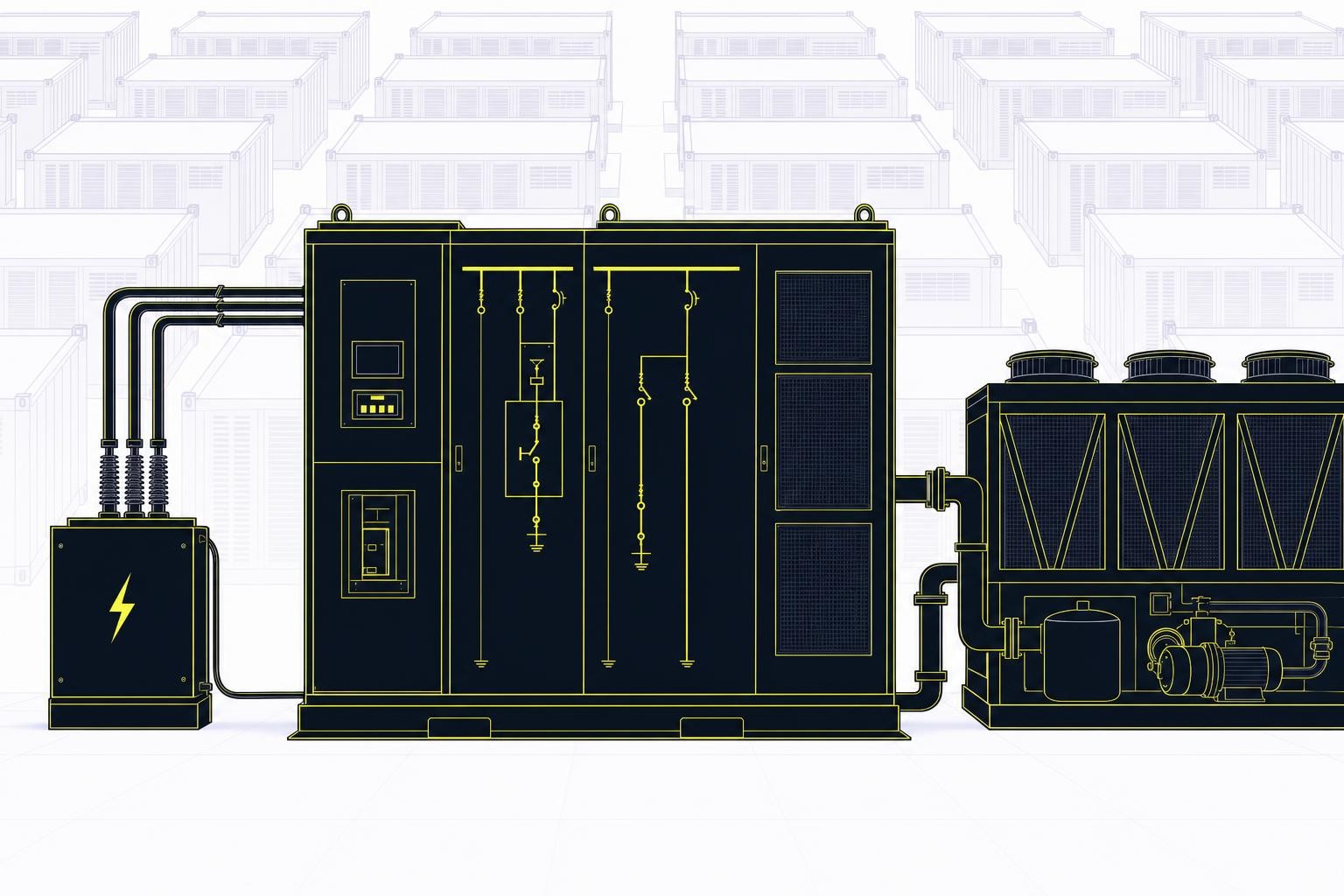
Trane Technologies and Eaton on 17 August 2026 published a joint reference design that integrates thermal management and electrical power distribution for high-density AI data centers, claiming combined energy efficiency gains of up to 15% against conventional low-voltage approaches[1].
What the design does
The reference design uses a medium-voltage architecture and is included in both the Trane Continuum Rubin DSX and Eaton Beam Rubin DSX platforms, which are built to align with Nvidia's DSX AI Factory platforms and the Nvidia Omniverse DSX Blueprint digital-twin layer. The companies describe it as replacing a "traditionally slow, manual and siloed design process" with a unified system in which power distribution and thermal management are pre-coordinated from the grid to the chip.
The stated performance claims, compared with conventional low-voltage designs, are:
- Energy efficiency improvement of up to 15%
- Installation cost reduction of up to 30%
- Copper use reduction of up to 80%
The copper reduction is a direct consequence of the medium-voltage approach. At 800 VDC, the same wire gauge can carry 157% more power than 415 VAC, cutting material and installation costs and simplifying cable management, according to Nvidia's own documentation cited by the companies. The design is also described as forward-compatible with liquid cooling and direct-current power architectures as they become more widely adopted.
The integration argument
The core commercial proposition is that power and cooling systems, historically specified and procured separately, can exchange real-time operating signals when designed as a single stack. The companies say this allows the combined system to respond more dynamically to changing loads and reduces risk during deployment.
Eaton CTO for the electrical sector Michael Regelski framed the goal as moving beyond a reference design as a document and toward a repeatable system that deployment teams can use across projects. Trane's chief technology and sustainability officer Mauro Atalla said the collaboration is intended to help customers "accelerate deployment, improve efficiency and confidently plan to scale."
Neither company disclosed a timeline for first customer implementations or named any operator that has committed to the design.
Market context
Global data center capacity is projected to nearly triple by 2030, with AI driving roughly 70% of that growth. The pressure on deployment timelines is acute: interconnection queues, transformer lead times, and the sheer complexity of coordinating electrical and mechanical contractors have all extended the time from site selection to energisation. A pre-integrated reference design that reduces on-site coordination is a direct response to that constraint.
The Trane-Eaton announcement arrives as a broader set of vendors - from prefabricated power module makers to software firms targeting GPU power-spike management - are competing to compress the gap between a data center breaking ground and drawing load.
What to watch: whether hyperscalers or colocation operators publicly adopt the Trane-Eaton reference design, and whether the efficiency and cost figures hold up in disclosed real-world deployments rather than vendor press releases.
The images and texts on this page were created with the help of AI.
Related
Ready-to-build BESS projects lose their premium as Australia's NEM arbitrage spreads collapse 85%
Panellists at the Battery Asset Management Summit Australia 2026 said the venture-capital-style returns that once rewarded ready-to-build BESS projects have disappeared as NEM price spreads fell 85% in a year.
10 Sept 2026UK government opens three-month consultation on AI for clean energy, backed by 34-recommendation network review
DESNZ published its Vision for an AI-enabled clean energy system on 8 September, opening a call for evidence that closes 6 November and will feed into the UK's first AI for Clean Energy Strategy.
10 Sept 2026Heatwaves expose a three-layer risk for wind operators: resource, hardware, and people
Extreme heat cuts wind output, stresses nacelle components, and grounds maintenance crews - all at once. A look at how bad the summer of 2026 has been, and what the trend means for grid reliability.
10 Sept 2026