Tokyo Gas signs 20-year offtake for 202 MWh Fukushima BESS as Eku Energy nears first Japan COD
Tokyo Gas has agreed a 20-year tolling deal for a 49.7 MW/202.1 MWh BESS in Fukushima Prefecture, while Eku Energy completes major equipment installation at its first Japan project.
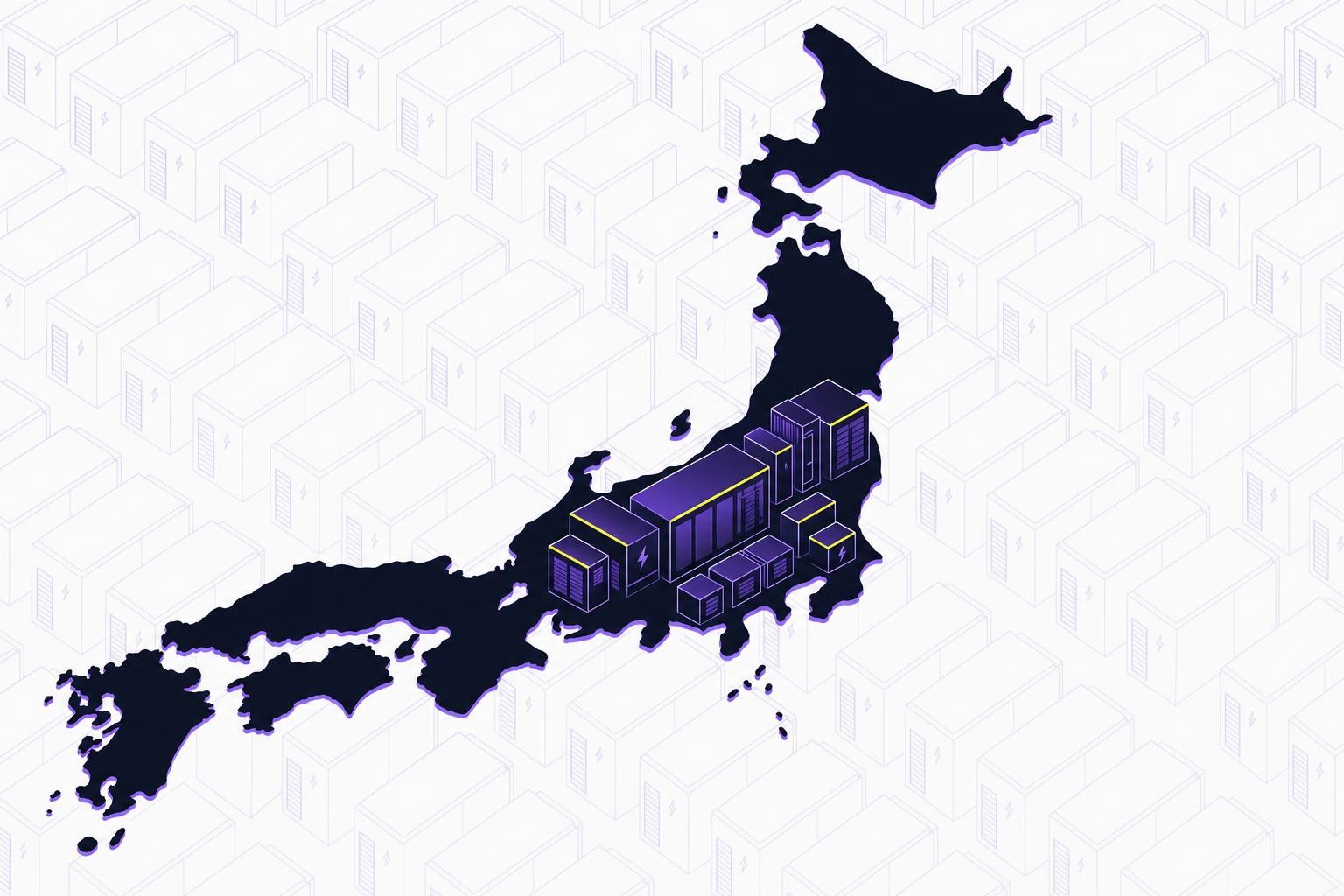
Two separate developments published this week confirm that Tokyo Gas is cementing its position as Japan's most active utility offtaker of grid-scale battery storage. On 28 July 2026, developer Hexa Energy Services announced a long-term offtake agreement with Tokyo Gas for a 49.7 MW / 202.1 MWh BESS in Fukushima Prefecture[1]. Separately, Eku Energy disclosed on 4 August that it has completed major equipment installation at its 30 MW / 120 MWh Hirohara BESS in Miyazaki Prefecture and is now targeting a commercial operation date of January 2027[1].
The Fukushima deal
Tokyo Gas will acquire operating rights and dispatch the asset's stored energy into electricity markets over the 20-year term of the agreement. Hexa Energy Services will develop, own and maintain the facility, which is scheduled to reach commercial operation in 2029.
The structure mirrors the tolling arrangement Tokyo Gas signed with Eku Energy for Hirohara in April 2024: the developer retains ownership while the utility holds full operating rights for the duration of the contract. Further details were not disclosed in Hexa's announcement, including whether the project carries any long-term contracted revenue streams beyond the offtake.
Hirohara nears the finish line
Eku Energy completed major equipment construction at its 30 MW / 120 MWh Hirohara BESS in Miyazaki Prefecture, Kyushu, including installation of 32 Tesla Megapack 2 XL units. The project now moves into integration and commissioning, with system testing and regulatory inspections still ahead; Eku says it remains on track for its January 2027 COD.
Eku Energy is jointly owned by Australia's Macquarie Asset Management fund and Canada's British Columbia Investment Management Corporation. MUFG Bank provided project finance for Hirohara - the first standalone battery storage project the bank has financed in Japan.
Hirohara is no longer Eku's only Japan asset. The company's project page shows:
- Kami-Tonno BESS (Nogata City, Fukuoka Prefecture) - commenced operations in April 2026
- Naganohara BESS (Naganohara, Gunma Prefecture) - announced May 2026, in development
- Three further large-scale BESS projects announced since Hirohara.
Tokyo Gas as a repeat offtaker
The Fukushima deal is the second time Tokyo Gas has taken the operating-rights side of a tolling agreement for a grid-scale BESS in Japan. The structure - developer owns, utility dispatches - is becoming a template for the market. Eku described its original Hirohara offtake as a "first-of-a-kind" agreement for Japan when it closed financing in mid-2024. That framing no longer holds: the same commercial structure has now been replicated by a separate developer and the same counterparty within roughly 15 months.
Market backdrop
Japan's grid-scale BESS pipeline has expanded rapidly on paper. Applications to connect standalone BESS projects to Japan's transmission and distribution grids rose from 70 GW in mid-2024 to 170.8 GW by end-2025, yet only 0.62 GW is connected - a significant gap between investor interest and physical deployment. Grid connection bottlenecks and policy instability are the primary barriers, with speculative grid applications, firm charging-side requirements, slow interconnection reforms, and shifting auction volumes constraining deployment and undermining revenue certainty.
Japan aims to install 10 GW of energy storage capacity by 2030, aligning with its target to raise renewables' share of electricity generation to nearly 40%.[1] In the Tokyo Electric Power Company service area, the first output control of renewable energy in the region began in March 2026, highlighting the growing importance of flexible supply-demand balancing as renewable deployment expands.
The two deals announced this week - one project targeting 2027, one targeting 2029 - sit at opposite ends of that deployment gap. Whether the Fukushima project clears the grid connection queue on schedule will be a more telling indicator of market progress than the offtake signing itself.
The images and texts on this page were created with the help of AI.
Related
Ready-to-build BESS projects lose their premium as Australia's NEM arbitrage spreads collapse 85%
Panellists at the Battery Asset Management Summit Australia 2026 said the venture-capital-style returns that once rewarded ready-to-build BESS projects have disappeared as NEM price spreads fell 85% in a year.
10 Sept 2026UK government opens three-month consultation on AI for clean energy, backed by 34-recommendation network review
DESNZ published its Vision for an AI-enabled clean energy system on 8 September, opening a call for evidence that closes 6 November and will feed into the UK's first AI for Clean Energy Strategy.
10 Sept 2026Heatwaves expose a three-layer risk for wind operators: resource, hardware, and people
Extreme heat cuts wind output, stresses nacelle components, and grounds maintenance crews - all at once. A look at how bad the summer of 2026 has been, and what the trend means for grid reliability.
10 Sept 2026