South Korea names first 86 villages in its Sunshine Income Villages solar scheme
South Korea's Ministry of Interior and Safety has selected 86 villages for the first round of its Sunshine Income Villages community solar programme, targeting 700 sites by end-2026 and 2,500 by 2030.
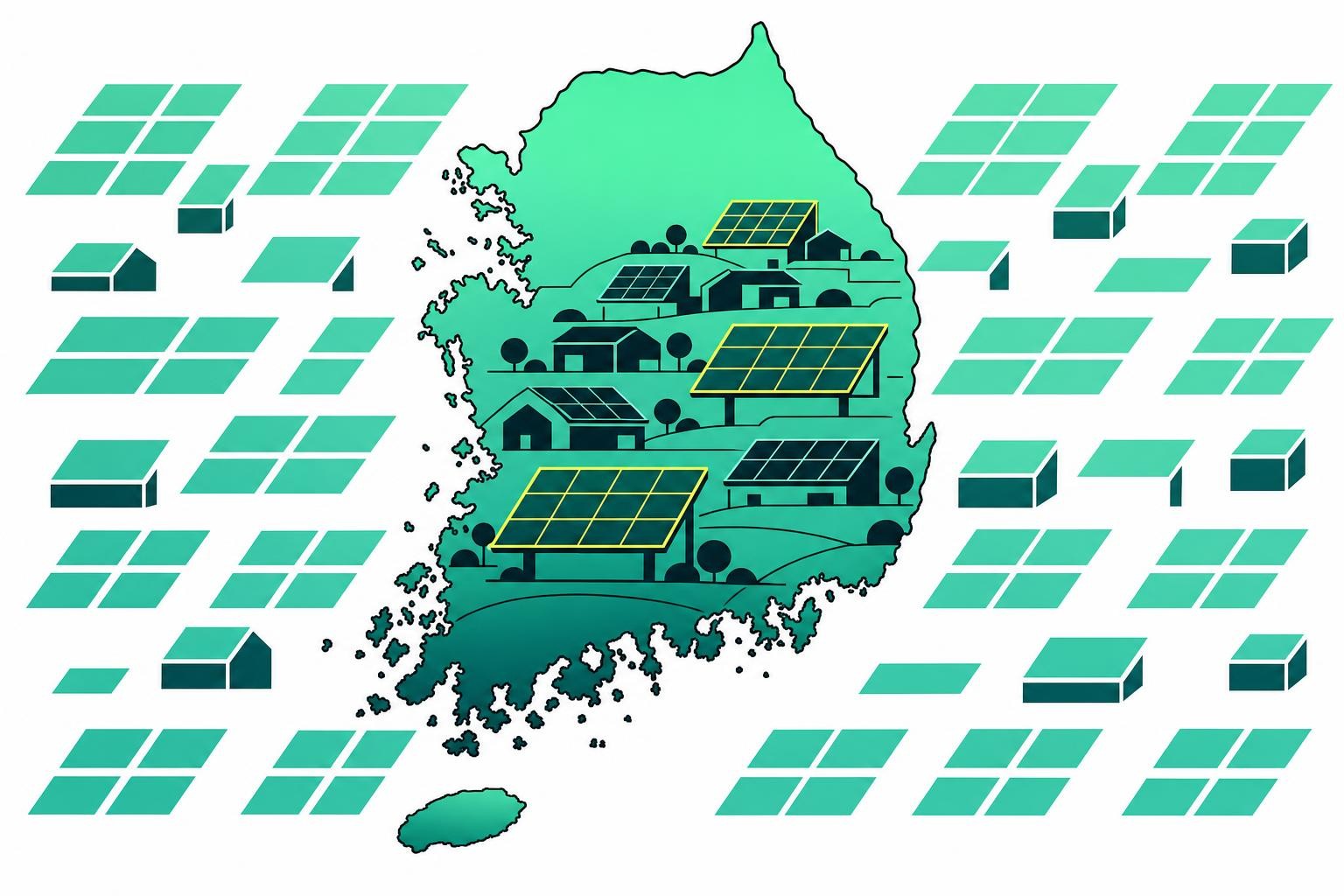
South Korea's Ministry of Interior and Safety has selected 86 villages to participate in the first round of its Sunshine Income Villages initiative, the government announced on 10 August 2026. The scheme installs solar facilities on idle land, farmland and reservoirs, with local residents forming cooperatives to share both the energy and the revenue[1].
How the selection breaks down
The 86 villages were chosen from 129 that applied during the first open call[1]. Of those selected:
- Nine were assessed as ready for rapid implementation, having already secured financial plans, site selection and a formed cooperative[1].
- Seventy-seven are classed as "conditionally selected" - they still need to finalise financial plans, grid connections or lease negotiations before they can proceed[1].
The government says it will promptly guide selected villages through follow-up procedures, including granting permits and providing financial support covering up to 85% of solar installation costs[1].
The cooperative and financing model
Under the programme, residents form cooperatives to install and operate solar plants on underutilised local land - including farmland, reservoirs and village commons - then sell surplus electricity and distribute the proceeds[1]. Long-term, low-interest loans cover up to 85% of installation costs, drawn from approximately KRW 450 billion in renewable energy financing available in 2026[1]. New cooperatives are also eligible for acquisition tax exemptions and property tax reductions.
Grid connection has been identified as the programme's largest structural obstacle. The government is pursuing legal amendments to grant priority grid connections for participating villages, and plans to support energy storage system installations in areas where grid capacity is constrained[1].
Scale and second-round pipeline
The Ministry of Interior and Safety has set a target of 700 solar villages in 2026, rising to 2,500 by 2030, drawn from approximately 38,000 administrative villages nationwide[1]. The second application round, which closed at the end of July, drew 617 village applications from 116 cities and counties across 12 provinces[1]. Final selections from that round are expected at the end of September[1].
Minister Yoon Ho-joong said he expects the first 86 villages to "become exemplary cases and serve as a stepping stone for nationwide expansion"[1].
The initiative sits alongside a broader acceleration in South Korean solar deployment. Cumulative solar capacity reached 30,346 MW by the end of 2025, a 3.6 GW increase on the prior year, according to IRENA[1]. A groundbreaking ceremony for the country's largest single-site PV complex - a 400 MW project in Haenam - took place on 7 August 2026, and a 1 GW solar tender was announced in July[1].
The September second-round results will be the first real test of whether the programme can scale at the pace the government has set. Conditional selections in the first round - 77 of the 86 approved villages - still need to close on grid connections and financing before any panels go in the ground; how quickly those conditions are cleared will determine whether the 700-village target for 2026 is achievable in practice.
The images and texts on this page were created with the help of AI.
Related
Ready-to-build BESS projects lose their premium as Australia's NEM arbitrage spreads collapse 85%
Panellists at the Battery Asset Management Summit Australia 2026 said the venture-capital-style returns that once rewarded ready-to-build BESS projects have disappeared as NEM price spreads fell 85% in a year.
10 Sept 2026UK government opens three-month consultation on AI for clean energy, backed by 34-recommendation network review
DESNZ published its Vision for an AI-enabled clean energy system on 8 September, opening a call for evidence that closes 6 November and will feed into the UK's first AI for Clean Energy Strategy.
10 Sept 2026Heatwaves expose a three-layer risk for wind operators: resource, hardware, and people
Extreme heat cuts wind output, stresses nacelle components, and grounds maintenance crews - all at once. A look at how bad the summer of 2026 has been, and what the trend means for grid reliability.
10 Sept 2026