North Carolina rooftop solar rebounds after two-thirds installation drop, driven by leasing and battery incentives
NC rooftop solar installations fell two-thirds between Q4 2025 and Q1 2026 after the 25D tax credit expired, but leasing models and Duke Energy battery rebates are pulling the market back.
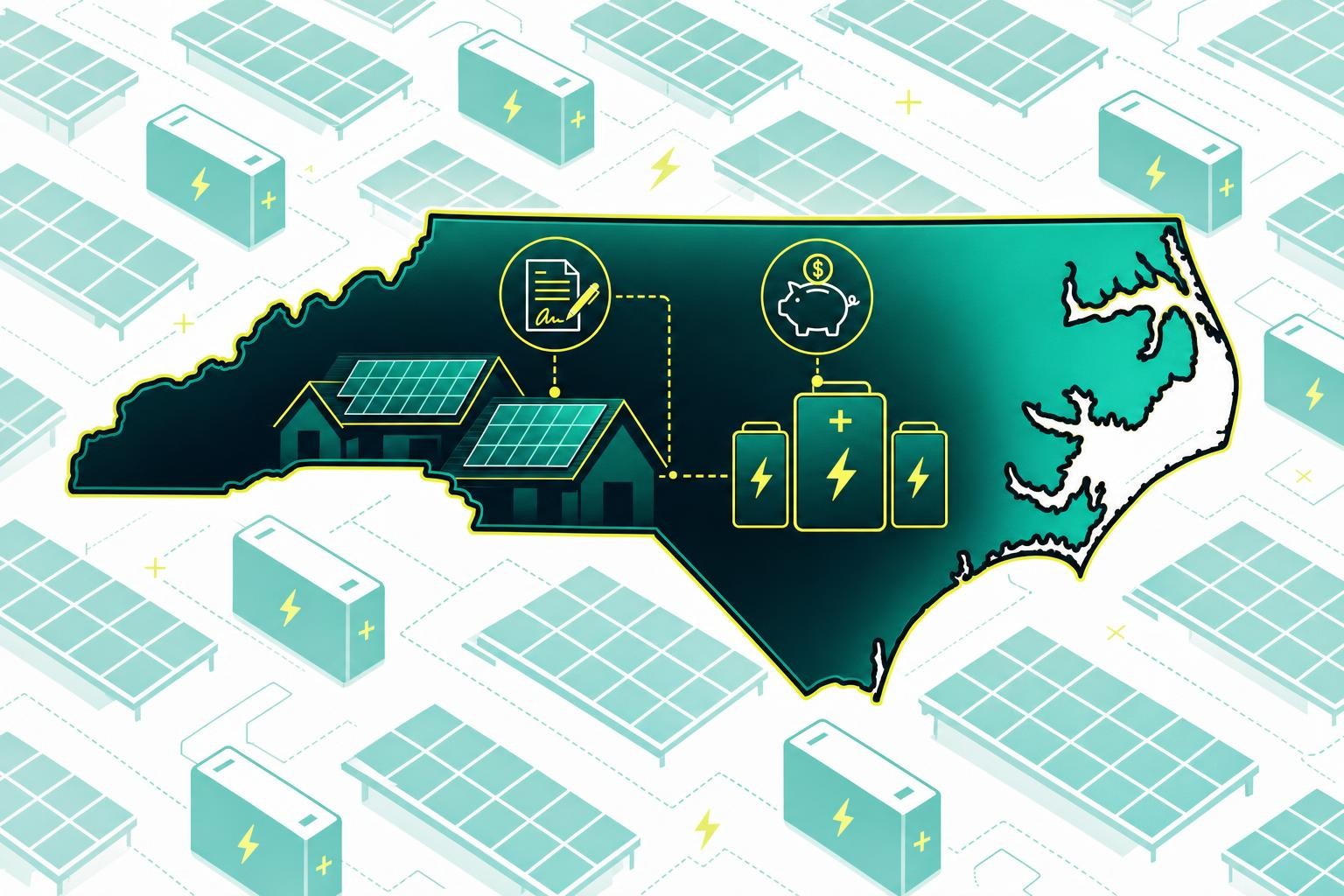
New rooftop solar installations in North Carolina fell by two-thirds between Q4 2025 and Q1 2026, according to estimates from the North Carolina Sustainable Energy Association, after the One Big Beautiful Bill Act eliminated the 30% federal residential tax credit at the end of 2025[1]. And yet, installers who survived the initial freefall say sales are now rising again - a recovery built on leasing structures and utility battery incentives rather than the purchase-and-credit model that defined the previous decade.
The policy stack that hit at once
The federal blow was the most visible. Signed into law on 4 July 2025, the One Big Beautiful Bill terminated the Section 25D residential clean energy credit for systems installed after 31 December 2025 - nearly a decade ahead of the schedule the Inflation Reduction Act had set[1]. The abrupt end, with no phase-down, meant homeowners who had not yet installed by year-end received nothing.
North Carolina's state-level policy environment compounded the pressure:
- SB266, passed in 2025 via a legislative veto override, erased the state's interim carbon reduction target of a 70% power-sector cut by 2030, a move SEIA analysts warn could cost ratepayers up to $23 billion through 2050.
- Duke Energy's revised net-metering structure, approved by the North Carolina Utilities Commission in 2023, shifted new customers onto time-of-use billing that credits midday solar exports at avoided cost - roughly $0.034/kWh - against a retail rate of $0.12-$0.14/kWh.
- Legacy net-metering customers are scheduled to transition off the old 1:1 rate structure on 31 December 2026, adding urgency for anyone still considering a purchase-model installation.
The combined effect was a sharp contraction. North Carolina ranked fifth nationally for total installed solar capacity as of February 2026, with a market valued at $14.4 billion, but the residential segment bore the brunt of the policy shift.
How the market is adapting
The mechanism keeping the market alive is the commercial 48E tax credit, which still applies to third-party-owned systems through end-2027. Leasing companies can pass that benefit to homeowners indirectly through lower monthly payments, even though the homeowner cannot claim the credit directly.
Solar leasing was only authorised in North Carolina in 2017 and was not widely available until 2026. For the first time, installers across the state - including in western North Carolina, where purchase-plus-credit had been the dominant model - are offering zero-upfront-cost lease products. The window is finite: once the 48E credit expires for commercial entities at end-2027, the economics of leasing deteriorate sharply.
Duke Energy's PowerPair programme is the other pillar. The utility offers up to $9,000 in rebates for combined solar-plus-battery installations, with Duke Energy Progress already at capacity and limited slots remaining in the Duke Energy Carolinas territory. Enrolled battery owners can also earn ongoing monthly credits through Duke's EnergyWise Home and Power Manager programmes, which allow the utility to dispatch residential batteries 30 to 36 times per year.
What installers are reporting
The picture from the ground is more resilient than the headline volume numbers suggest. NC Solar Now's vice president of sales said the company had just recorded a record month. The North Carolina Sustainable Energy Association notes that the number of rooftop companies in the state has shrunk - primarily through the exit of national chains - but the firms that remain are seeing sales recover after the winter trough[1].
The national residential segment posted a 6% year-over-year gain in Q1 2026, partly because overflow interconnections from the late-2025 rush continued to be processed into the new year. North Carolina's own trajectory was steeper on the downside but is tracking a similar recovery pattern.
What to watch
The critical dates are end-2026 and end-2027. Duke Energy's Net Metering Bridge Rate closes to new applicants on 31 December 2026, after which new customers move to the lower-value time-of-use billing structure. The 48E commercial credit - the engine behind leasing economics - expires for new systems at end-2027. Installers who have framed the current period as a two-year window to "make hay and electrons while the sun shines" are not wrong about the arithmetic. Whether the market finds a third structural support before that window closes - state-level incentives, rising retail rates, or grid-services revenue from aggregated residential batteries - will determine whether the rebound is durable or a second cliff.
The images and texts on this page were created with the help of AI.
Related
Ready-to-build BESS projects lose their premium as Australia's NEM arbitrage spreads collapse 85%
Panellists at the Battery Asset Management Summit Australia 2026 said the venture-capital-style returns that once rewarded ready-to-build BESS projects have disappeared as NEM price spreads fell 85% in a year.
10 Sept 2026UK government opens three-month consultation on AI for clean energy, backed by 34-recommendation network review
DESNZ published its Vision for an AI-enabled clean energy system on 8 September, opening a call for evidence that closes 6 November and will feed into the UK's first AI for Clean Energy Strategy.
10 Sept 2026Heatwaves expose a three-layer risk for wind operators: resource, hardware, and people
Extreme heat cuts wind output, stresses nacelle components, and grounds maintenance crews - all at once. A look at how bad the summer of 2026 has been, and what the trend means for grid reliability.
10 Sept 2026