North Carolina rooftop solar leasing window narrows as Section 48E safe harbor closes
NC rooftop solar fell two-thirds in Q1 2026 after the 25D credit expired. Leasing companies are filling the gap - but the Section 48E safe harbor closed 4 July, tightening the runway to end-2027.
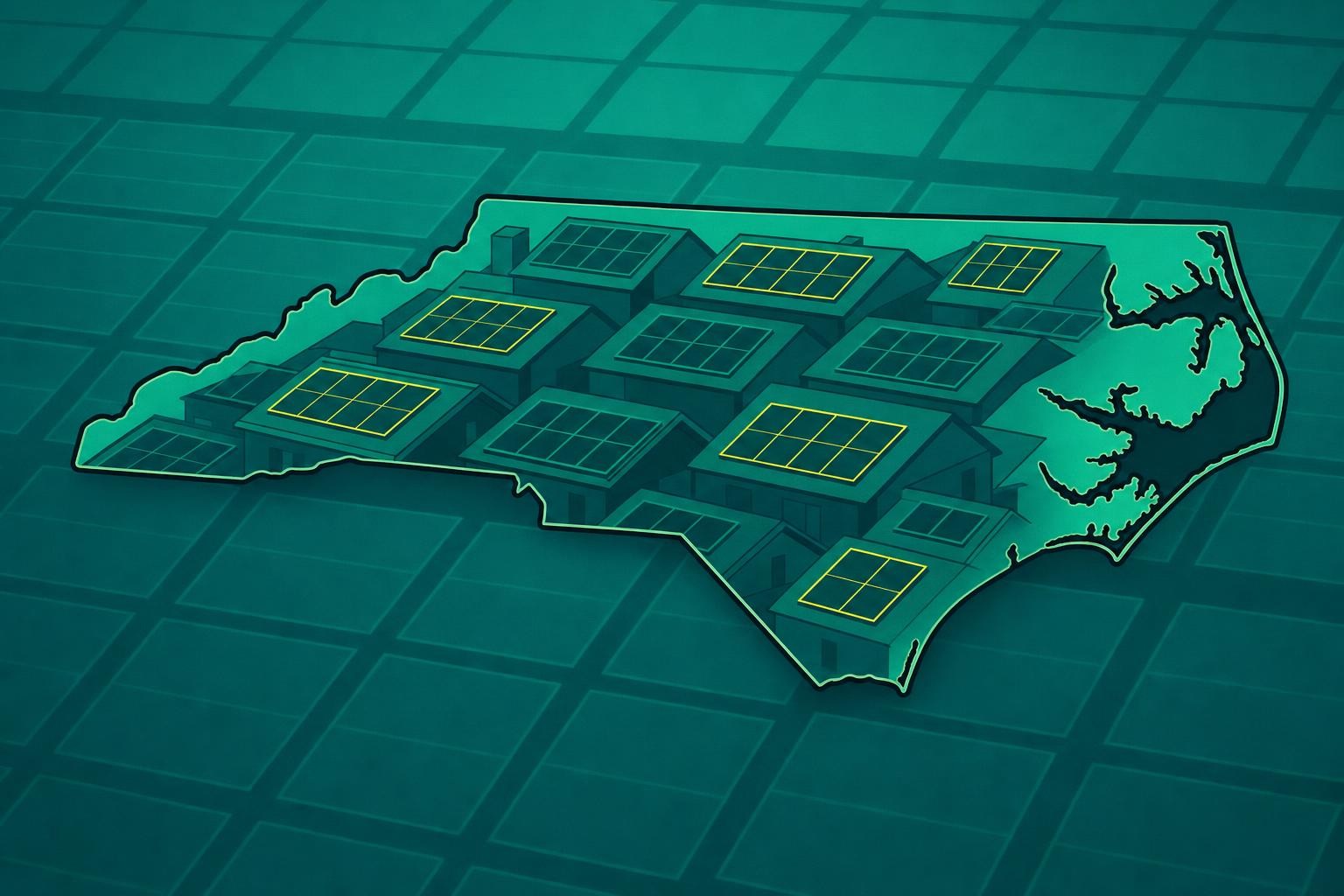
New rooftop solar installations in North Carolina dropped by two-thirds between Q4 2025 and Q1 2026, according to estimates from the North Carolina Sustainable Energy Association, after the 30% federal residential tax credit expired on 31 December 2025[1]. And yet installers in the state say the market is holding up better than they feared.
The reason is a structural shift in how rooftop solar is being financed - one that now has a hard deadline attached to it.
The policy gap that leasing fills
The One Big Beautiful Bill Act, signed on 4 July 2025, terminated the Section 25D residential solar tax credit for any system installed on or after 1 January 2026 - cutting off nearly a decade of runway that had been scheduled to run through 2032. Homeowners who buy or finance their own panels receive no federal credit in 2026.
The surviving pathway is third-party ownership. The business-claimed Section 48E tax credit for residential solar leases and PPAs remains in effect through the end of 2027. In those arrangements, the leasing company claims the tax credit and the homeowner benefits from lower payments for their system. Durham-based EnerWealth Solutions is one company explicitly built around this model: it buys rooftop panels using the commercial credit and rents them to homeowners, passing on the savings[1].
The approach is not unique to North Carolina, but the state is a useful test case. Its rooftop solar market has historically lagged its utility-scale sector, and state-level policy support for residential panels has been thinning[1].
The 4 July 2026 safe harbor has closed
The more consequential development - one that postdates the initial market shock - is that the Section 48E begin-construction safe harbor closed on 4 July 2026. Projects that began construction on or before that date locked in the longer timing pathway; new lease and PPA projects still qualify for the 30% investment tax credit but generally must be placed in service by 31 December 2027.
That means leasing companies that did not commence construction before 4 July now face a firm 17-month window to install and commission systems. The practical constraints are real:
- Permitting alone typically takes four to eight weeks
- Module supply chains face new cost pressure from the 15% Section 232 polysilicon tariff taking effect 4 December 2026
- Duke Energy Progress's PowerPair rebate programme has already reached capacity; only Duke Energy Carolinas slots remain
For EnerWealth and similar operators, the calculus is straightforward: the credit window is fixed, the safe harbor is closed, and the installation clock is running[1].
Duke's PowerPair: a second prop, near its limit
Duke Energy's PowerPair programme - approved by the North Carolina Utilities Commission - offers up to $9,000 in rebates for solar-plus-battery installations: $0.36 per watt of DC solar capacity (capped at $3,600) and $400 per kWh of battery storage (capped at $5,400). Capacity covers approximately 6,000 to 8,000 homes based on the allotted kW capacities for Duke Energy Progress and Carolinas.
Duke Energy Progress has reached capacity and its waitlist is closed; Duke Energy Carolinas retains limited capacity. The programme is first-come, first-served with no confirmed successor. Installers who have been routing customers toward PowerPair as a substitute for the expired federal credit are now working against two simultaneous countdowns.
Nationally, SEIA data show the U.S. residential solar segment installed 1,179 MWdc in Q1 2026, up 6% year-over-year but down 15% quarter-over-quarter, with volumes partly sustained by an overflow of late-2025 installations initiated to capture the expiring 25D credit. SEIA projects residential solar will slowly start growing again in 2027, fuelled by continued third-party ownership project tax credit eligibility and higher retail energy prices.
What to watch
The effective deadline for new NC leasing projects to qualify for the Section 48E credit is now 31 December 2027, with no safe-harbor extension available for projects that did not break ground before 4 July 2026. Whether the state's leasing market can sustain meaningful volume through that window - and what happens to installers when it closes - will be the defining question for North Carolina's residential solar sector over the next 18 months.
The images and texts on this page were created with the help of AI.
Related
Ready-to-build BESS projects lose their premium as Australia's NEM arbitrage spreads collapse 85%
Panellists at the Battery Asset Management Summit Australia 2026 said the venture-capital-style returns that once rewarded ready-to-build BESS projects have disappeared as NEM price spreads fell 85% in a year.
10 Sept 2026UK government opens three-month consultation on AI for clean energy, backed by 34-recommendation network review
DESNZ published its Vision for an AI-enabled clean energy system on 8 September, opening a call for evidence that closes 6 November and will feed into the UK's first AI for Clean Energy Strategy.
10 Sept 2026Heatwaves expose a three-layer risk for wind operators: resource, hardware, and people
Extreme heat cuts wind output, stresses nacelle components, and grounds maintenance crews - all at once. A look at how bad the summer of 2026 has been, and what the trend means for grid reliability.
10 Sept 2026