Malaysia's Palm Oil Board nears commercial launch of Sawit EcoTherm immersion cooling fluid for data centers
Malaysia's MPOB is finalising a licensing agreement for Sawit EcoTherm, a palm oil-based immersion cooling fluid that could cut data center water use - but raises land-use questions.
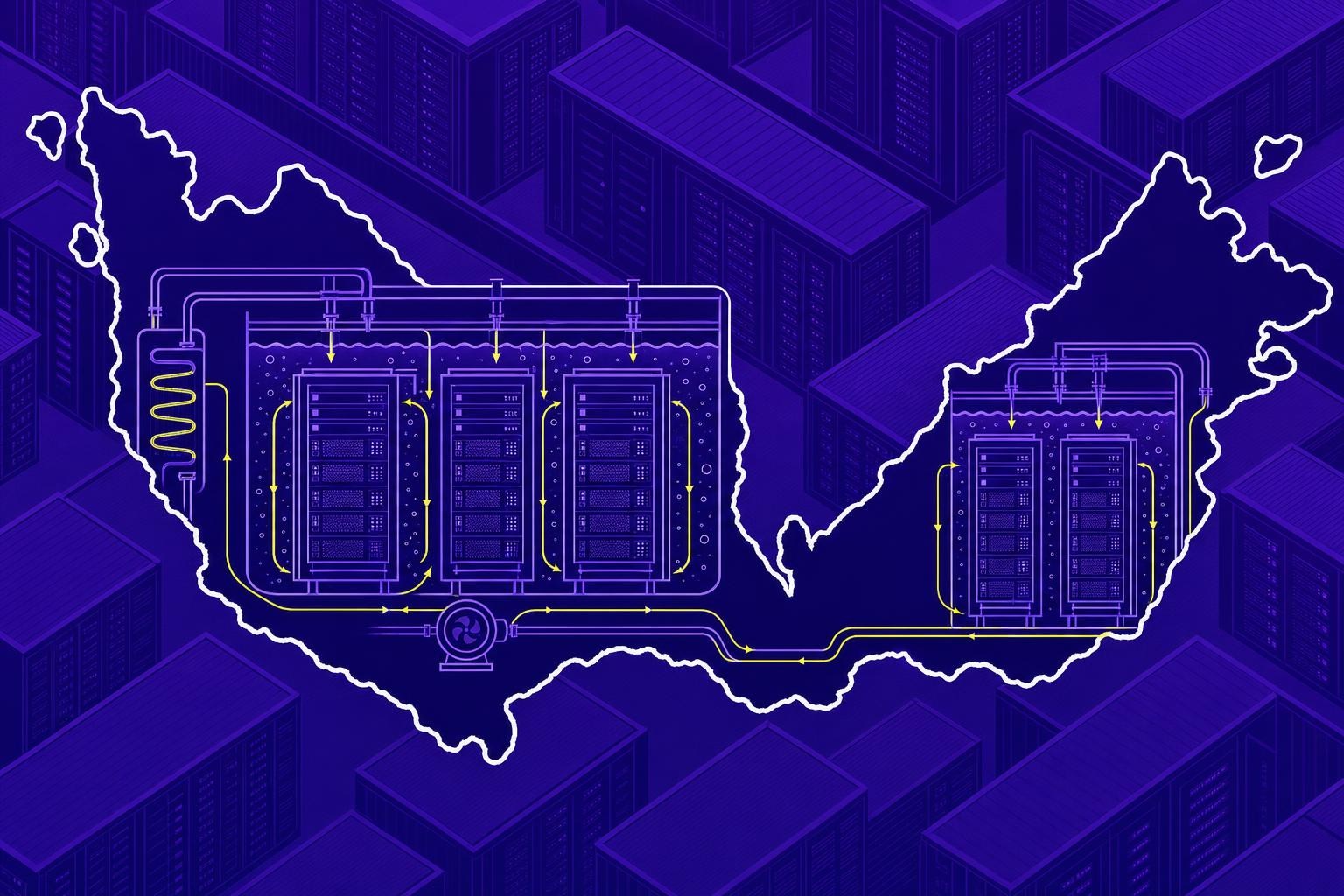
Malaysia's government palm oil agency is close to putting a bio-derived immersion cooling fluid into commercial production, adding a locally sourced option to a market currently dominated by fluorocarbons and mineral oils. The Malaysian Palm Oil Board (MPOB) says its Sawit EcoTherm fluid is in the final stages of development, with a licensing agreement being finalised with a local manufacturer[1].
What the fluid is and how it works
Sawit EcoTherm is a non-conductive dielectric fluid made from locally sourced palm-derived materials, developed by MPOB's Advanced Oleochemical Technology Division. The fluid submerges server hardware entirely, removing heat in a closed-loop system without evaporative cooling towers. MPOB says the formulation contains up to 95% palm-based renewable biomaterials, is PFAS-free, readily biodegradable, and has low ecological toxicity.
The claimed performance figures are significant:
- Immersion cooling systems using the fluid can reduce energy consumption by 30-50% compared with conventional air cooling
- AI servers generate three to five times more heat than conventional servers, making higher-density liquid cooling increasingly necessary[1]
- Conventional water-cooling systems are projected to consume 876 million litres of water per day across Malaysia's data center industry - equivalent to the needs of roughly four million people
As of January 2026, Malaysia's data centers were already consuming 28.68 million litres of water per day, according to the National Water Services Commission.
Cargill already markets an immersion cooling fluid that is 90% vegetable oil, so the chemistry is not novel; what is new is a nationally backed, palm-derived product positioned to leverage Malaysia's existing oleochemical supply chain[1].
The market context
Malaysia's data center build-out gives the fluid a large potential home market. Johor's incoming pipeline stood at 8,542 MW as of mid-2026, the largest in Asia-Pacific, with a co-location vacancy rate of just 0.7%. Between 2021 and mid-2025, the Malaysian government approved roughly RM 144.4 billion (approximately US$31-32 billion) across 143 data center projects.
A 65 MW immersion-cooled facility is already planned in Cyberjaya, funded by state-backed developer Selangor Industrial Corporation[1] - a potential early test site for Sawit EcoTherm. Only about 1% of the world's data centers currently use immersion cooling, so the addressable market is large but adoption is slow, partly because maintenance complexity is higher when components are permanently submerged.
The land-use question
The fluid's sustainability case is not straightforward. Malaysia is the world's second-largest palm oil producer, after Indonesia[1], and palm oil production has been linked to deforestation, with plantations replacing biodiverse habitats[1]. Environmental campaigners have connected the industry to habitat loss for orangutans and Sumatran elephants[1]. Experts say the net environmental outcome depends on whether existing plantations can meet incremental demand or whether new land clearance follows.
MPOB's path to commercial adoption requires more than a licensing deal. The agency says it will need pilot projects, technical validation, and cooperation across technology providers, server manufacturers, and immersion cooling system integrators before operators gain confidence in the fluid's long-term reliability.
What to watch: whether the Cyberjaya immersion-cooled facility or another Malaysian operator agrees to a pilot, and whether MPOB publishes sourcing criteria that address the deforestation concern before hyperscalers - many of which carry public zero-deforestation commitments - are asked to evaluate the product.
The images and texts on this page were created with the help of AI.
Related
Ready-to-build BESS projects lose their premium as Australia's NEM arbitrage spreads collapse 85%
Panellists at the Battery Asset Management Summit Australia 2026 said the venture-capital-style returns that once rewarded ready-to-build BESS projects have disappeared as NEM price spreads fell 85% in a year.
10 Sept 2026UK government opens three-month consultation on AI for clean energy, backed by 34-recommendation network review
DESNZ published its Vision for an AI-enabled clean energy system on 8 September, opening a call for evidence that closes 6 November and will feed into the UK's first AI for Clean Energy Strategy.
10 Sept 2026Heatwaves expose a three-layer risk for wind operators: resource, hardware, and people
Extreme heat cuts wind output, stresses nacelle components, and grounds maintenance crews - all at once. A look at how bad the summer of 2026 has been, and what the trend means for grid reliability.
10 Sept 2026