Huawei raises liquid-cooled charging to 800 A and cuts grid connection requirement to 50 kW with new DC ESS solution
Huawei Digital Power unveiled an 800 A liquid-cooled DC charging dispenser and a DC ESS+Charger solution at Power2Drive Europe 2026 in Munich, requiring as little as 50 kW of grid connection.
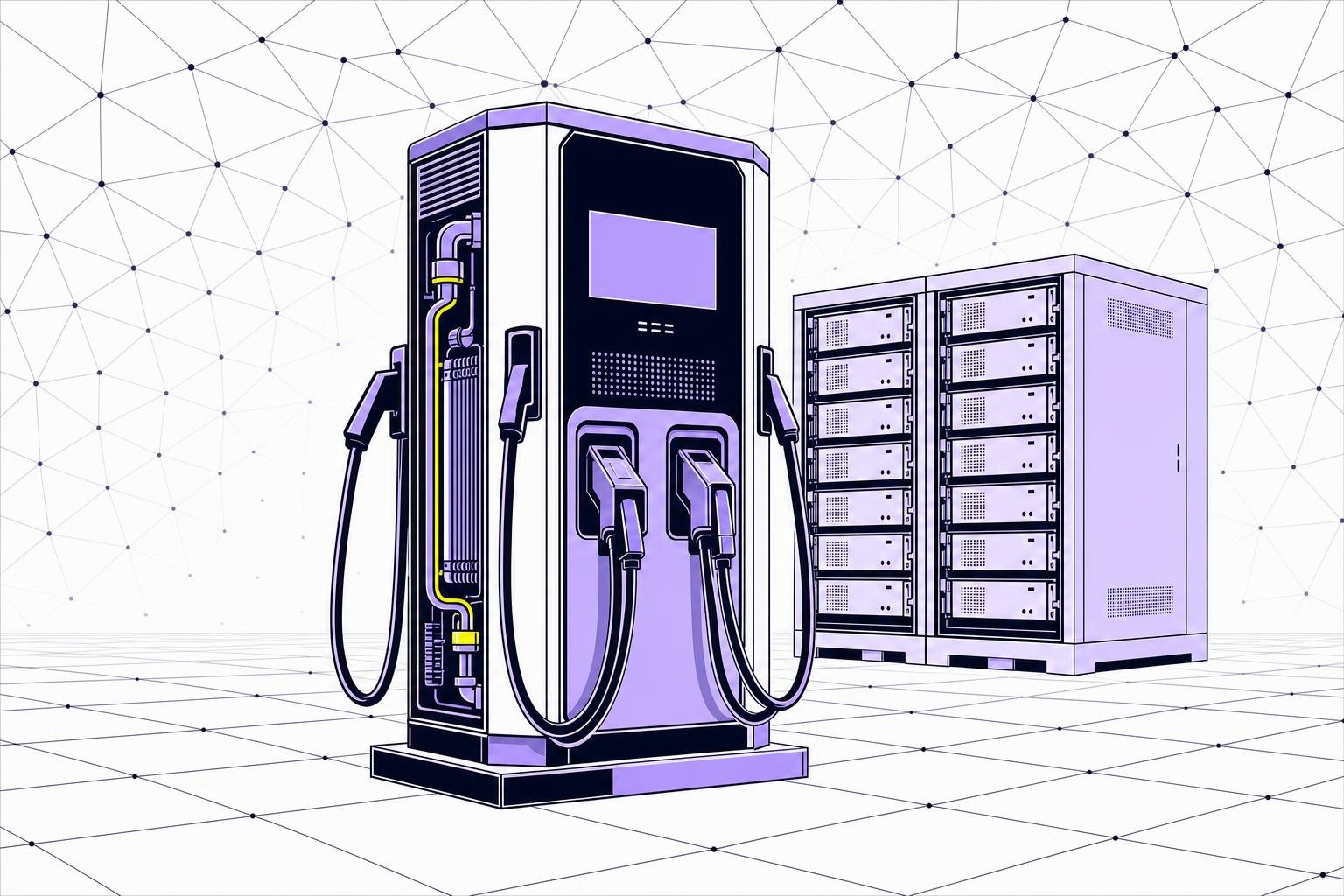
Huawei Digital Power unveiled an 800-ampere liquid-cooled DC charging dispenser and a new DC ESS+Charger Solution at Power2Drive Europe 2026, held at Messe München from 23 to 25 June 2026, targeting charging operators who cannot secure adequate grid capacity upgrades[1].
What changed from last year
The headline hardware step is a jump in dispenser current. Liquid-cooled DC dispensers now reach 800 A, and boost DC dispensers reach 600 A[1] - up from 500 A per connector on the equivalent 2025 product. The dispenser supports a 150-1,000 V voltage range and keeps noise below 55 dB through full liquid cooling[1].
The system delivers up to 720 kW of total power and can add 200 km of range in five minutes[1]. The solution has received prime-level safety certification from TÜV[1].
A megawatt charger has also launched in China and is undergoing field testing ahead of introduction to Europe[1].
The grid-constraint argument
The DC ESS+Charger architecture is Huawei's answer to a specific commercial problem: charging operators in Europe who want to deploy ultra-fast charging but face slow or expensive grid connection upgrades. The DC ESS+Charger Solution builds on Huawei's earlier AC ESS+Charger offering and is explicitly positioned for Europe's ageing grid infrastructure[1].
The claimed advantages of the DC-coupled architecture over AC-coupled alternatives are:
- Grid connection requirement of just 50 kW, eliminating the need for capacity-expansion applications[1]
- A DC bus connected directly to the DC BESS resolves energy export issues entirely[1]
- One fewer power conversion stage lifts ESS round-trip efficiency to 92.1%[1]
- No power distribution construction required, cutting site build time from months to weeks[1]
Two deployment scenarios
Huawei has structured the solution around two site types:
- New construction (residential communities, gas stations): operates within sub-240 kVA grid capacity, pairing 240-720 kW power units with a 1C DC ESS. Huawei claims this cuts payback by 1.5 years versus the industry average[1].
- Reconstruction: reusing existing 240 kVA capacity and cabling with a DC ESS can expand a site from four to 12 parking spots, each capable of delivering up to 600 kW[1].
A power-sharing matrix and intelligent power scheduling allow flexible configuration across dispensers, which Huawei says improves station turnover for charging point operators[1].
Ecosystem positioning
Huawei is presenting the solution as more than hardware. The FusionCharge offering integrates PV, ESS, and charging into a single architecture, with the DC bus enabling on-grid or off-grid operation depending on site conditions[1]. Huawei Digital Power has deployed charging networks across more than 60 countries and regions.
The modular design is intended to allow operators to upgrade from fast to ultra-fast charging without secondary capital investment - power units, dispensers, and ESS can all be swapped independently[1].
What to watch: whether European charging point operators adopt the DC-coupled ESS architecture at scale, or whether grid upgrade timelines improve enough to reduce the commercial case for behind-the-meter storage at charging sites. Huawei's megawatt charger timeline for Europe will also be a marker of how quickly the company expects high-voltage EV adoption to accelerate on the continent.
The images and texts on this page were created with the help of AI.
Related
Ready-to-build BESS projects lose their premium as Australia's NEM arbitrage spreads collapse 85%
Panellists at the Battery Asset Management Summit Australia 2026 said the venture-capital-style returns that once rewarded ready-to-build BESS projects have disappeared as NEM price spreads fell 85% in a year.
10 Sept 2026UK government opens three-month consultation on AI for clean energy, backed by 34-recommendation network review
DESNZ published its Vision for an AI-enabled clean energy system on 8 September, opening a call for evidence that closes 6 November and will feed into the UK's first AI for Clean Energy Strategy.
10 Sept 2026Heatwaves expose a three-layer risk for wind operators: resource, hardware, and people
Extreme heat cuts wind output, stresses nacelle components, and grounds maintenance crews - all at once. A look at how bad the summer of 2026 has been, and what the trend means for grid reliability.
10 Sept 2026