Ritsumeikan researchers identify the circuit mechanism behind mirror-cell hotspots in half-cell HJT modules
A Ritsumeikan University team has published an outdoor-validated circuit model showing how short-circuit current mismatch drives unexpected hotspot formation in unshaded cells of half-cell HJT modules.
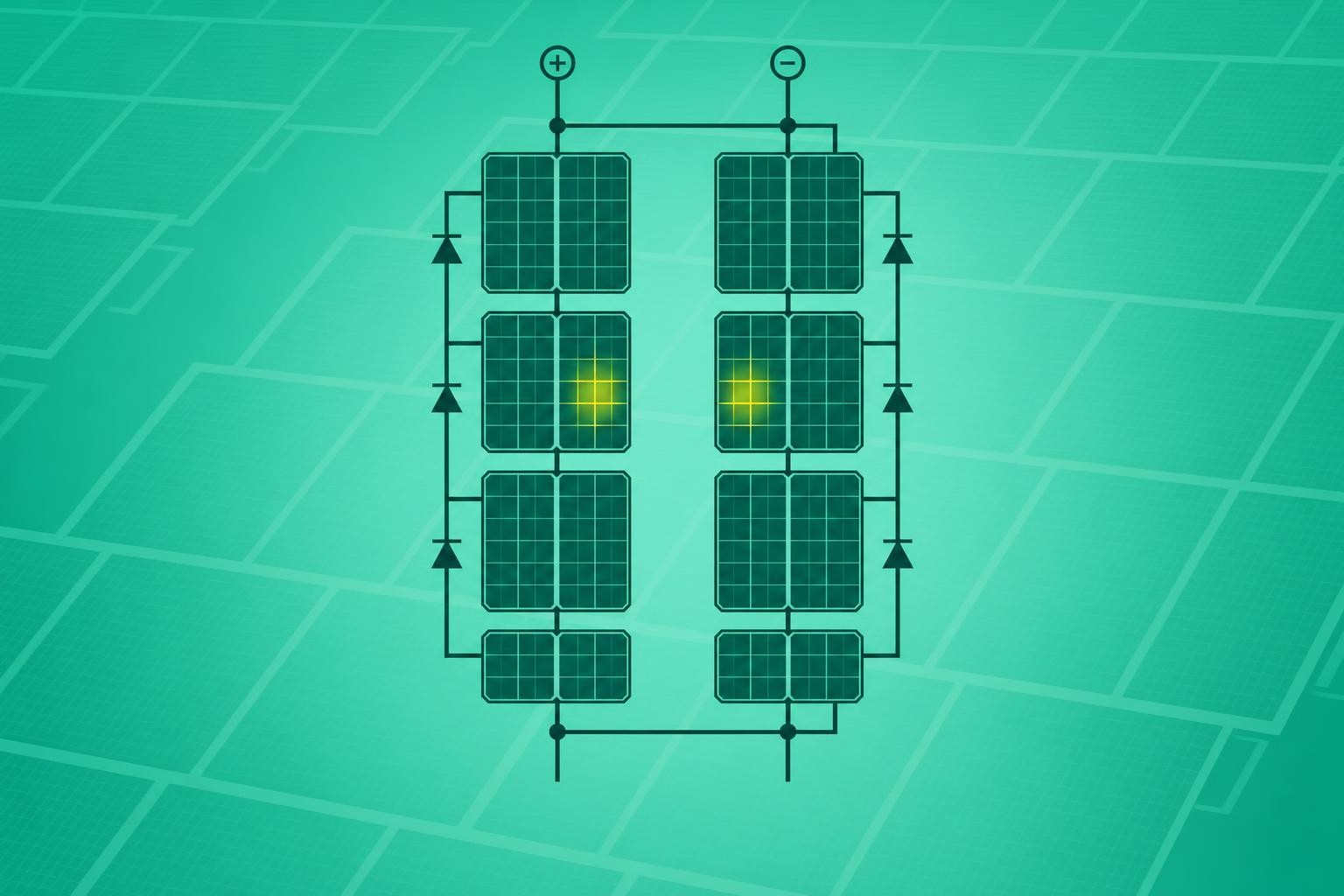
A research team at Japan's Ritsumeikan University has published the first outdoor-validated, circuit-level explanation of hotspot mirroring in commercial 120-half-cell silicon heterojunction (HJT) modules, identifying short-circuit current mismatch as the dominant driver of localized overheating in cells that are not themselves shaded[1]. The findings appear in Solar Energy.
What hotspot mirroring is - and why it matters for HJT
Half-cell modules split each cell into two halves and wire the resulting substrings in parallel pairs, each pair protected by a bypass diode. When partial shading triggers a bypass diode, the parallel "mirror" substring continues to carry current - but the mismatch in short-circuit current (ΔIsc) between cells in that substring can push one unshaded cell into deep reverse bias, generating heat comparable to the shaded cell itself[1].
The phenomenon had been observed in laboratory and field settings before, but prior work stopped short of quantifying which electrical parameters govern how severe the heating becomes[1]. That gap is what the Ritsumeikan team set out to close.
HJT and TOPCon solar cells exhibit higher hotspot temperatures than PERC cells under equivalent reverse-bias conditions, a characteristic tied to their higher breakdown voltages and lower irradiance-dependent reverse current - properties that make the architecture attractive for efficiency but that also concentrate dissipation when mismatch occurs.
How the experiment was set up
The team mounted a commercial 120-half-cell HJT module outdoors under natural sunlight and connected it to an electronic load. The module comprised six substrings of 20 series-connected half-cells each; two substrings formed each bypass-diode-protected unit, and three units were connected in series[1].
Individual half-cells were selectively shaded with a light-blocking sheet. Infrared thermography recorded temperature distributions at two fixed operating voltages - 36.5 V and 22.7 V - with the module held at each voltage for ten minutes before images were captured[1].
Key observations:
- At 22.7 V (bypass diode active), the mirror cell reached 44.4 °C - a 15.2 °C rise above the surrounding module temperature[1].
- At 36.5 V, where the bypass diode was not activated, no comparable heating appeared in the mirror substring[1].
- Bypass diode activation is necessary but not sufficient: when mirror-substring cells are electrically identical, the negative unit voltage distributes broadly and no single cell overheats[1].
What the circuit model shows
To isolate the governing parameters, the researchers built an equivalent circuit model in LTspice, calibrated against measured current-voltage characteristics of an encapsulated HJT coupon cell[1]. The model was used to sweep ΔIsc, shunt resistance, and temperature across realistic operating ranges.
ΔIsc - the short-circuit current mismatch between parallel mirror-substring cells - has the strongest influence on mirror-cell hotspot power dissipation; shunt resistance variation has a secondary effect[1]. A slight mismatch is enough to force one cell into deep reverse bias and make it the dominant dissipation site, while the remaining cells in the substring stay relatively cool[1].
The temperature-power feedback loop - where a warming cell changes its own electrical characteristics, which in turn alters dissipation - had not previously been incorporated into a validated predictive framework for this failure mode[1].
What to watch
The practical implication is that hotspot risk in half-cell HJT modules cannot be assessed by evaluating shaded cells alone; the mirror substring must be included in any thermal evaluation. The researchers argue that cell-level ΔIsc sorting during manufacturing, and potentially tighter shunt resistance specifications, are the most direct levers for reducing risk. Whether module qualification standards such as IEC 61215 will be updated to reflect mirror-substring testing remains an open question for the industry.
The images and texts on this page were created with the help of AI.
Related
Ready-to-build BESS projects lose their premium as Australia's NEM arbitrage spreads collapse 85%
Panellists at the Battery Asset Management Summit Australia 2026 said the venture-capital-style returns that once rewarded ready-to-build BESS projects have disappeared as NEM price spreads fell 85% in a year.
10 Sept 2026UK government opens three-month consultation on AI for clean energy, backed by 34-recommendation network review
DESNZ published its Vision for an AI-enabled clean energy system on 8 September, opening a call for evidence that closes 6 November and will feed into the UK's first AI for Clean Energy Strategy.
10 Sept 2026Heatwaves expose a three-layer risk for wind operators: resource, hardware, and people
Extreme heat cuts wind output, stresses nacelle components, and grounds maintenance crews - all at once. A look at how bad the summer of 2026 has been, and what the trend means for grid reliability.
10 Sept 2026