Greece's fire service launches nationwide wind farm probe after Boeotia megafire kills two
Greek prosecutors have ordered a nationwide inspection of all ~450 wind farms after a faulty private power line was blamed for a megafire that burned more than 11,200 hectares west of Athens.
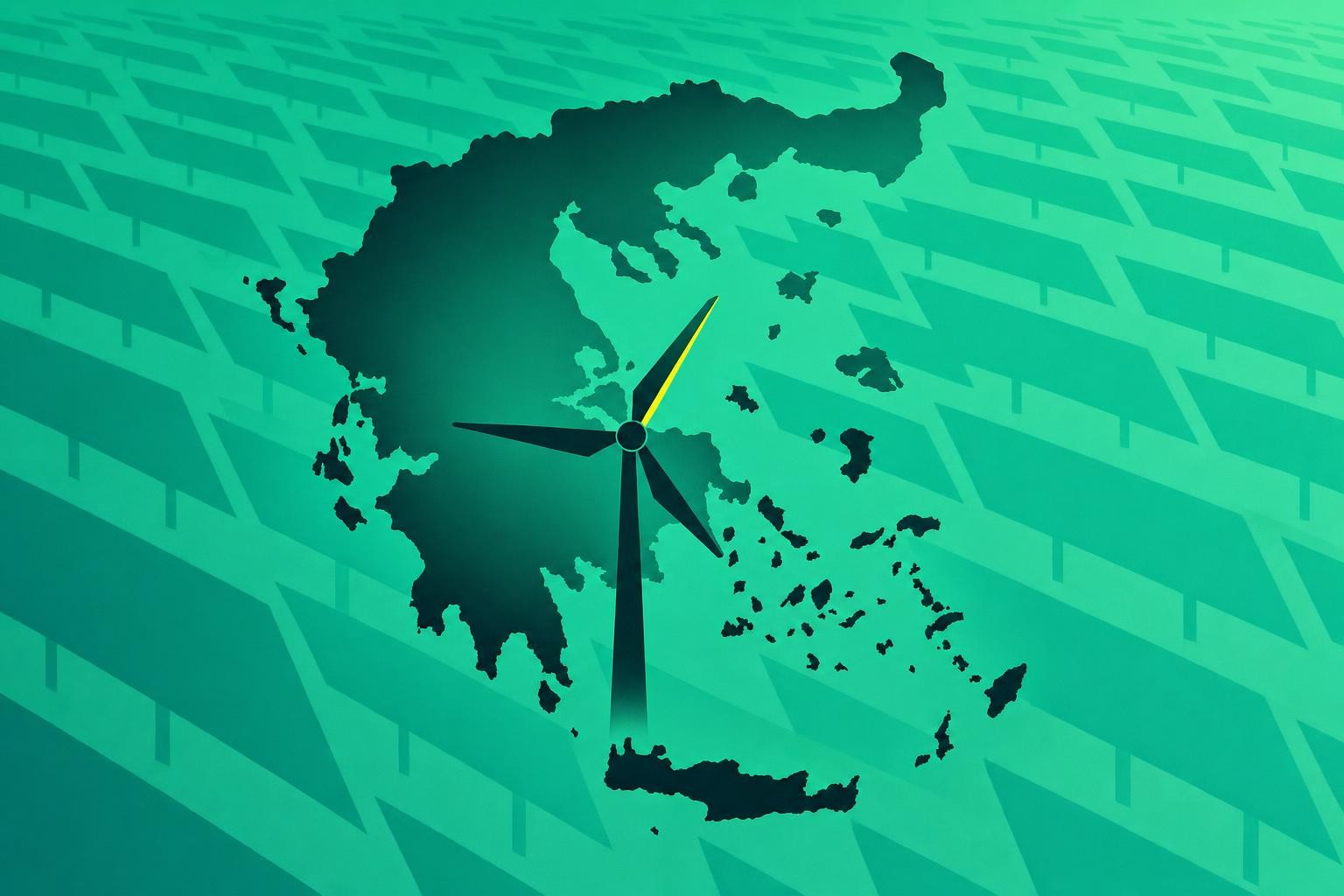
Greece's Fire Service has launched a nationwide criminal investigation into wind farm installations after a preliminary forensic report concluded that a faulty private power line serving a five-turbine wind farm in Boeotia ignited a megafire on 31 July 2026 that burned more than 11,200 hectares across Attica and Boeotia and killed two people.[1]
What the forensic report found
A preliminary investigation pointed to faults in a wind farm's power line as the likely origin of the devastating wildfire. The Fire Service's Arson Crimes Directorate (DAEE) found no evidence of arson, discarded cigarettes, fireworks, hot works, or other human activity that could have ignited the blaze at its point of origin near the village of Mavro Spithari in Boeotia.
The private electricity distribution network transitions from an underground cable to an overhead line supported by wooden utility poles before reaching the wind farm's facilities. Investigators found a fallen wooden utility pole and power conductors lying on the burned ground, and identified localized deformations and heat damage on the metal strands of the conductors, concluding that these defects existed before the wildfire and were not caused by it. Fire Service investigators, using video footage and witness statements, determined that oscillations in the conductors of the private transmission line produced sparks that fell onto dry vegetation.
The fire then spread rapidly under strong winds into neighbouring Attica, destroying thousands of hectares of forest and scrubland and damaging or destroying around 200 homes in the coastal area of Porto Germeno. Two firefighting helicopter crew members - a Greek and a Danish national - were killed on 2 August when their aircraft collided with another helicopter over the fire front at Psatha.
Three charged, including a mayor
Greek authorities placed a town mayor who owns an electrical company and two others in pre-trial detention after charging them with arson over the wildfire. Investigators believe the blaze started on 31 July with a spark from power cables at a wind farm near Agios Vasileios, a seaside village at the foot of a mountain 85 km northwest of Athens.
The three individuals detained are:
- Giannis Apostolou, mayor of the small town of Stylida around 140 km northwest of Athens, who owns an electrical installation company linked to the wind farm
- A contractor for his company
- The wind farm's owner
All three could face more than 10 years in jail if convicted.
Scope of the nationwide probe
The overseeing magistrate of the Arson Crime Investigation Division ordered a preliminary investigation on a national level, in agreement with the Supreme Court Prosecutor, on any criminal offenses relating to the installation of wind power facilities. According to ANT1 TV, there are 450 wind farms throughout the country.
Investigators will examine whether wind farms across Greece are operating with the required permits and whether rules governing their installation, maintenance and operation are being followed. Special attention will also be given to wind farms that have previously been linked to fire incidents.
The probe is framed as a compliance and criminal-conduct inquiry, not a verdict on wind energy itself. A 2025 study presented by the Hellenic Wind Energy Association, using wildfire and wind-farm data from Greece, reported no statistical correlation between the presence of wind farms and wildfire occurrence.
The move does not establish that wind farms or wind turbines generally cause wildfires. Rather, prosecutors are examining whether individual installations may have operated in violation of regulations or whether infrastructure associated with them may have contributed to a fire.
The stakes for Greece's wind build-out
The incident lands at a sensitive moment for Greek wind. Greece's installed wind energy capacity surpassed 6 GW for the first time, reaching 6,017 MW by the end of the first half of 2026, according to data from the Hellenic Scientific Association for Wind Energy (ELETAEN). During that six-month period, 65 new wind turbines with a combined capacity of 320.6 MW were brought online, representing investments of approximately €400 million. Greece's 2030 national plan targets 8 GW of onshore wind capacity.
That distinction matters because wind power has become a major part of Greece's renewable-energy strategy. ELETAEN also highlighted delays affecting wind farms selected through renewable energy auctions between 2018 and 2022. Those tenders awarded projects with a combined capacity of 1,592 MW, all of which should already be operational. By the end of the first half of 2026, however, only 1,191 MW - around 75% - had entered service, with the association attributing the delays primarily to administrative and permitting obstacles. A compliance-driven enforcement sweep could add further friction to an already slow permitting pipeline.
The key question now is whether the DAEE's inspections surface systemic deficiencies in privately operated grid-connection infrastructure - or confirm the Boeotia incident as an isolated failure of a specific installation. The outcome will determine whether Greece's regulators move toward sector-wide technical standards for wind farm power lines, or limit consequences to the individuals already in custody.
The images and texts on this page were created with the help of AI.
Related
Ready-to-build BESS projects lose their premium as Australia's NEM arbitrage spreads collapse 85%
Panellists at the Battery Asset Management Summit Australia 2026 said the venture-capital-style returns that once rewarded ready-to-build BESS projects have disappeared as NEM price spreads fell 85% in a year.
10 Sept 2026UK government opens three-month consultation on AI for clean energy, backed by 34-recommendation network review
DESNZ published its Vision for an AI-enabled clean energy system on 8 September, opening a call for evidence that closes 6 November and will feed into the UK's first AI for Clean Energy Strategy.
10 Sept 2026Heatwaves expose a three-layer risk for wind operators: resource, hardware, and people
Extreme heat cuts wind output, stresses nacelle components, and grounds maintenance crews - all at once. A look at how bad the summer of 2026 has been, and what the trend means for grid reliability.
10 Sept 2026