Germany's BSH puts offshore grid infrastructure blueprint to public consultation
Germany's Federal Maritime and Hydrographic Agency has published an offshore grid infrastructure blueprint for public consultation, as Berlin works to align grid build-out with its 70 GW offshore wind target for 2045.
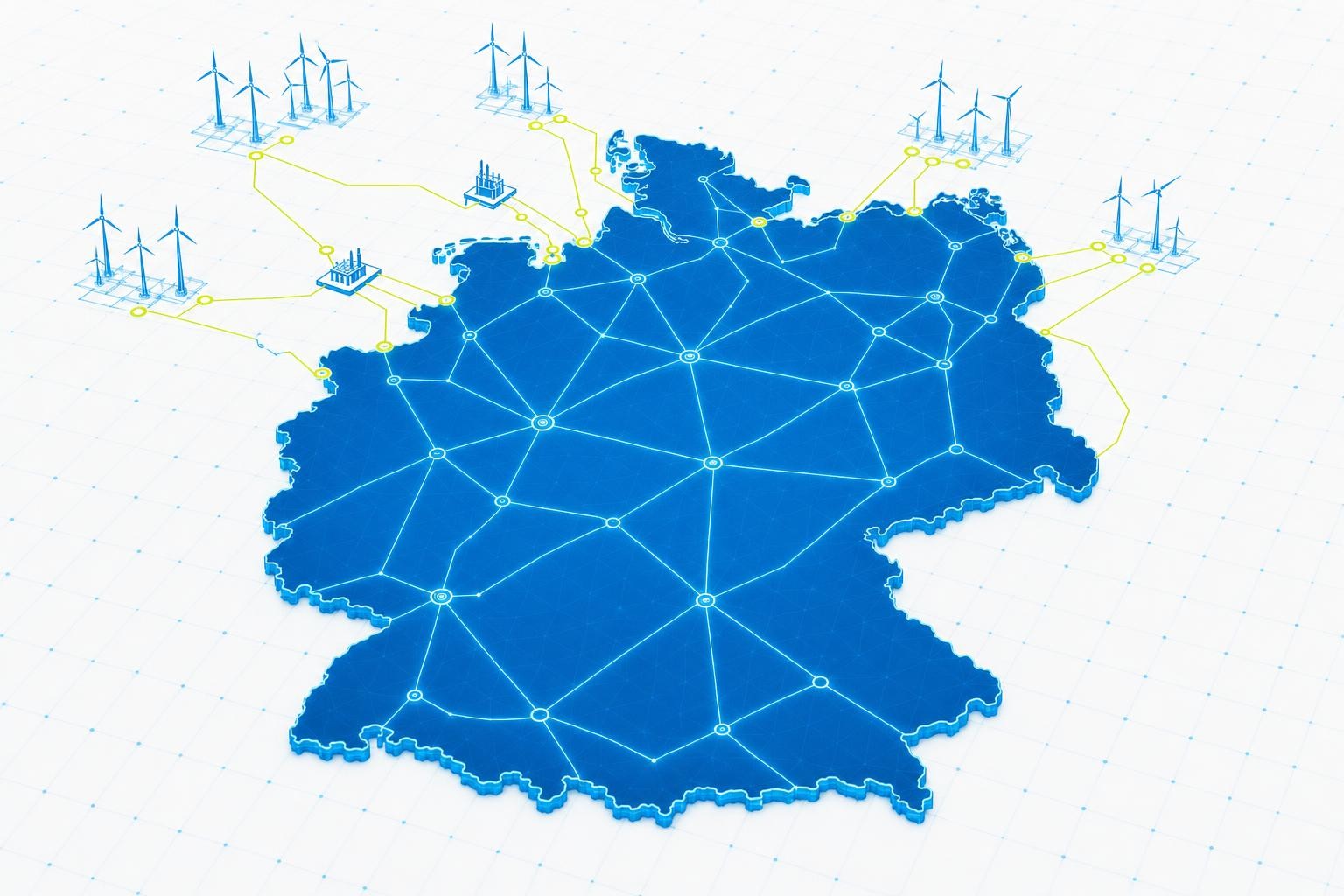
Germany's Federal Maritime and Hydrographic Agency (BSH) has published an offshore grid infrastructure blueprint and opened it for public consultation[1], the latest in a sequence of planning moves as Berlin tries to synchronise grid build-out with an offshore wind programme that has been running behind schedule.
What the blueprint covers
The BSH document is the second amendment to the 2025 Site Development Plan (Flächenentwicklungsplan, FEP), which defines wind energy areas, grid connection routes, and auction timelines in the North and Baltic Seas. The amendment proposes several changes to offshore wind areas, auction schedules, and grid connection plans in the North Sea, including revised planning options for sites N-10.1 and N-10.2 - which received no bids in 2025 - adjustments to commissioning dates for several areas, changes to the boundaries of sites N-12.5 and N-12.6, and modifications to the route of the NOR-10-1 offshore grid connection.
The BSH has proposed three options for redesigning areas N-10.1 and N-10.2 to improve project economics ahead of a new auction in 2027. Under the amendment, four offshore wind areas with a combined capacity of 4 GW are planned for auction in 2027: N-10.1 and N-10.2 with 2.5 GW, N-13.1 with 0.5 GW, and N-13.2 with 1 GW.
The draft does not currently provide for a 2027 auction for areas N-12.4 and N-12.5, whose 2026 tender was suspended.
Grid plan running in parallel
The BSH consultation sits alongside a separate but related process at the Bundesnetzagentur (BNetzA). The BNetzA launched a consultation running until 24 August on the second draft of the Network Development Plan (NDP) for the expansion of the electricity grid up to 2037 and 2045.
Transmission system operators proposed 159 expansion measures, of which the regulator considers 118 ready for approval. The new draft also provides for up to eight additional offshore connections by 2037 to accommodate new offshore wind projects.
The gap between targets and reality
Germany's Offshore Wind Energy Act (WindSeeG) sets statutory targets of at least 30 GW by 2030, at least 40 GW by 2035, and at least 70 GW by 2045. The current position is well short of that trajectory.
10.8 GW is already in operation, another 1.3 GW is under construction, and a final investment decision has been made for 2.6 GW. Less advanced are 17.5 GW that have been awarded or hold a grid connection claim, and 9 GW designated for tender but not yet awarded. As a result, the 2030 target can no longer be met on time.
The draft WindSeeG amendment, which closed its stakeholder consultation on 17 August 2026, addresses part of the problem by replacing the fixed 4,000 MW annual auction target with a flexible corridor. From 2027, the annual auction volume becomes a corridor of, in principle, 2,000 to 4,800 MW, replacing the currently fixed 4,000 MW target per year. The 70 GW target is maintained, but the policy centre of gravity shifts from speed of build-out to cost efficiency, bankability, and supply-chain resilience.
What to watch
The BSH consultation deadline and the BNetzA NDP comment window both close in late August 2026. The more consequential sequence runs after that: the WindSeeG amendment must clear Cabinet, parliamentary deliberation, and EU state aid review before 2027 auctions can proceed. The stakeholder consultation closed on 17 August 2026, followed by Cabinet adoption, parliamentary deliberations, and EU state aid clearance - a tight sequence if the 2027 auctions are to proceed on time. Whether the revised site configurations for N-10.1 and N-10.2 are enough to attract bids after the 2025 zero-bid outcome is the question the industry will be watching most closely.
The images and texts on this page were created with the help of AI.
Related
Ready-to-build BESS projects lose their premium as Australia's NEM arbitrage spreads collapse 85%
Panellists at the Battery Asset Management Summit Australia 2026 said the venture-capital-style returns that once rewarded ready-to-build BESS projects have disappeared as NEM price spreads fell 85% in a year.
10 Sept 2026UK government opens three-month consultation on AI for clean energy, backed by 34-recommendation network review
DESNZ published its Vision for an AI-enabled clean energy system on 8 September, opening a call for evidence that closes 6 November and will feed into the UK's first AI for Clean Energy Strategy.
10 Sept 2026Heatwaves expose a three-layer risk for wind operators: resource, hardware, and people
Extreme heat cuts wind output, stresses nacelle components, and grounds maintenance crews - all at once. A look at how bad the summer of 2026 has been, and what the trend means for grid reliability.
10 Sept 2026