Empromptu launches Grid Guard software to smooth GPU power spikes in AI data centres
San Francisco startup Empromptu has released Grid Guard, software that staggers GPU workloads by 50-200 ms to cut data centre power volatility by an average of 80%, without hardware changes.

San Francisco-based Empromptu AI on 3 August 2026 released Grid Guard, a software platform designed to predict and smooth the sharp power spikes that occur when large GPU clusters execute compute-intensive tasks simultaneously[1]. The company says early deployments have cut power volatility by an average of 80% without meaningfully affecting AI workload performance[1], though it has not disclosed deployment sites or provided independent validation of those results.
The problem Grid Guard addresses
Thousands of GPUs firing simultaneously can swing power demand by tens of megawatts in milliseconds - fast enough to damage generators and force costly infrastructure overbuild. When GPU clusters execute the same operation at the same instant - starting a training batch, syncing data, processing a large input - power demand can swing by tens of megawatts in milliseconds, at a rate turbines and generators were not designed to handle. The industry's default response has been to overbuild: more batteries, more generators, more redundancy, more capital expense.
Grid response to rapid load changes can take up to 90 minutes with traditional generation resources, and such swift transitions may disrupt electric resonance, transformer stability, and voltage for other grid users. The problem is not confined to peak draw - it is the speed and synchronisation of the transitions that causes the stress.
How the software works
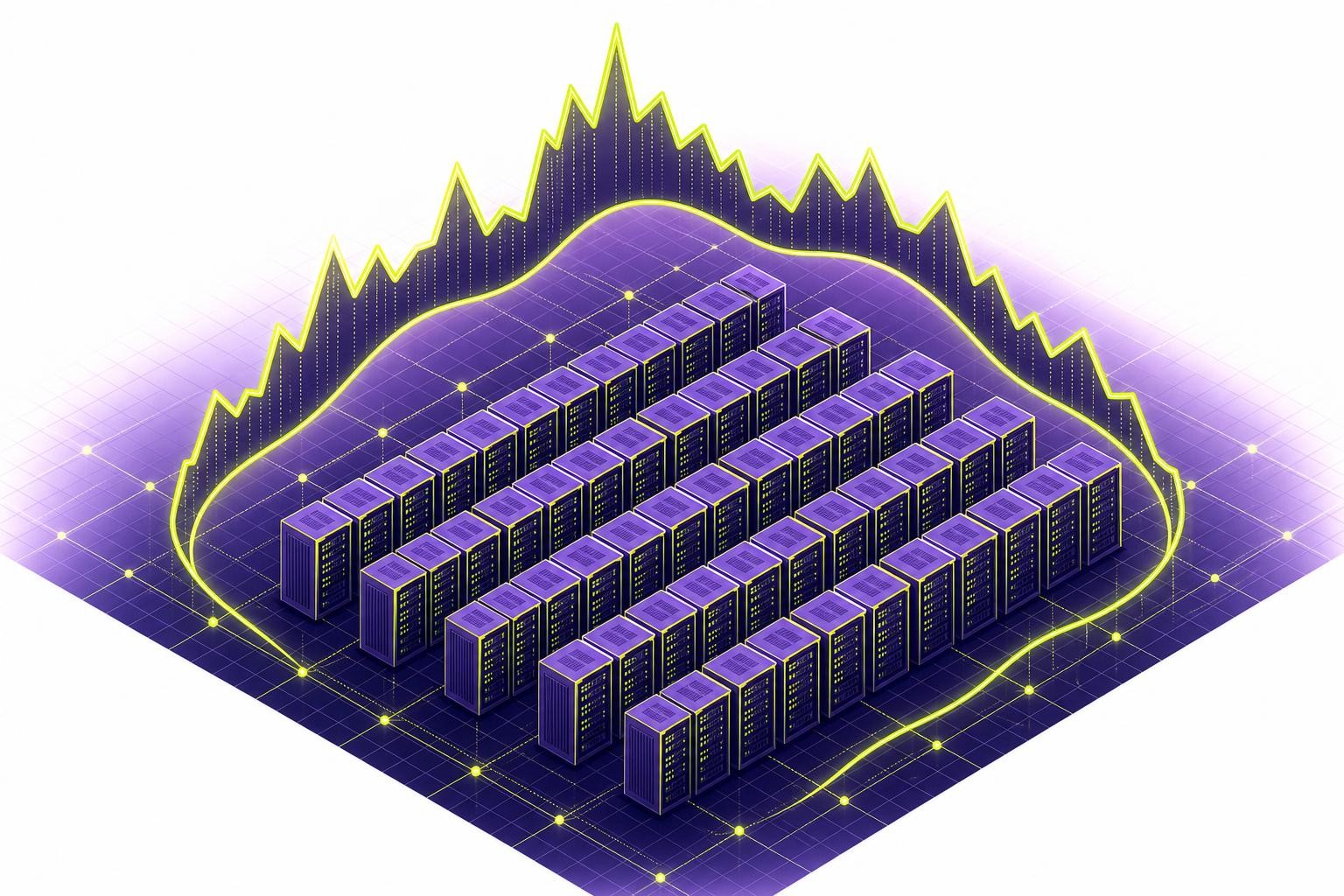
Grid Guard staggers GPU workloads by 50 to 200 milliseconds, turning a sharp power spike into a smooth rolling ramp. That timing margin is small enough to have no material effect on training throughput but large enough to eliminate the synchronised surge at the grid interface.
The platform combines four functions: forecasting short-term changes in GPU power demand; scheduling workloads to reduce synchronised load spikes; sending demand signals to power infrastructure such as batteries and generators; and analysing the cost of different workload patterns. Because it operates in software, it can be deployed without changes to physical infrastructure and improves continuously as it learns from real operational data.
Market context
Grid Guard enters a crowded but still-unsolved space. Nvidia's GB300 NVL72 platform addresses the same problem in hardware, integrating onboard energy storage to smooth power spikes and aiming to reduce peak grid demand by up to 30%. Oracle has published work on a millisecond-scale GPU "heartbeat" signal that enables a lightweight software smoother to fill brief idle valleys[1]. Empromptu's claim of an 80% volatility reduction, if independently confirmed, would represent a materially larger improvement than hardware-only approaches - though the comparison is not direct, as the metrics measure different things.
Grid Guard is already engaged with a major power company ahead of a live deployment, which Empromptu has not named. The company argues that managing power demand in software could reduce the need for additional electrical infrastructure deployed to absorb short-duration load spikes.
What to watch
The 80% volatility figure is self-reported and unaudited. Independent measurement - ideally from a utility or grid operator with metering at the point of interconnection - would be the test that matters. Empromptu's engagement with an unnamed power company is the most significant near-term signal: if that utility publishes interconnection data before and after Grid Guard deployment, it will be the first third-party evidence for a software-only approach to this problem at commercial scale.
The images and texts on this page were created with the help of AI.
Related
Ready-to-build BESS projects lose their premium as Australia's NEM arbitrage spreads collapse 85%
Panellists at the Battery Asset Management Summit Australia 2026 said the venture-capital-style returns that once rewarded ready-to-build BESS projects have disappeared as NEM price spreads fell 85% in a year.
10 Sept 2026UK government opens three-month consultation on AI for clean energy, backed by 34-recommendation network review
DESNZ published its Vision for an AI-enabled clean energy system on 8 September, opening a call for evidence that closes 6 November and will feed into the UK's first AI for Clean Energy Strategy.
10 Sept 2026Heatwaves expose a three-layer risk for wind operators: resource, hardware, and people
Extreme heat cuts wind output, stresses nacelle components, and grounds maintenance crews - all at once. A look at how bad the summer of 2026 has been, and what the trend means for grid reliability.
10 Sept 2026