Grid flexibility at data centers is an operational problem, not just a market one
When a grid signal arrives at a data center, someone has to decide who changes what, and how the site recovers. That question is now being answered by regulators, not operators.
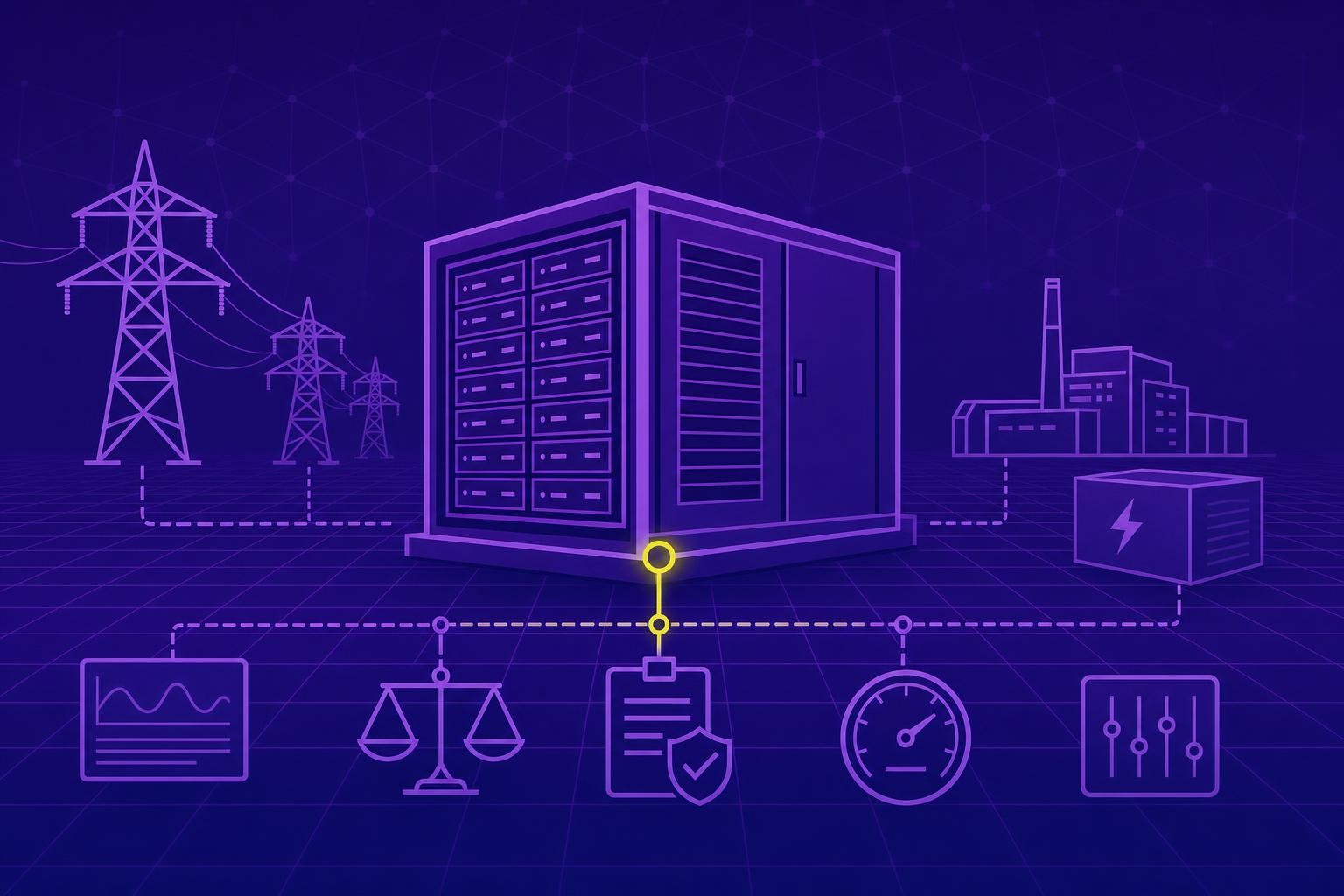
A Data Center Dynamics opinion piece published this month frames the grid flexibility debate in terms that planners and operators should take seriously: flexibility depends on who can change a live system, when they can do it, and how the site recovers[1]. That framing matters because the regulatory environment has moved faster than most operators' internal governance has.
The emergency order that changed the terms
On 14 July 2026, the US Department of Energy temporarily authorized PJM Interconnection to direct eligible backup resources at large-load sites - including data centers - as a last resort before firm load interruption or during an Energy Emergency Alert Level 3. The order covered auxiliary, standby, and directly connected generation, battery storage, and other backup resources, while excluding assets serving a critical reliability or backup need[1]. It ran for one week, through 21 July, unless renewed[1].
That July order was not the first. The DOE issued its initial Section 202(c) order authorizing PJM to direct data center backup generation on 26 January 2026, with a second extension following days later. By the time the July heat wave arrived, this had become a repeating instrument - a pattern that the Center for Progressive Reform noted was unprecedented before 2026.
The July order did not allow PJM to switch off servers[1]. But it did mean that, during those emergency conditions, an eligible backup resource at an affected site was no longer exclusively internal[1]. External authority could require a change in live electrical operations.
What NERC's Level 3 alert added
The emergency orders arrived in a context already reshaped by NERC. On 4 May 2026, NERC issued a Level 3 "Essential Actions" Alert - its highest-urgency notification - in response to documented events in which 1,000 MW or more of computational load dropped off the bulk power system in seconds, causing significant grid oscillations. These were customer-initiated: protection circuits at data centers detected power quality problems and automatically disconnected to protect sensitive equipment.
NERC's companion May 2026 Reliability Guideline on emerging large loads is a 47-page voluntary document that calls for resource adequacy studies representing firm and flexible load components, behind-the-meter resources, AI training operating windows, and probabilistic scenarios across weather, load, and outage combinations. Registered entities were required to acknowledge the alert by 11 May 2026 and report on their activities by 3 August 2026.
The guideline is non-binding. But as Morgan Lewis noted in June, interconnecting transmission owners may incorporate NERC's recommendations into interconnection requirements, operating procedures, commissioning protocols, and outage coordination processes - making the practical effects significant even without mandatory compliance obligations.
What flexibility actually means in practice
The DCD piece draws a line between what sounds flexible and what is operationally deliverable[1]:
- Standby generators are not automatically continuous or market-participating generation[1]
- Cooling can use thermal inertia, but operating conditions and the rebound constrain it[1]
- Moving a batch job is not instantaneous curtailment[1]
- Accepted demand response is distinct from involuntary load shedding[1]
In March 2026, Google announced it had integrated 1 GW of data center demand response into long-term US utility contracts - with Indiana Michigan Power, Tennessee Valley Authority, Entergy Arkansas, Minnesota Power, and DTE Energy - by limiting or shifting machine-learning workloads. Google itself noted that flexibility was limited and available only at certain locations[1]. That is contracted capacity, not a delivery record[1].
The most operationally detailed proof point to date came from a demonstration at Nebius's London AI Factory. Over five days, a 96-GPU NVIDIA Blackwell Ultra cluster running production-grade AI workloads responded to 22 live dispatch events, reducing power by approximately 30 percent in under 40 seconds, while meeting every requested power-reduction target across more than 200 simulated grid events. The Emerald AI Conductor platform prioritized urgent workloads and absorbed flexibility through lower-priority work. That is a real operational result - but the cluster was small relative to gigawatt-scale demand.
The governance gap
The DCD piece's sharpest observation is organizational[1]: one accountable owner must decide when grid, facilities, platform, and customer priorities conflict. NERC's May 2026 guideline reinforces exactly this discipline[1].
Most large data centers today still operate as fixed, always-on loads. As the UK prepares for over 6 GW of data center deployments by 2030, National Grid and EPRI estimate that power-flexible AI data centers could make more than 2 GW of capacity available back to the grid when needed. The gap between that potential and current practice is not technical - it is about who owns the decision when a grid signal arrives and compute is running.
What to watch: NERC's standards project initiated on 18 March 2026 is expected to convert the voluntary guideline into binding reliability standards. When that happens, the governance question stops being optional.
The images and texts on this page were created with the help of AI.
Related
Ready-to-build BESS projects lose their premium as Australia's NEM arbitrage spreads collapse 85%
Panellists at the Battery Asset Management Summit Australia 2026 said the venture-capital-style returns that once rewarded ready-to-build BESS projects have disappeared as NEM price spreads fell 85% in a year.
10 Sept 2026UK government opens three-month consultation on AI for clean energy, backed by 34-recommendation network review
DESNZ published its Vision for an AI-enabled clean energy system on 8 September, opening a call for evidence that closes 6 November and will feed into the UK's first AI for Clean Energy Strategy.
10 Sept 2026Heatwaves expose a three-layer risk for wind operators: resource, hardware, and people
Extreme heat cuts wind output, stresses nacelle components, and grounds maintenance crews - all at once. A look at how bad the summer of 2026 has been, and what the trend means for grid reliability.
10 Sept 2026