The Daily Baseload Brief
Europe's largest battery enters service in Scotland; Arevon's 1,200 MWh Nighthawk comes online in California; Latin America's solar build accelerates while storage lags. Power sector digest for 14 August 2026.
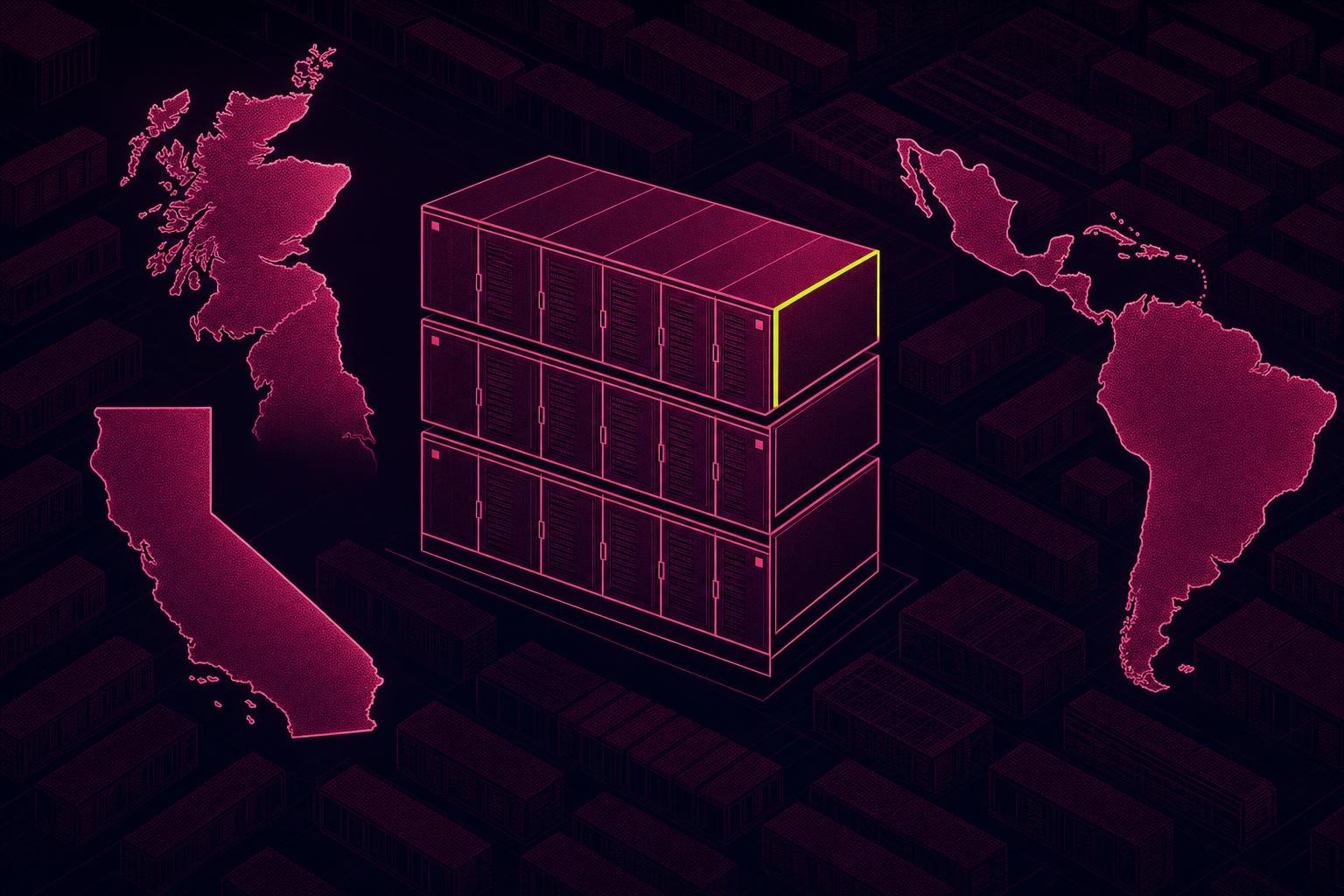
Copenhagen Infrastructure Partners' Coalburn 1 - a 500 MW, two-hour lithium-ion BESS in South Lanarkshire, Scotland - entered commercial operation on 12 August, becoming the largest operational battery in Europe.
Coalburn 1 was supplied by Canadian Solar's e-STORAGE subsidiary under a contract covering 1,170 MWh DC of SolBank battery technology, with RES appointed as asset manager. CIP divested a 50% stake to AXA IM Alts ahead of commissioning. The project is the first of three CIP transmission-connected BESS assets in Scotland; Coalburn 2 and Devilla reached financial investment decisions in January 2026 and are due to begin construction in 2027, bringing the combined Scottish portfolio to 1.5 GW / 3 GWh.
On the same day, Arevon Energy announced that its 300 MW / 1,200 MWh Nighthawk Energy Storage Project in Poway, California, had started operations under a long-term resource adequacy agreement with Pacific Gas and Electric. Nighthawk uses Tesla Megapack LFP technology and is the largest standalone BESS in Arevon's portfolio. The project was backed by a $920 million financing package closed in March 2026, including a $482 million debt facility led by CIBC and a $268 million tax credit transfer agreement.
Also on 12 August, Verano Energy awarded the BESS supply contract for its 152 MW / 606 MWh Observatorio project to Sungrow. No location or COD was disclosed in the announcement.
In Latin America, a pv magazine survey published 10 August found that renewables comprised roughly 80% of newly installed power generation capacity in the region in 2025, driven by falling solar costs, rising drought frequency, and demand for grid stability[1]. Storage deployment, however, remains concentrated in demonstration projects, small-scale grid-support applications, and remote-area microgrids, with a large-scale market yet to take shape[1]. Transmission bottlenecks are a parallel constraint: Chile's Atacama Desert holds substantial utility-scale solar potential, but insufficient grid infrastructure forces curtailment and negative electricity prices in the north while central and southern cities remain undersupplied.
On the Texas interconnection queue, ERCOT will seek a good cause exception from the PUCT at the commission's 20 August open meeting after suspending Batch Zero large-load classification notifications that had been scheduled for 7 August. ERCOT is tracking approximately 438,000 MW of large-load requests, with roughly 89% from data centers. The 20 August hearing is the next formal decision point for a process that underpins grid access for the bulk of the Texas data center pipeline.
The images and texts on this page were created with the help of AI.
Related
Ready-to-build BESS projects lose their premium as Australia's NEM arbitrage spreads collapse 85%
Panellists at the Battery Asset Management Summit Australia 2026 said the venture-capital-style returns that once rewarded ready-to-build BESS projects have disappeared as NEM price spreads fell 85% in a year.
10 Sept 2026UK government opens three-month consultation on AI for clean energy, backed by 34-recommendation network review
DESNZ published its Vision for an AI-enabled clean energy system on 8 September, opening a call for evidence that closes 6 November and will feed into the UK's first AI for Clean Energy Strategy.
10 Sept 2026Heatwaves expose a three-layer risk for wind operators: resource, hardware, and people
Extreme heat cuts wind output, stresses nacelle components, and grounds maintenance crews - all at once. A look at how bad the summer of 2026 has been, and what the trend means for grid reliability.
10 Sept 2026