CS Wind Offshore puts CNC Onsite's automated cable-penetration machine into service at Aalborg
CS Wind Offshore has deployed a custom CNC Onsite gantry machine at its Aalborg facility to mill cable penetrations in offshore wind transition pieces, replacing manual flame cutting.
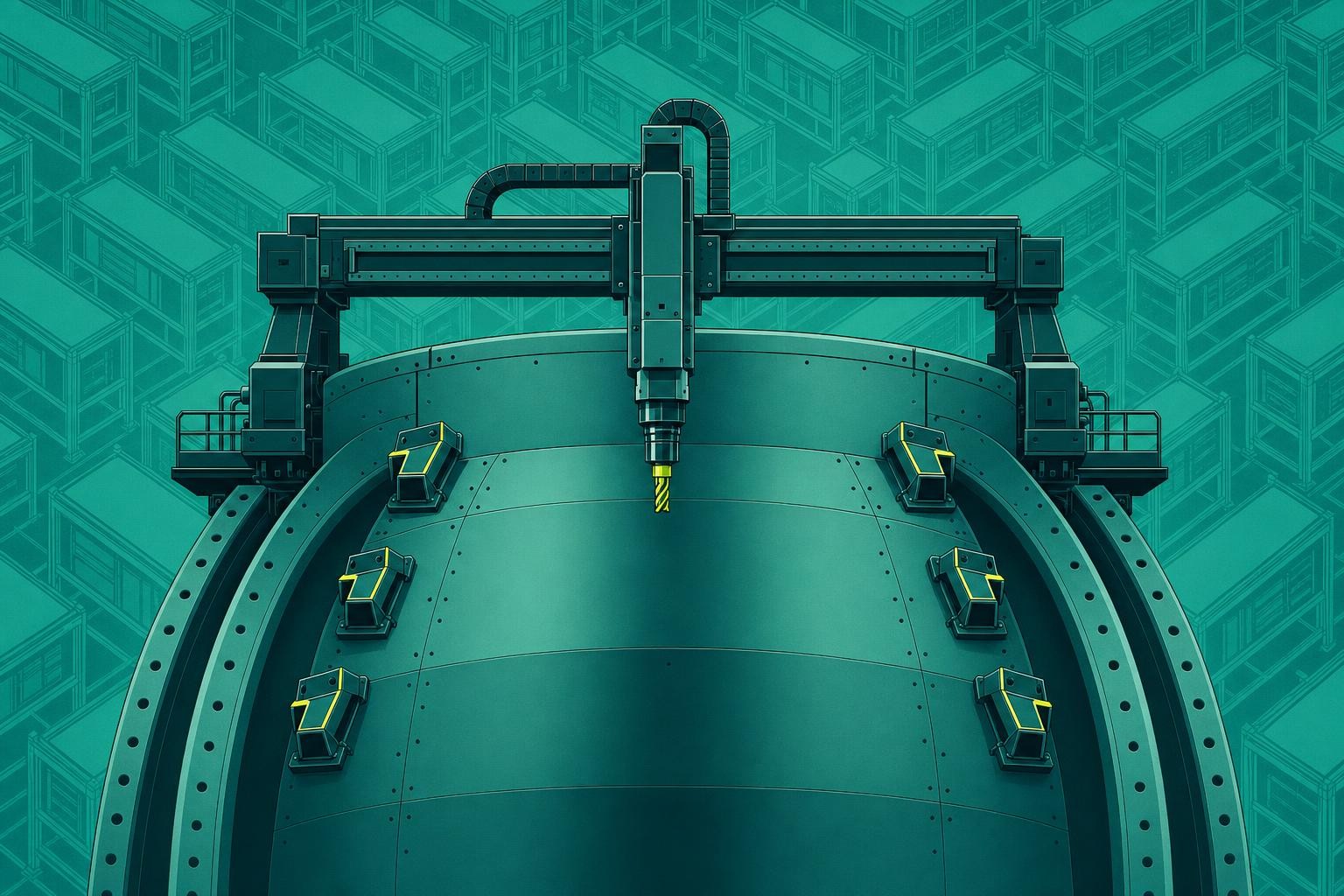
CS Wind Offshore has begun operating a custom-built automated milling machine from Danish specialist CNC Onsite at its Aalborg facility to produce cable penetrations in offshore wind transition pieces, replacing a manual flame-cutting and grinding process[1].
What the machine does
Each transition piece processed by the machine requires six cable penetrations and 12 pressure relief holes[1]. The cable penetrations allow cables powering external workspace lighting and platform cranes to be sealed, while the pressure relief holes are designed to prevent structural warping under changing pressure and rough sea conditions[1].
The machine is a mobile gantry unit that attaches to the curved surface of a transition piece using a magnetic fastening system, leaving no marks on the steel[1]. It completes all cable penetrations in a single automated pass using computer-controlled milling, producing clean-cut holes suited to reliable cable sealing[1].
Key specifications of the new machine:
- Penetration dimensions: 180 mm × 350 mm
- Operating angle range: 28° to 90°, with penetrations machined at 45° to accommodate diagonal cable routing
- Mounting: magnetic gantry, no surface damage to the steel
Context: a second CNC Onsite machine at Aalborg
This is the second CNC Onsite machine deployed at CS Wind Offshore's Aalborg site. The first - a flange-facing unit named "Goliath" - was commissioned roughly two years ago to mill the large-diameter flanges of transition pieces after welding. Goliath achieves a global flatness tolerance of 1 mm and a local flatness tolerance of 0.3 mm for an 8-metre flange, against an industry standard of 2.5 mm. CS Wind Offshore's measurement team reported tolerances better than specified.
The new cable-penetration machine extends CNC automation further into the TP production sequence, covering a step that had previously relied on manual cutting tools. CS Wind Offshore produces transition pieces at its 450,000 square metre facility in Aalborg and ships them to offshore wind farms worldwide.
Why precision matters here
Transition pieces sit between the monopile foundation and the turbine tower, making them a structurally critical node. Cable penetrations that are poorly cut can compromise sealing integrity, creating pathways for water ingress and corrosion. Pressure relief holes that are imprecisely positioned or sized risk failing to relieve internal pressure differentials under storm conditions, which can cause structural deformation.
Automating both steps - flange facing and cable penetration - reduces dependence on operator skill and shortens the inspection cycle before handover.
What to watch
CS Wind Offshore has not disclosed which projects will receive transition pieces processed by the new machine, nor has it indicated whether the cable-penetration machine will be replicated at other facilities. As turbine ratings continue to rise and transition pieces grow larger, the pressure on dimensional tolerances at every stage of TP manufacture is likely to increase - making the case for further automation at the Aalborg line.
The images and texts on this page were created with the help of AI.
Related
Ready-to-build BESS projects lose their premium as Australia's NEM arbitrage spreads collapse 85%
Panellists at the Battery Asset Management Summit Australia 2026 said the venture-capital-style returns that once rewarded ready-to-build BESS projects have disappeared as NEM price spreads fell 85% in a year.
10 Sept 2026UK government opens three-month consultation on AI for clean energy, backed by 34-recommendation network review
DESNZ published its Vision for an AI-enabled clean energy system on 8 September, opening a call for evidence that closes 6 November and will feed into the UK's first AI for Clean Energy Strategy.
10 Sept 2026Heatwaves expose a three-layer risk for wind operators: resource, hardware, and people
Extreme heat cuts wind output, stresses nacelle components, and grounds maintenance crews - all at once. A look at how bad the summer of 2026 has been, and what the trend means for grid reliability.
10 Sept 2026