BWO tells Berlin its two-stage CfD model falls short of what the offshore wind market needs
Germany's offshore wind trade group says the government's draft WindSeeG amendment makes CfDs a last resort rather than a standard feature - and that distinction matters for bankability.
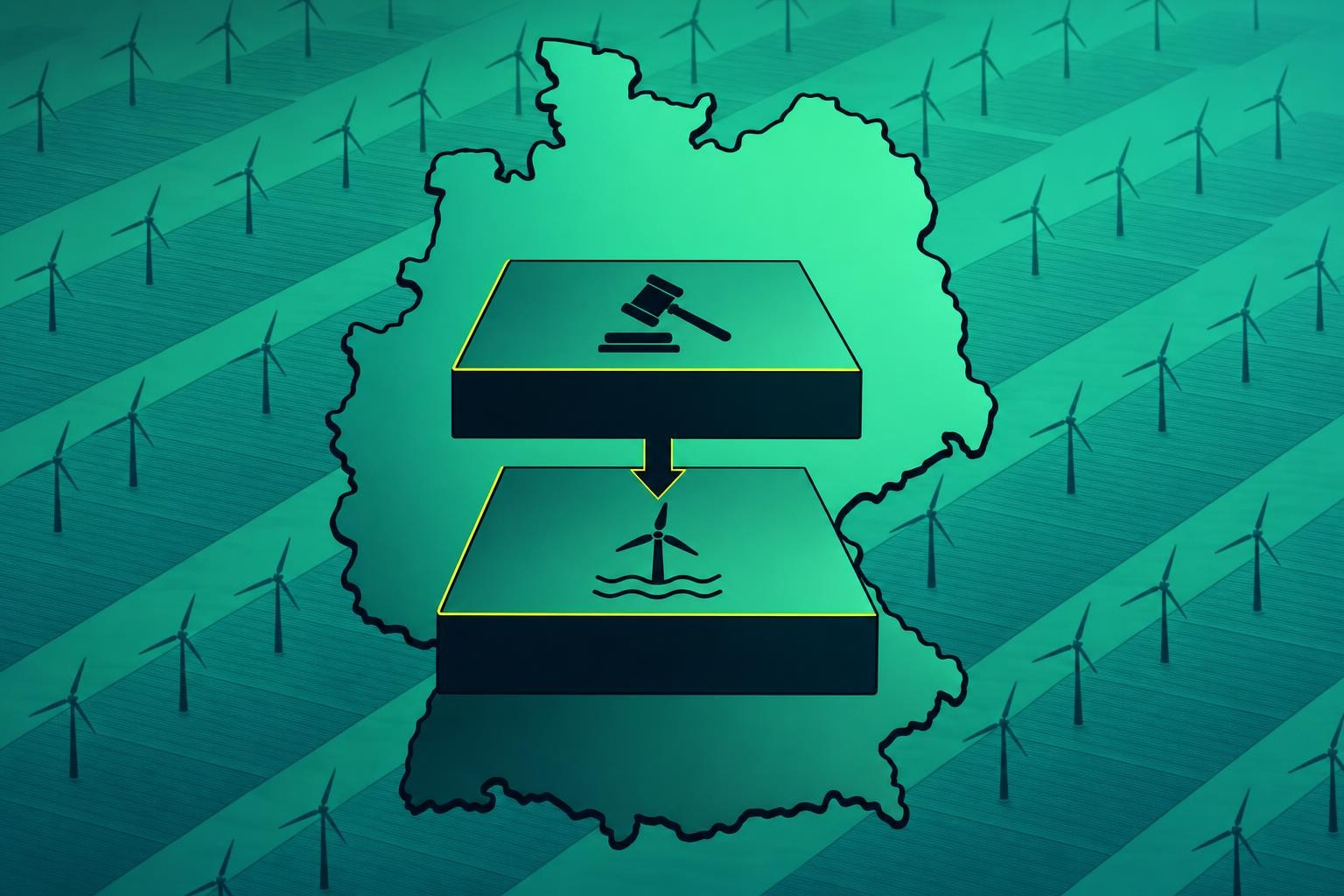
Germany's offshore wind trade association has told the federal government that its draft reform of the Wind Energy at Sea Act (WindSeeG) does not go far enough, arguing that the proposed two-stage auction mechanism treats contracts for difference as a fallback rather than a structural feature of every tender.[1]
The Federal Ministry for Economic Affairs and Energy (BMWE) published the draft amendment on 10 August 2026, opening a stakeholder consultation that closed at 10am on 17 August.[1] The German Offshore Wind Energy Association (BWO) submitted its response within that window.
What the draft proposes
The draft retains Germany's statutory target of at least 70 GW of offshore wind capacity by 2045 and sets an annual auction corridor of 2,000 MW to 4,800 MW from 2027, replacing the previously fixed 4,000 MW annual target. It also proposes extending the standard operating period for new offshore wind farms from 25 to 35 years, and introduces provisions for cross-border offshore wind projects.
The auction mechanism works in two stages:
- Stage one tests whether any bidder will develop a site without revenue support. Where multiple bidders are willing, a dynamic ascending auction determines a payment component - 90% of which flows to the connecting transmission system operator as an electricity cost reduction, with 5% each allocated to marine conservation and fisheries.
- Stage two is triggered only if no bidder accepts the opening price in stage one - at which point a descending auction for the lowest applicable CfD strike value becomes available.
The draft also confirms that no offshore wind auction will take place in 2026, following converter platform delays at sites N-10.1 and N-10.2 and the government's earlier decision to suspend that round.
Where BWO draws the line
The BWO welcomed the inclusion of two-sided CfDs in principle, but said the proposed sequencing is the wrong design. The association's core objection is that CfD protection should be reliably available from the outset of every tender, not activated only when no developer is prepared to take on full merchant risk.
"With the CfD, the draft takes an important step in the right direction," said BWO managing director Stefan Thimm, "but it is crucial that it is used from the outset, rather than kicking in only when no one is willing to bear the full market risk."
The association argued that the two-stage structure effectively rewards developers willing to accept the greatest risk, rather than making risks manageable across the board. BWO said CfDs can give investors long-term planning certainty and make an important contribution to restoring lost confidence in the German market.
BWO also criticised the draft for omitting a mechanism that would allow developers to voluntarily return sites awarded in the 2023-2025 tender rounds that are no longer economically viable. The association has argued since May 2026 that without such a route, unviable projects could remain tied up for years, blocking grid connection capacity and offshore areas that could otherwise be re-tendered quickly.
The backdrop: a market that has already failed once
The urgency of BWO's position is grounded in recent history. A 2.5 GW tender for North Sea sites N-10.1 and N-10.2 attracted no bids in August 2025 - the first complete failure of a German offshore wind auction - prompting the government to postpone the re-tender to 2027. Earlier 2025 rounds, while technically successful, saw a declining number of bids and falling bid values.
The failed tender exposed the structural weaknesses of Germany's existing model: uncapped negative bidding, grid connection delays, and potential losses from wake effects in the densely packed German North Sea. CfDs are already used in several major European offshore markets, including the UK, France, Belgium, and Poland. BWO has noted that almost all Baltic Sea countries have either introduced bilateral CfDs or are in the process of doing so, and warned that a divergent German design would complicate cross-border cooperation and drive up project costs.
What to watch
The consultation has now closed. The next test is whether the BMWE revises the two-stage mechanism before the draft proceeds through the Bundestag - and whether the re-tender of N-10.1 and N-10.2, planned for 2027, will be governed by the new rules or the old ones. BWO has made clear it will continue pressing for a CfD-only model as the legislative process moves forward.
The images and texts on this page were created with the help of AI.
Related
Ready-to-build BESS projects lose their premium as Australia's NEM arbitrage spreads collapse 85%
Panellists at the Battery Asset Management Summit Australia 2026 said the venture-capital-style returns that once rewarded ready-to-build BESS projects have disappeared as NEM price spreads fell 85% in a year.
10 Sept 2026UK government opens three-month consultation on AI for clean energy, backed by 34-recommendation network review
DESNZ published its Vision for an AI-enabled clean energy system on 8 September, opening a call for evidence that closes 6 November and will feed into the UK's first AI for Clean Energy Strategy.
10 Sept 2026Heatwaves expose a three-layer risk for wind operators: resource, hardware, and people
Extreme heat cuts wind output, stresses nacelle components, and grounds maintenance crews - all at once. A look at how bad the summer of 2026 has been, and what the trend means for grid reliability.
10 Sept 2026