Brazil's Chamber of Deputies takes up mandatory reverse logistics bill for solar panels and batteries
Bill 753/2026 would require manufacturers, importers and retailers to collect and recycle end-of-life PV panels and batteries, ahead of an estimated 550,000-tonne waste wave.
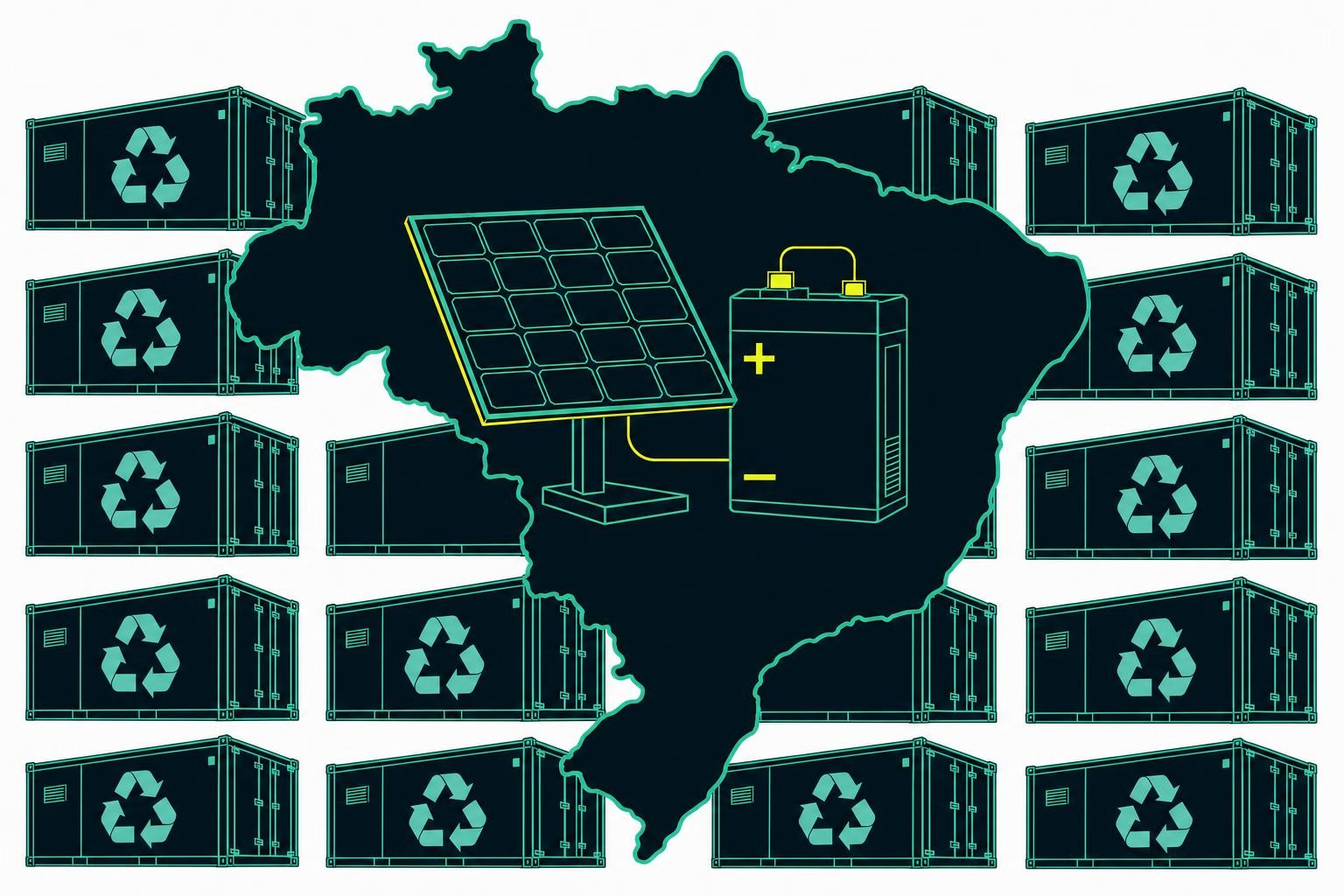
A bill filed in Brazil's Chamber of Deputies would make reverse logistics mandatory for photovoltaic panels, batteries and energy storage systems, placing collection and recycling obligations on manufacturers, importers and retailers[1]. The proposal, Bill 753/2026, was introduced by Representative Clodoaldo Magalhães and is now under committee review[1].
What the bill requires
Bill 753/2026 establishes a producer-responsibility framework with several distinct obligations[1]:
- Manufacturers, importers and retailers must collect discarded equipment and route it to licensed recycling or disposal facilities.
- Collection systems must be organised by the sector itself, with no reliance on public urban cleaning services.
- Installation companies must advise consumers on return procedures and accept modules, batteries and components replaced during maintenance for forwarding to licensed recyclers.
- Equipment must be designed to ease disassembly and material reuse, and to minimise hazardous substances - an ecodesign requirement embedded in the text.
The bill also formally incorporates PV panels and batteries into Brazil's existing National Solid Waste Policy (PNRS), the 2010 framework that already governs reverse logistics for other product categories[1].
The waste problem driving the proposal
In his justification, Magalhães cited studies projecting that Brazil could generate around 550,000 tonnes of photovoltaic panel waste over the next few years[1]. That figure reflects the scale of the build-out: Brazil's cumulative installed PV capacity stood at roughly 68 GW by early 2026, split between approximately 46 GW of distributed generation and 22.3 GW of utility-scale plants, with Absolar forecasting total capacity reaching 75.87 GW by year-end.
The solar boom began in earnest around 2015, meaning the first large cohort of panels - typically carrying 25-year warranties - will begin reaching end-of-life between 2028 and 2035. Manufacturing scrap and premature failures from extreme weather already generate an estimated 3,000-5,000 tonnes of waste annually. Domestic recycling capacity is limited to fewer than five dedicated facilities, mostly concentrated in São Paulo and Minas Gerais, with a combined processing capacity of approximately 6,000-8,000 tonnes per year as of 2026.
The regulatory gap is well-documented. Although Brazil has applicable legal tools, including the National Solid Waste Policy and Decree No. 10.240/2020, there is still a lack of direct regulation aimed at solar modules. In practice, disposal has fallen on the final consumer, who faces high costs and a shortage of collection points, with the sector operating without specific guidelines that guarantee shared responsibility between manufacturers, distributors and integrators.
Legislative path
The bill must clear three committees - Environment and Sustainable Development, Urban Development, and Constitution, Justice and Citizenship - before a full Chamber vote[1]. If it passes both the Chamber and the Senate, it proceeds to presidential sanction[1]. No timeline for committee hearings has been set.
What to watch
The bill's ecodesign provisions are the element most likely to draw industry pushback, as they would impose product-level requirements on manufacturers and importers rather than simply creating a collection fund. The committee sequence also matters: the Constitution, Justice and Citizenship panel will determine whether the bill's sector-funded collection mandate conflicts with existing public-service frameworks under the PNRS. Brazil's solar industry association Absolar has not yet issued a public position on the proposal.
The images and texts on this page were created with the help of AI.
Related
Ready-to-build BESS projects lose their premium as Australia's NEM arbitrage spreads collapse 85%
Panellists at the Battery Asset Management Summit Australia 2026 said the venture-capital-style returns that once rewarded ready-to-build BESS projects have disappeared as NEM price spreads fell 85% in a year.
10 Sept 2026UK government opens three-month consultation on AI for clean energy, backed by 34-recommendation network review
DESNZ published its Vision for an AI-enabled clean energy system on 8 September, opening a call for evidence that closes 6 November and will feed into the UK's first AI for Clean Energy Strategy.
10 Sept 2026Heatwaves expose a three-layer risk for wind operators: resource, hardware, and people
Extreme heat cuts wind output, stresses nacelle components, and grounds maintenance crews - all at once. A look at how bad the summer of 2026 has been, and what the trend means for grid reliability.
10 Sept 2026