Blue Energy pairs gas turbines with BWRX-300 reactors in a bid to make nuclear project-financeable for the first time
Blue Energy's gas-to-nuclear strategy - prefabricated shipyard modules, fixed-price contracts, and early gas revenue - aims to unlock commercial project debt for nuclear, a first in the sector's history.
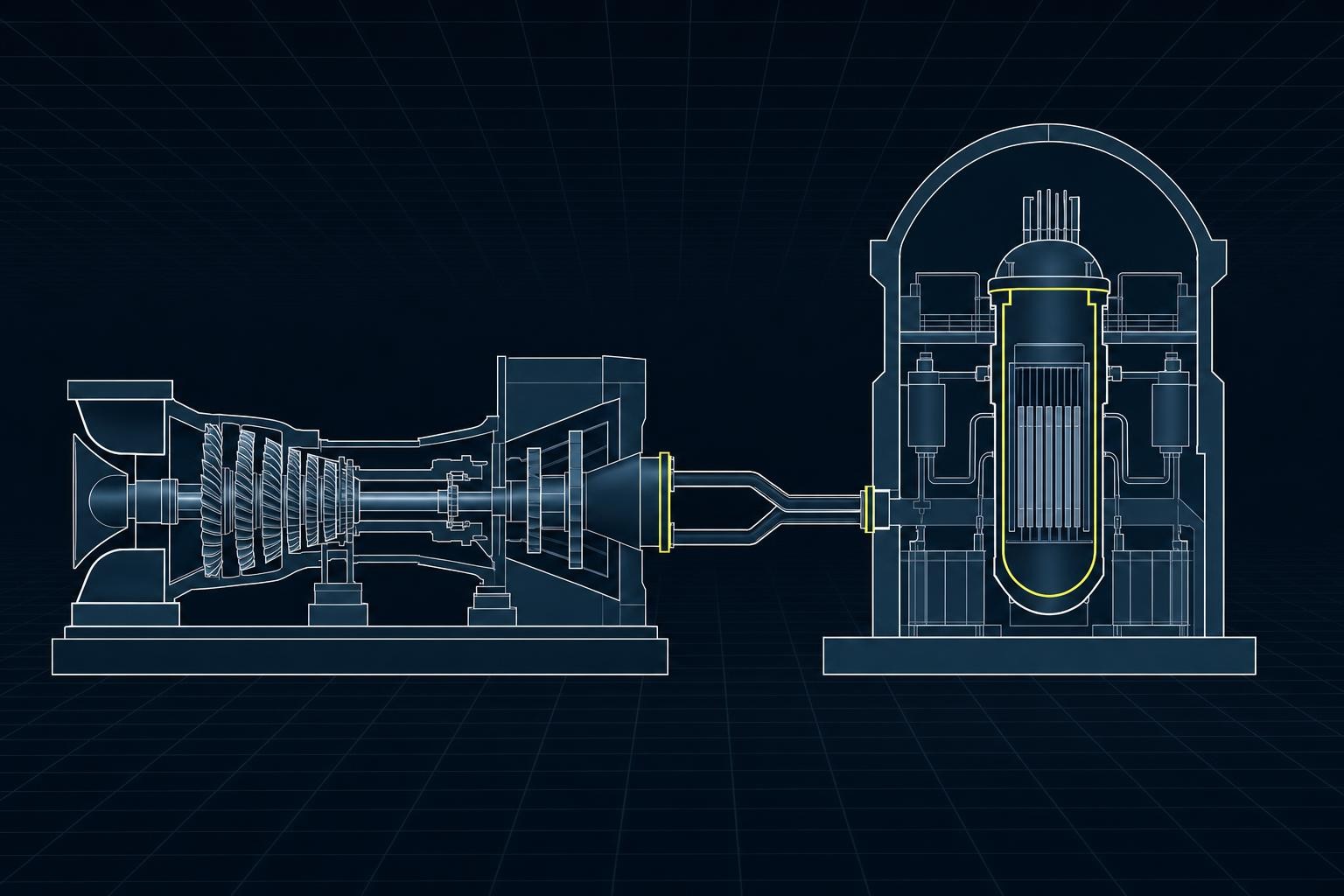
The central problem with new nuclear in the West has never been the reactor. A DOE study of 75 reactors whose construction began between 1966 and 1977 found average construction costs ran 207% above initial estimates[1], and the pattern has not improved: Vogtle Units 3 and 4, which entered commercial service in July 2023 and April 2024, cost more than $36 billion - the most expensive power plant ever built. No commercial lender will underwrite that risk. Blue Energy, a developer spun out of MIT's Nuclear Science and Engineering Department in 2023, is now arguing it has found the structural fix - and Constellation Technology Ventures, the venture arm of the largest nuclear fleet operator in the United States, has put money behind the claim.
The construction problem
Reactors make up less than 10% of the cost of a nuclear power plant; over 90% of the cost comes from construction and the regulatory challenges surrounding the rest of the plant. That asymmetry is the core of Blue Energy's argument: reinventing the reactor is the wrong lever. Instead, the company is borrowing manufacturing logic from the offshore oil and gas and LNG industries, prefabricating standardised plant modules in existing shipyards and barging them to site[1]. The reactor building itself uses seabed XL-monopiles adapted from offshore wind foundations, produced in automated fabrication lines. The separation between nuclear and non-nuclear systems is deliberate: it allows the vast majority of the plant to be built under fixed-price commercial contracts, in facilities with no nuclear licensing burden.
The gas-to-nuclear capital stack
The second half of the model is financial. Blue Energy's phased approach starts the plant as a natural gas facility, generating revenue before a single fuel rod is loaded[1]. That early cash flow changes the risk profile for institutional lenders - construction risk is spread across two distinct phases rather than concentrated in a single, decade-long nuclear megaproject.
The Texas project with Crusoe illustrates the sequencing:
- Two GE Vernova 7HA.02 gas turbines (~1 GW) are targeted for delivery by 2029, with gas power to the Crusoe AI campus as early as 2028
- Up to five BWRX-300 small modular reactors (~1.5 GW nuclear) would follow, with transition targeted by 2031
- Final investment decision is targeted for 2027, with early site works in Texas planned for 2026
- The Port of Victoria site carries roughly $100 million in prior site investment from an earlier Exelon licensing effort, abandoned in 2012
Blue Energy raised $380 million in April 2026 and forged a strategic collaboration with GE Vernova to advance the 2.5 GW project. Constellation Technology Ventures' subsequent investment - its first ever in a U.S. SMR developer - added an operational nuclear operator to the capital table alongside existing backers VXI Capital, At One Ventures, and Engine Ventures.
What the NRC milestone means
Blue Energy recently secured a key U.S. Nuclear Regulatory Commission licensing milestone that supports its goal of delivering reliable power in 48 months or less through the phased strategy. That is a meaningful threshold: it suggests the NRC is engaging with the gas-first, nuclear-second sequencing as a coherent licensing pathway, not just a financing workaround.
Whether fixed-price contracting can actually hold at nuclear scale remains the open question. EPC contractors have historically refused to sign such terms on megaprojects precisely because schedule risk is so difficult to bound. Blue Energy's bet is that shipyard prefabrication - where module production runs in parallel with site preparation - compresses the window of exposure enough to make fixed-price terms viable. The 2027 FID date will be the first real test of whether lenders agree.
The images and texts on this page were created with the help of AI.
Related
Ready-to-build BESS projects lose their premium as Australia's NEM arbitrage spreads collapse 85%
Panellists at the Battery Asset Management Summit Australia 2026 said the venture-capital-style returns that once rewarded ready-to-build BESS projects have disappeared as NEM price spreads fell 85% in a year.
10 Sept 2026UK government opens three-month consultation on AI for clean energy, backed by 34-recommendation network review
DESNZ published its Vision for an AI-enabled clean energy system on 8 September, opening a call for evidence that closes 6 November and will feed into the UK's first AI for Clean Energy Strategy.
10 Sept 2026Heatwaves expose a three-layer risk for wind operators: resource, hardware, and people
Extreme heat cuts wind output, stresses nacelle components, and grounds maintenance crews - all at once. A look at how bad the summer of 2026 has been, and what the trend means for grid reliability.
10 Sept 2026