Base Power's Base Core enters production as residential BESS market faces a 5% contraction in 2026
Base Power's 39.2 kWh LFP home battery is now in production in Austin as Wood Mackenzie forecasts a 5% residential storage contraction for 2026 - the market context behind a $13 billion valuation.
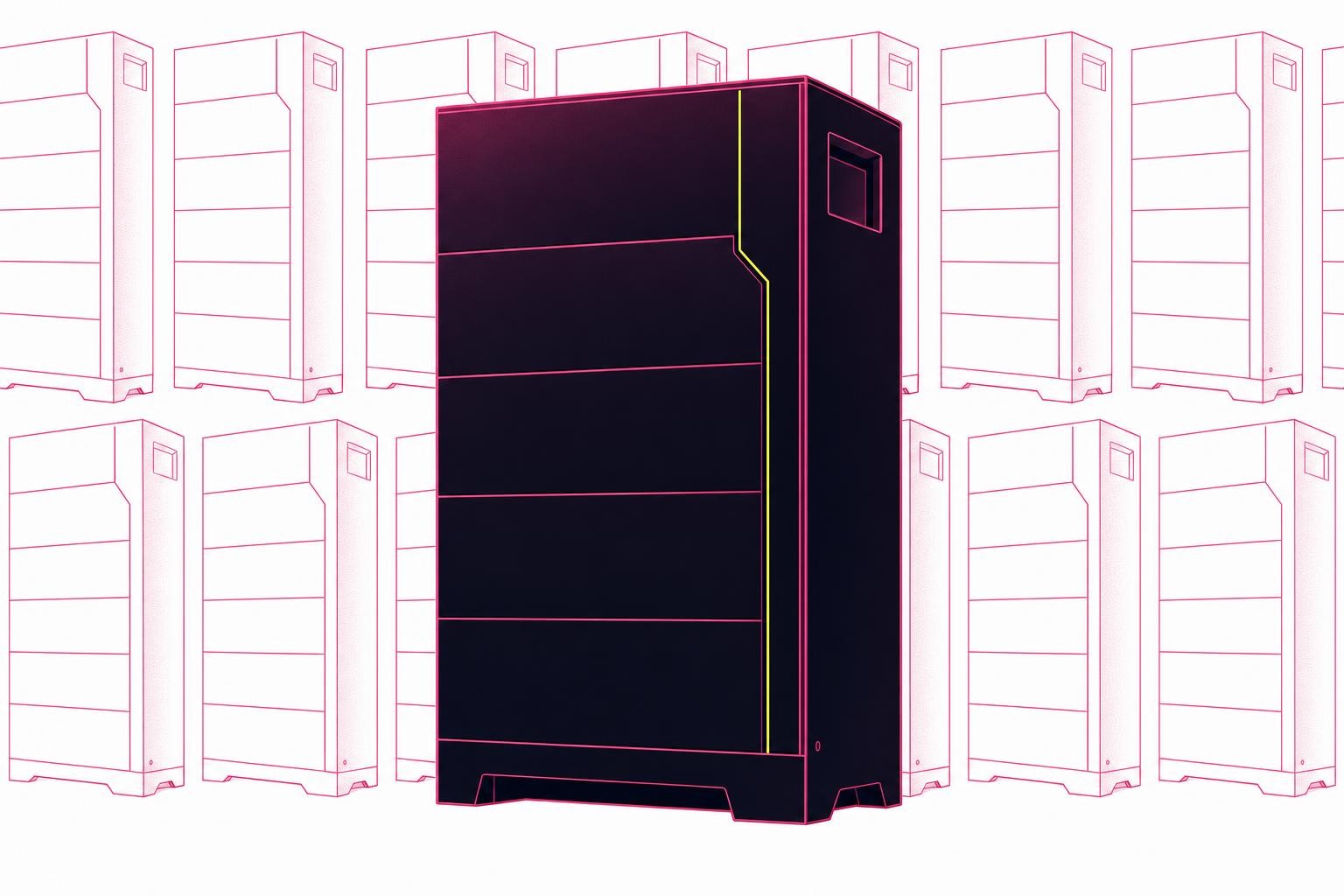
Base Power announced on 3 August 2026 that its Base Core home battery is in production at Base Factory 1 in Austin, Texas, alongside a US$1 billion Series D financing that values the company at US$13 billion post-money[1]. The product launch and the funding round together mark a deliberate bet that a vertically integrated, VPP-first model can grow through a residential storage market that analysts expect to contract this year.
What Base Core is
Base Core is a 39.2 kWh lithium iron phosphate (LFP) battery system with a 12-year rated lifetime, carrying UL 1973 and UL 9540 certifications. It is available in a dual-unit configuration at 78.4 kWh. By comparison, Base Core's capacity more than doubles the Tesla Powerwall 3's 13.5 kWh capacity.
The system is designed for whole-home backup and rapid installation. Base said the system can be installed in less than an hour, switch over seamlessly during an outage, and operate in extreme weather conditions. With dimensions of 39.5" x 30.68" x 22", each battery cabinet takes up a small footprint of just over 15 cubic feet.
The battery is not sold outright to homeowners. Customers pay a heavily discounted upfront installation fee - as low as $695 in Base's direct-to-consumer Texas markets, and $295-$445 in some utility-partnership deals - plus a small monthly fee of around $19-$29, rather than purchasing a comparable battery outright, which the company says can otherwise cost $15,000-$20,000.
The VPP model and utility partnerships
Base Power's commercial logic is that the battery fleet, not individual units, is the product. Base's model combines distributed residential battery installations into a larger fleet capable of supporting utility capacity and grid reliability.
The utility partnership roster has grown steadily:
- In February 2026, Base and El Paso Electric announced a residential distributed energy resource (DER) pilot programme, deploying a fleet of networked residential batteries in EPE's service region.
- In April 2026, Austin Energy's city council approved a partnership with Base Power, enabling the utility to dispatch the startup's fleet of residential batteries to enhance local grid reliability.
- Through the GVEC programme, the aggregation participates directly in ERCOT's wholesale energy and ancillary services markets - and passed ERCOT's performance tests on its first attempt.
Over the past year, the company expanded its battery fleet to more than 500 MWh and entered Illinois after initially operating in Texas, while establishing partnerships with El Paso Electric, Austin Energy, and CoServ covering more than 200 MW of capacity.
The market backdrop
The US residential battery storage segment is projected to contract 5% in 2026, driven by tax equity constraints and updated permitting data, according to Wood Mackenzie and the American Clean Power Association. The contraction is attributed to constraints in tax equity availability and updated permitting rules. After that shallow contraction - following a rush of installations ahead of the expiration of the Section 25D tax credit at the end of last year - the residential storage segment is expected to expand at a 12% average annual pace over the next four years.
The broader US storage market installed a record 3.3 GW / 8.4 GWh in Q1 2026, surpassing the previous Q1 record by 54%, with utility-scale activity accounting for more than 2.3 GW / 6.8 GWh. Utility-scale activity dominated, with more than 2.3 GW / 6.8 GWh installed in Q1 2026.
Base Power's subscription model sidesteps the tax-credit dependency that is squeezing conventional residential installers: because Base retains ownership of the hardware, the economics do not depend on the homeowner claiming a purchase-based credit. According to co-founder Justin Lopas, the new capital is earmarked for factory buildout, hiring, field installation capacity, and a second facility.
Investors and capital raised
The Series D round was led by Ribbit, Addition, Valor Equity Partners, and JPMorganChase's Strategic Investment Group, with existing investors including Thrive Capital, a16z, and Lightspeed also participating. The company said it has now raised more than $2.5 billion to date.
The pace of fundraising is notable: Base Power raised a $1 billion Series C from Addition in October 2025, followed by a second $1 billion Series D in August 2026 - two billion-dollar rounds in ten months. At the time of the Series C, the company had deployed more than 100 MWh of residential battery capacity and was preparing to open its first factory.
The key question for the next twelve months is whether the utility-partnership pipeline outside Texas - particularly in PJM territory, where market rules differ materially from ERCOT's energy-only structure - can absorb the production volumes that Base Factory 1 is now generating, and whether a second facility materialises on the timeline Lopas described.
The images and texts on this page were created with the help of AI.
Related
Ready-to-build BESS projects lose their premium as Australia's NEM arbitrage spreads collapse 85%
Panellists at the Battery Asset Management Summit Australia 2026 said the venture-capital-style returns that once rewarded ready-to-build BESS projects have disappeared as NEM price spreads fell 85% in a year.
10 Sept 2026UK government opens three-month consultation on AI for clean energy, backed by 34-recommendation network review
DESNZ published its Vision for an AI-enabled clean energy system on 8 September, opening a call for evidence that closes 6 November and will feed into the UK's first AI for Clean Energy Strategy.
10 Sept 2026Heatwaves expose a three-layer risk for wind operators: resource, hardware, and people
Extreme heat cuts wind output, stresses nacelle components, and grounds maintenance crews - all at once. A look at how bad the summer of 2026 has been, and what the trend means for grid reliability.
10 Sept 2026