Australian Vanadium submits Stage Two bid for WA's A$150 million Kalgoorlie flow battery project
Australian Vanadium and VSUN Energy filed a Stage Two proposal for the 50 MW/500 MWh Kalgoorlie VBESS on 27 July 2026, targeting 2029 commercial operation under a build-own-operate model.
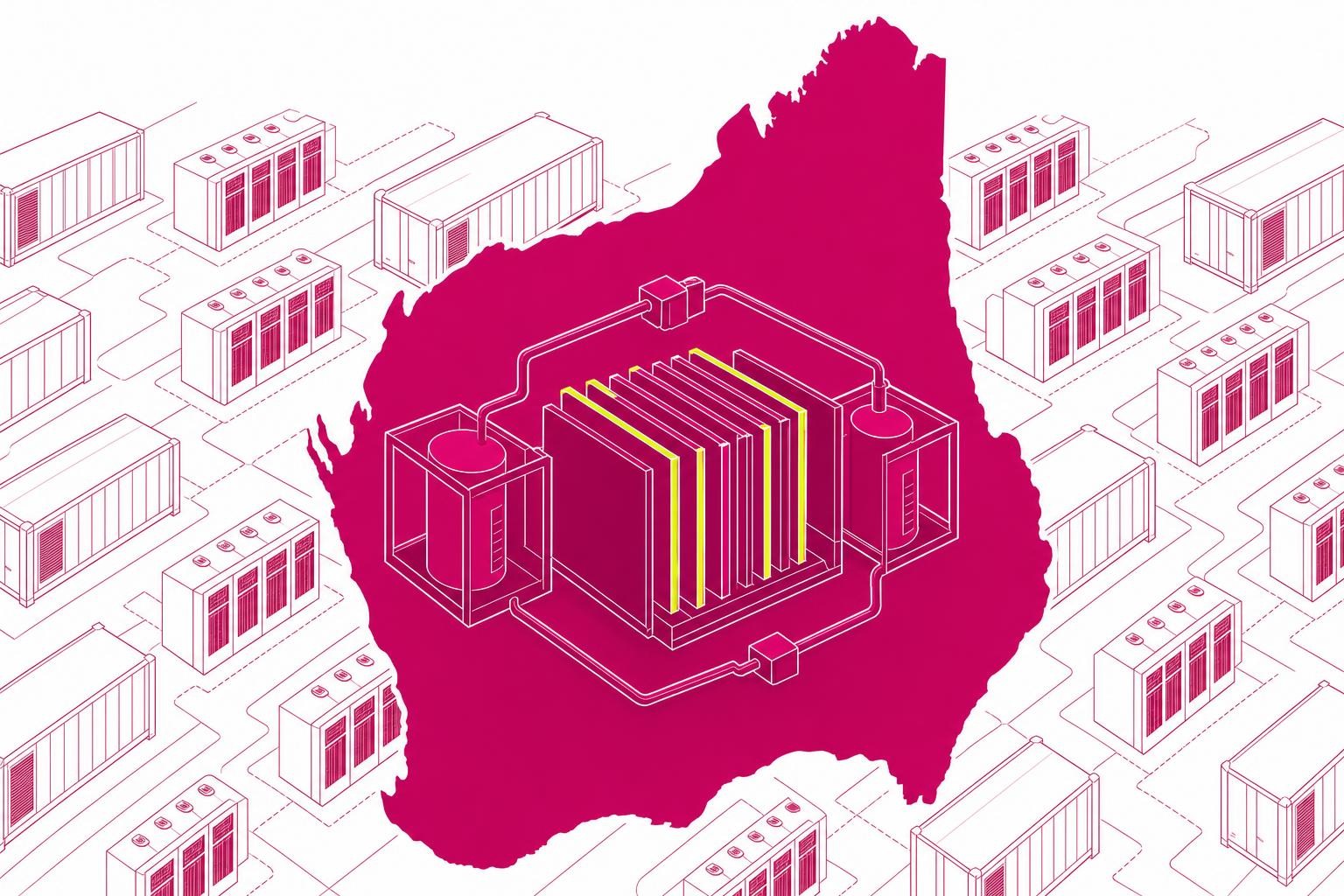
Australian Vanadium Limited (AVL) and its wholly owned subsidiary VSUN Energy submitted a Stage Two proposal to the Western Australian government for the Kalgoorlie Vanadium Battery Energy Storage System (VBESS) on 27 July 2026[1], entering the final competitive round of a procurement process backed by A$150 million in state funding for a 50 MW/500 MWh, 10-hour-duration vanadium flow battery.[1]
What AVL is proposing
AVL and VSUN Energy's consortium-led proposal is structured as a build-own-operate arrangement, with commercial operation targeted for 2029, subject to selection, financing, approvals, and construction milestones.
The scoping study will assess the financial and technical merits of the system, with AVL responsible for:
- Battery system design and technical specifications
- Cost estimates and electrolyte supply considerations
- Project financing options
- Assessment of potential government funding opportunities[1]
The project would connect to the South West Interconnected System near Kalgoorlie, positioned to support grid reliability across the Eastern Goldfields region.
The procurement process
The WA government's Department of Energy and Economic Diversification (DEED) opened Stage Two of the expression-of-interest process in May 2026, with proposals due by 20 July 2026. The government will evaluate submissions with the aim of selecting a preferred proponent to commence commercial negotiations in the second half of 2026.
Stage One, which closed on 30 January 2026, was a market-sounding exercise that attracted significant industry interest and informed the structure of Stage Two. Proposals are evaluated against technical delivery capability, commercial viability, local content participation, and alignment with the state's Made in WA plan.
The Kalgoorlie VBESS is positioned as Australia's largest vanadium battery and potentially the largest vanadium flow battery deployed outside China, where the bulk of commercial-scale installations are concentrated.
AVL's vertical integration argument
AVL's bid draws on what the company describes as a "pit-to-battery" strategy spanning mining, processing, electrolyte production, and battery deployment. Its electrolyte manufacturing facility in Wangara, Perth - the only operational vanadium electrolyte plant in Western Australia - has a production capacity of 33 MWh per year of high-purity electrolyte and has advanced qualification with multiple leading original equipment manufacturers.
The electrolyte supply angle is directly relevant to the Kalgoorlie bid: the WA government has required a high proportion of local content, and AVL's in-state manufacturing base is a structural differentiator against international bidders.
AVL announced a separate 18-month MoU with Alcoa of Australia on 4 August 2026 to evaluate a 50–80 MW, 400–640 MWh vanadium flow battery at Alcoa's alumina refineries — a behind-the-meter industrial application distinct from the Kalgoorlie grid project. That MoU was reported here on 7 August 2026.
What to watch
The WA government has not disclosed how many Stage Two proposals it received or when a preferred proponent announcement is expected beyond "second half of 2026." AVL is competing against other shortlisted proponents; submission does not guarantee preferred status. The Kalgoorlie decision will be a significant data point for the commercial viability of utility-scale vanadium flow batteries in Australia - and for whether AVL's integrated supply-chain model can convert into a contracted project at scale.
The images and texts on this page were created with the help of AI.
Related
Ready-to-build BESS projects lose their premium as Australia's NEM arbitrage spreads collapse 85%
Panellists at the Battery Asset Management Summit Australia 2026 said the venture-capital-style returns that once rewarded ready-to-build BESS projects have disappeared as NEM price spreads fell 85% in a year.
10 Sept 2026UK government opens three-month consultation on AI for clean energy, backed by 34-recommendation network review
DESNZ published its Vision for an AI-enabled clean energy system on 8 September, opening a call for evidence that closes 6 November and will feed into the UK's first AI for Clean Energy Strategy.
10 Sept 2026Heatwaves expose a three-layer risk for wind operators: resource, hardware, and people
Extreme heat cuts wind output, stresses nacelle components, and grounds maintenance crews - all at once. A look at how bad the summer of 2026 has been, and what the trend means for grid reliability.
10 Sept 2026