Australian Vanadium and Alcoa sign 18-month MoU to assess 50-80 MW flow battery at WA alumina refineries
Australian Vanadium and Alcoa have signed an 18-month MoU to scope a 50-80 MW, 400-640 MWh vanadium flow battery at Alcoa's Western Australia alumina refineries.
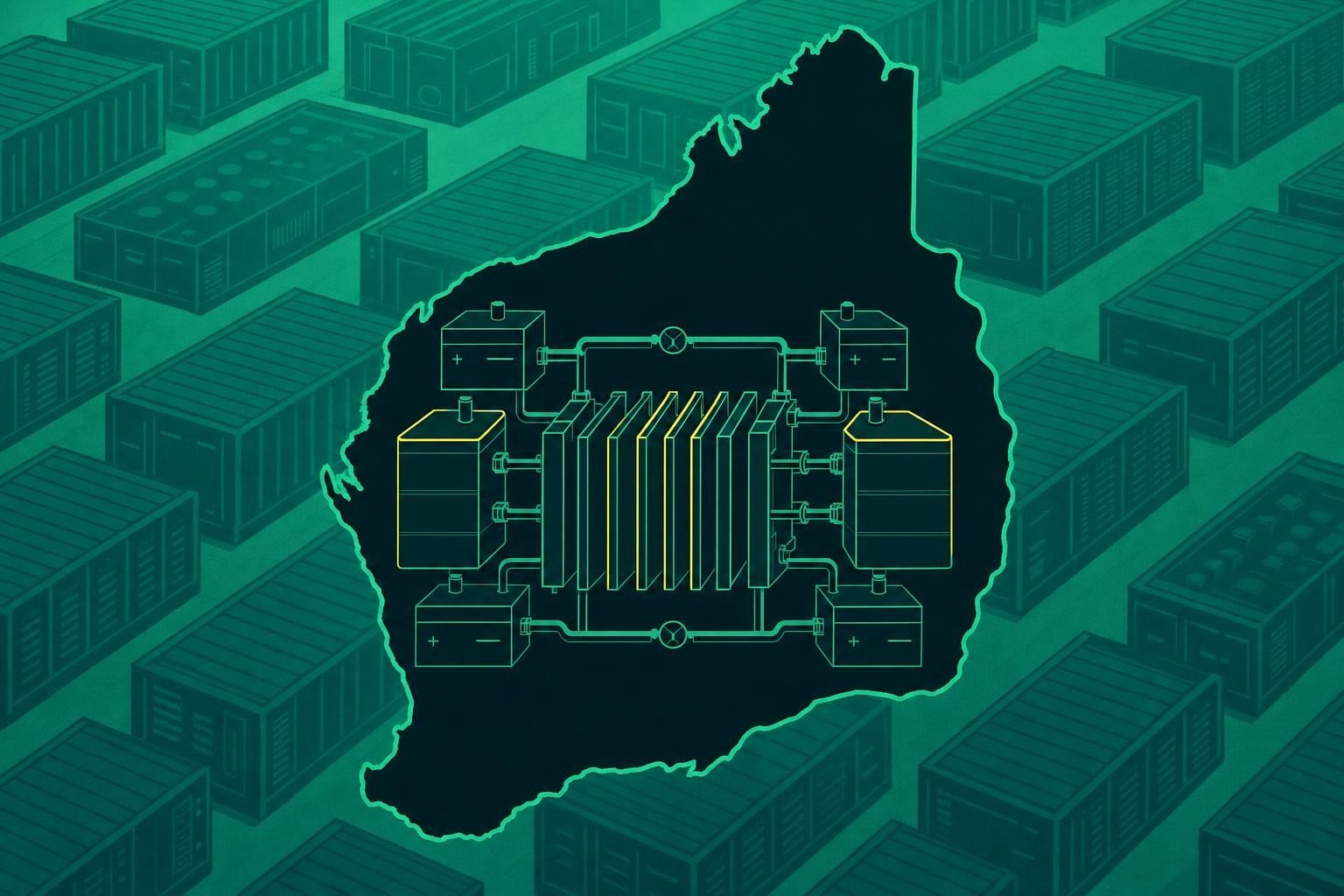
Australian Vanadium Limited (AVL) and Alcoa of Australia have signed a non-binding memorandum of understanding to evaluate deploying a vanadium flow battery energy storage system at Alcoa's alumina refinery operations in Western Australia[1]. The proposed system carries a nominal power output of 50-80 MW and a storage duration of 6-8 hours, extendable beyond eight hours, implying total capacity of 400-640 MWh[1].
What the scoping study covers
AVL and its wholly owned subsidiary VSUN Energy will lead the work[1]. Their remit covers:
- Battery system design and technical specifications
- Cost estimates and electrolyte supply considerations
- Project financing options
- Assessment of potential government funding opportunities[1]
The MoU has an initial term of 18 months and is non-binding except for customary confidentiality and intellectual property provisions. Neither party is obligated to enter a future commercial arrangement or proceed to further feasibility work. If the scoping study produces positive results and both parties agree, they may consider progressing to detailed feasibility studies and discuss potential commercial arrangements, including possible energy offtake agreements.
The study is expected to draw on AVL's V-NOMAD electrolyte technology platform - designed to reduce delivered electrolyte cost at utility scale - and VSUN Energy's Lumina utility-scale vanadium flow battery development platform[1].
Alcoa's refinery footprint and decarbonisation pressure
Alcoa operates three alumina refineries in Western Australia - at Kwinana, Pinjarra and Wagerup - as well as the Huntly and Willowdale bauxite mines in the Darling Range. Alumina refining is among the harder industrial processes to decarbonise: fossil-derived thermal energy accounts for roughly 90% of the sector's energy and emissions, making electricity storage a necessary but insufficient lever on its own.
Alcoa has committed to reducing its Scope 1 and Scope 2 greenhouse gas emission intensity by 50% by 2030 from a 2015 baseline and to reach net zero by 2050. The company is already trialling mechanical vapour recompression and electric calcination at its WA sites, and the VFB study fits that broader electrification agenda.
AVL's broader pipeline in Western Australia
The Alcoa MoU was announced roughly a week after AVL submitted its Stage Two proposal to the Western Australian government for the Kalgoorlie Vanadium Battery Energy Storage System - a 50 MW / 500 MWh, 10-hour-duration project designed to improve grid reliability in the state's Eastern Goldfields region, with commercial operation targeted for 2029. AVL proposes to build, own and operate that facility.
The two bids reflect AVL's strategy of participating across the vanadium value chain - from upstream mining and vanadium pentoxide processing through electrolyte manufacturing to battery deployment via VSUN Energy. VSUN Energy's Project Lumina has already completed detailed design work in collaboration with GenusPlus Group, Sedgman and Austrian manufacturer CellCube, and the most recent cost estimate for an eight-hour Lumina system stood at A$214/MWh levelised cost of storage, down from an earlier figure of A$251/MWh.
What to watch
The 18-month scoping window runs the study into early-to-mid 2028. The key question is whether AVL can demonstrate that a vanadium flow battery - with no thermal runaway risk and minimal degradation - offers a sufficiently differentiated value proposition at an alumina refinery to justify the higher upfront capital relative to lithium-ion. Alcoa's parallel decarbonisation trials at Pinjarra and Wagerup will also shape how much grid-connected storage the company ultimately needs, and at what duration.
The images and texts on this page were created with the help of AI.
Related
Ready-to-build BESS projects lose their premium as Australia's NEM arbitrage spreads collapse 85%
Panellists at the Battery Asset Management Summit Australia 2026 said the venture-capital-style returns that once rewarded ready-to-build BESS projects have disappeared as NEM price spreads fell 85% in a year.
10 Sept 2026UK government opens three-month consultation on AI for clean energy, backed by 34-recommendation network review
DESNZ published its Vision for an AI-enabled clean energy system on 8 September, opening a call for evidence that closes 6 November and will feed into the UK's first AI for Clean Energy Strategy.
10 Sept 2026Heatwaves expose a three-layer risk for wind operators: resource, hardware, and people
Extreme heat cuts wind output, stresses nacelle components, and grounds maintenance crews - all at once. A look at how bad the summer of 2026 has been, and what the trend means for grid reliability.
10 Sept 2026