AT&T deploys Airspan MobileAccess 6000 neutral-host DAS at Mississippi State's 60,000-seat Davis Wade Stadium
AT&T has installed an Airspan MobileAccess 6000-powered distributed antenna system at Davis Wade Stadium in Starkville, Mississippi, providing multi-operator cellular coverage across the 60,000-seat venue.
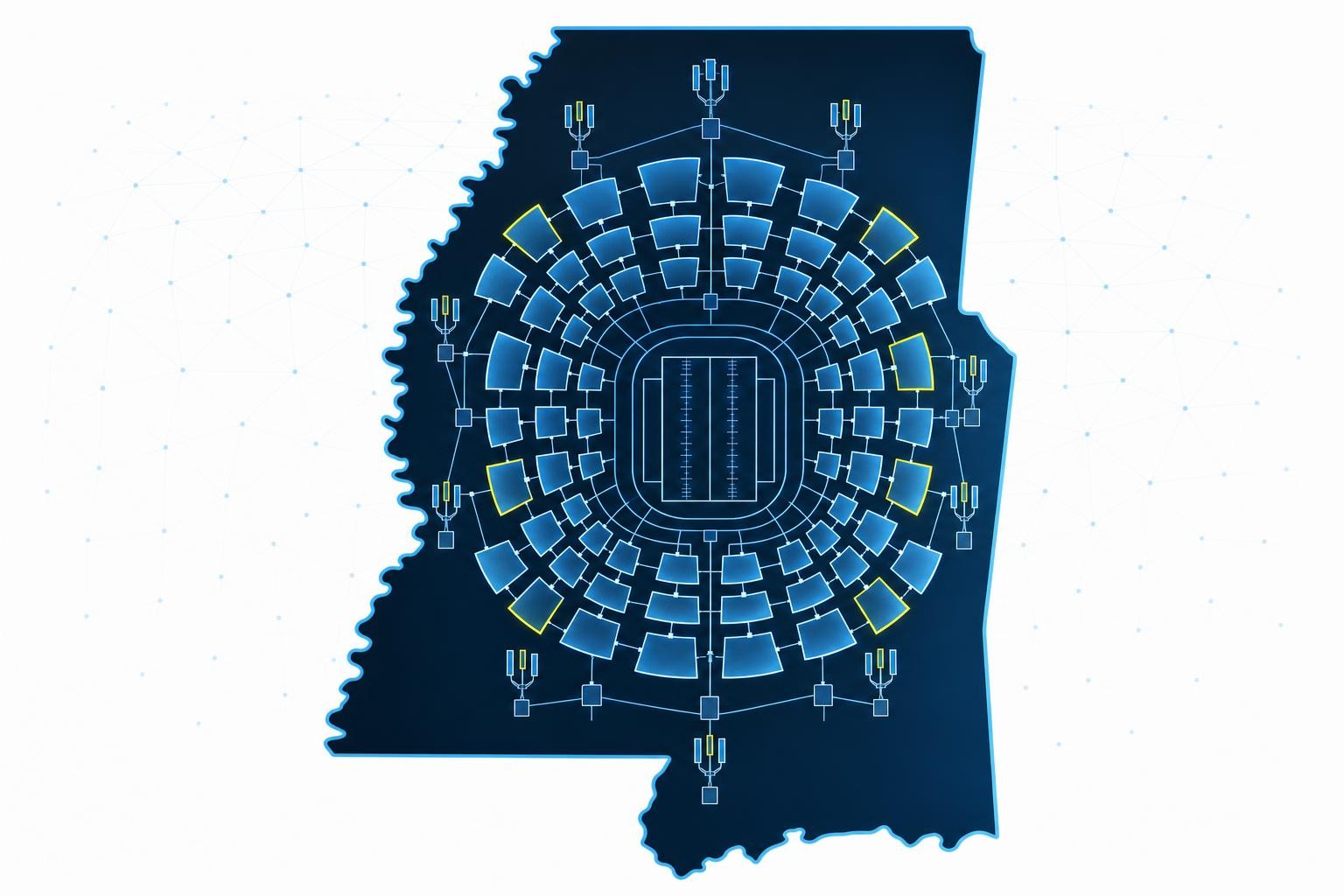
AT&T has completed the installation of a new distributed antenna system (DAS) at Mississippi State University's Davis Wade Stadium in Starkville, Mississippi, using Airspan Networks' MobileAccess 6000 Digital platform[1]. The network is owned and operated by AT&T as a neutral-host system, meaning it is designed to carry traffic for multiple operators across the 60,000-plus seat venue[1].
What was deployed
The system uses a 53-sector, MIMO architecture and supports all mid-band spectrum bands, including C-Band, 3.45 GHz, and 2.5 GHz[1]. Airspan's compact headend architecture was selected specifically because equipment space inside the stadium is constrained[1].
Key technical characteristics of the deployment:
- 53-sector MIMO layout designed for high-capacity game-day demand
- Full mid-band spectrum support: C-Band, 3.45 GHz, and 2.5 GHz
- Compact headend optimised for limited equipment space
- Antennas placed across the stadium to distribute coverage evenly rather than relying on a single rooftop antenna or cell tower[1]
M-Communications is listed as a project partner alongside Airspan and Mississippi State University.
Why a neutral-host model
A neutral-host DAS allows a single physical infrastructure layer to serve multiple mobile operators simultaneously, avoiding the need for each carrier to install its own antenna network. A DAS is a network of spatially separated antennas connected to a common signal source, able to distribute wireless and cellular coverage evenly throughout large structures or areas such as sporting venues, instead of relying on a single rooftop antenna or cell tower.
The model is increasingly common at large venues where the economics of per-operator builds are difficult to justify and where peak demand - a sold-out SEC football game, for instance - can concentrate tens of thousands of simultaneous users in a confined space. Amit Jain, senior vice president and general manager of in-building networks at Airspan, noted that "high-density venues like Davis Wade Stadium present some of the most demanding wireless design challenges, requiring exceptional network capacity with limited communications infrastructure footprint."
AT&T's Mississippi investment context
The Davis Wade deployment is part of AT&T's broader commitment to connectivity across Mississippi. From 2021 to 2025, AT&T invested nearly $1.4 billion in its wireless and wireline networks in the state.
Airspan's MobileAccess 6000 was selected for its compact headend architecture and medium-power remote units, helping reduce the overall equipment footprint while delivering the sectorization, deployment flexibility, and scalability required for a complex stadium environment.
What to watch
The Davis Wade installation follows Airspan's deployment of the same MobileAccess 6000 platform at Charlotte Douglas International Airport earlier in 2026, where the system covers sub-6 GHz spectrum across a large, high-traffic public venue. The pattern points to a growing pipeline of neutral-host DAS contracts at venues where peak wireless demand is episodic and dense - a dynamic that is structurally similar to the power-demand spikes that grid planners are now managing for data centers and large-load customers. Whether AT&T pursues further SEC venue deployments under the same neutral-host ownership model will be a signal of how aggressively it intends to monetise shared in-building infrastructure.
The images and texts on this page were created with the help of AI.
Related
Ready-to-build BESS projects lose their premium as Australia's NEM arbitrage spreads collapse 85%
Panellists at the Battery Asset Management Summit Australia 2026 said the venture-capital-style returns that once rewarded ready-to-build BESS projects have disappeared as NEM price spreads fell 85% in a year.
10 Sept 2026UK government opens three-month consultation on AI for clean energy, backed by 34-recommendation network review
DESNZ published its Vision for an AI-enabled clean energy system on 8 September, opening a call for evidence that closes 6 November and will feed into the UK's first AI for Clean Energy Strategy.
10 Sept 2026Heatwaves expose a three-layer risk for wind operators: resource, hardware, and people
Extreme heat cuts wind output, stresses nacelle components, and grounds maintenance crews - all at once. A look at how bad the summer of 2026 has been, and what the trend means for grid reliability.
10 Sept 2026