Advanced geothermal's 0.6 GW contracted pipeline faces a geographic mismatch with U.S. data center load
Fervo's May 2026 IPO put advanced geothermal on the map, but the sector's 0.6 GW contracted pipeline and a West-heavy resource base leave it trailing nuclear and misaligned with emerging load centers.
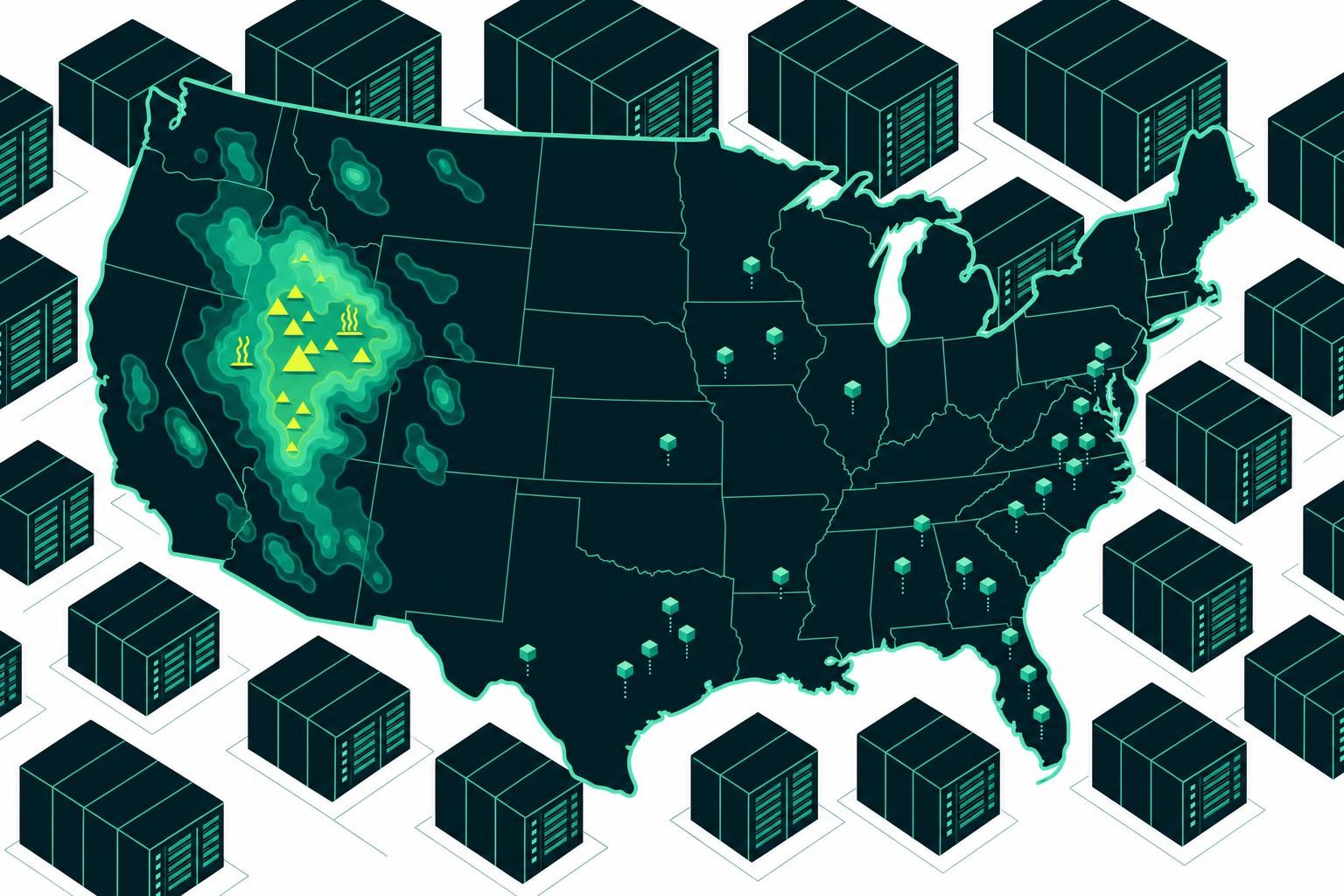
Fervo Energy's $1.89 billion Nasdaq IPO in May 2026 - which priced at $27 per share and closed its first trading day up 35% - has made advanced geothermal impossible to ignore[1]. But the sector trailing in Fervo's wake faces a structural problem that no amount of investor enthusiasm resolves: the best near-term geothermal resources sit in the West, while the fastest-growing data center load is clustering in the Southeast, Midwest, and Texas[1].
A pipeline dwarfed by nuclear
The numbers make the gap concrete. According to BNEF analyst Stephanie Diaz, data center operators have announced 43 GW of next-generation nuclear projects as of May 2026 - a figure that includes nonbinding agreements but nonetheless dwarfs the 0.6 GW contracted pipeline for next-generation geothermal[1]. Currence, which tracks the sector, counts at least 14 non-Fervo advanced geothermal startups, all of them watching Fervo's public-market performance closely[1].
Fervo itself illustrates the interconnection constraint directly. Cape Station's initial 500 MW build was sized by the grid connection Fervo was able to secure, not by the resource or the permit - the company holds rights to develop 2 GW at the site and has applied to expand its interconnection accordingly. If that application fails, Fervo has said it is fielding behind-the-meter inquiries from companies seeking to connect directly.
The geography problem
The lowest-risk, most financeable geothermal prospects remain concentrated in the western United States[1]. That is where Fervo's Cape Station (Beaver County, Utah) and its 115 MW Nevada project for Google are located, and where the bulk of near-term EGS development is planned. The problem is that data center demand is not following the same map.
Emerging load hotspots include:
- The Southeast, where utility interconnection queues are already strained
- The Midwest, where power purchase agreement structures for firm clean power are less developed
- Texas, where ERCOT's grid architecture and recent data center connection freezes add further complexity
Advanced geothermal technologies promise greater geographic flexibility over time - closed-loop systems and deeper EGS approaches can in principle access heat in dry-rock geology far from traditional hydrothermal zones. XGS Energy's 150 MW development agreement with Meta, signed in June 2025 to supply the PNM grid in New Mexico in support of Meta's data center operations there, is one early signal that the geography can shift[1]. XGS uses a water-independent closed-loop system specifically designed to work in arid, non-hydrothermal terrain.
Tangibility over braggawatts
The geothermal industry is also navigating a credibility question. Lucy Darago, chief commercial officer at XGS, told Latitude Media that because geothermal projects operate on nearer timelines than advanced nuclear, the signals the sector puts out "have to have real tangibility to them"[1]. XGS does not announce agreements that are decades out or aspirational, she said - a pointed contrast with the multi-decade nuclear pipelines that dominate the clean firm power headlines.
Behind-the-meter advanced geothermal could serve more than half of projected U.S. data center load growth over the next decade, according to one estimate cited in the Latitude Media analysis[1]. Whether that potential translates into contracted capacity depends on two things the sector does not yet control: interconnection queue position in load-growth regions, and the speed at which closed-loop and EGS technologies can demonstrate bankability outside the West.
What to watch: Fervo's Cape Station first power delivery, expected in late 2026, will be the sector's most important near-term data point - both for technology validation and for what it signals to lenders about financing advanced geothermal projects that sit further back in the interconnection queue.
The images and texts on this page were created with the help of AI.
Related
Ready-to-build BESS projects lose their premium as Australia's NEM arbitrage spreads collapse 85%
Panellists at the Battery Asset Management Summit Australia 2026 said the venture-capital-style returns that once rewarded ready-to-build BESS projects have disappeared as NEM price spreads fell 85% in a year.
10 Sept 2026UK government opens three-month consultation on AI for clean energy, backed by 34-recommendation network review
DESNZ published its Vision for an AI-enabled clean energy system on 8 September, opening a call for evidence that closes 6 November and will feed into the UK's first AI for Clean Energy Strategy.
10 Sept 2026Heatwaves expose a three-layer risk for wind operators: resource, hardware, and people
Extreme heat cuts wind output, stresses nacelle components, and grounds maintenance crews - all at once. A look at how bad the summer of 2026 has been, and what the trend means for grid reliability.
10 Sept 2026